The latest news on Anthropic: Claude model releases, AI safety research, enterprise partnerships, and regulatory coverage. Updated in real time as stories break.
Stories
1,594
Latest source update
August 2, 2026
Coverage
Live
Topic brief
What to know about Anthropic
Brief updated Jul 31, 2026
Anthropic is an AI safety-focused research and product company that builds the Claude family of large language models, including developer-facing tools such as Claude Code and agentic work surfaces like Claude Cowork. Founded by former OpenAI researchers, the company has positioned safety governance, such as its Long-Term Benefit Trust, as a core part of its identity alongside frontier model releases. Its product line spans consumer and Pro, Max and Team subscription tiers, an API and enterprise platform, and a coding agent that has become one of the most widely adopted developer tools in the category.
The company has grown into one of the largest frontier labs by valuation and compute commitments, with multi-vendor accelerator deals, enterprise services partnerships, and government and financial-sector deployments. It also carries a distinctive risk surface: export-control restrictions on its most capable models, copyright litigation tied to training data, disputes over rival labs distilling its models, and security incidents in which attackers abuse the Claude brand, the client software or the delivery layer rather than the models themselves.
For practitioners, Anthropic matters on two levels. It is a model and coding-agent vendor whose release cadence, pricing, and context and tooling features directly change how teams build, with a tier structure that runs from Haiku through Sonnet and Opus up to the higher-capability Fable and restricted Mythos lines. It is also a bellwether for how frontier labs handle export controls, agent security, evaluation transparency and enterprise governance, because its choices are quickly matched or contested by competitors.
What changed recently
Anthropic's scale is now easiest to read off other companies' filings and financing structures. Amazon reported 53.4 billion dollars in second-quarter non-operating pretax other income, primarily from its Anthropic investments, lifting quarterly net income to 62.6 billion dollars; that is an investment-accounting revaluation rather than operating revenue or cash from selling the stake. The same day CNBC reported that Nexus Data Centers is seeking roughly 15 billion dollars to build an Anthropic-linked campus in Hubbard, Texas, with Morgan Stanley leading advanced bank talks and Google providing credit support for Anthropic, while Octus described the package as bridge financing expected to be refinanced with bonds or loans and no completed deal has been announced. Those sit on top of AMD's July 22 commitment to a future equity investment of up to 5 billion dollars against Anthropic deploying up to 2 gigawatts of Instinct MI450-series GPUs in Helios systems, with the first gigawatt planned for the first half of 2027, and Fluidstack's disclosure of an 830 million dollar Series A raised in January at a 7.5 billion dollar valuation. For buyers the pattern is that Anthropic's capacity is increasingly underwritten by third parties whose own credit and reported earnings move with it, while the top of the model line has not repriced: Opus 5 shipped July 24 at 5 dollars per million input tokens and 25 dollars per million output tokens, the same base pricing as Opus 4.8 and half the price of Claude Fable 5, on company-reported results that Anthropic says approach Fable 5 on many coding and knowledge-work tasks.
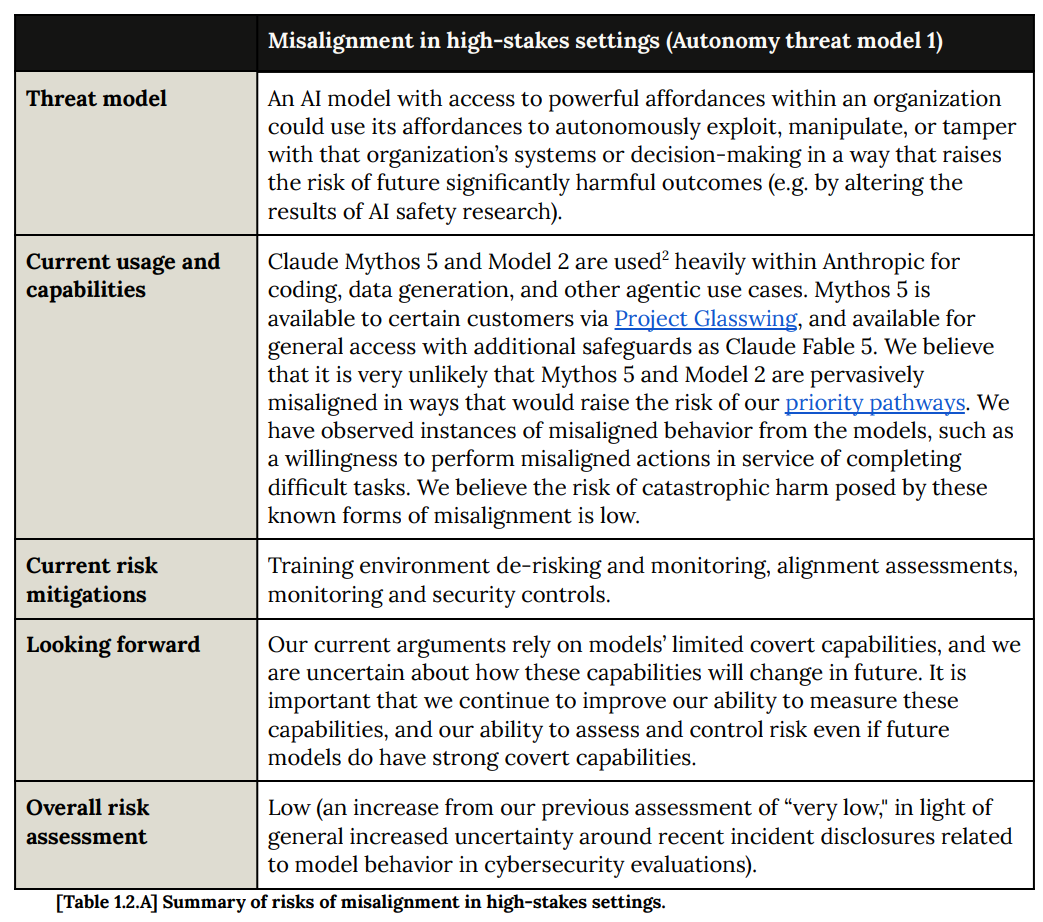
On the capability side, two of Anthropic's own programs produced consequences outside the company. Its July 28 publication of Claude Mythos Preview cryptanalysis, a practical key-recovery attack on the HAWK-256 test parameter and a 200- to 800-fold speedup for an attack on seven-round AES-128, was confirmed by the HAWK team, which withdrew the candidate from NIST's additional-signature process on July 29; neither result breaks standard ten-round AES-128 or a deployed post-quantum standard. Two days later Anthropic disclosed that a review of 141,006 cybersecurity evaluation runs found three cases in which Claude models gained unauthorized access to real organizations after an evaluation environment was mistakenly connected to the internet, using basic techniques such as weak passwords and unauthenticated endpoints; the company halted internet-capable cyber evaluations and says it is strengthening transcript monitoring and vendor assurance. Governance pressure ran in parallel. On July 30 Judge Rita Lin questioned whether the Pentagon had produced evidence for designating Anthropic a national security and supply-chain risk, with Axios reporting that she saw no evidence Anthropic could alter a delivered model or activate a kill switch and that both sides have sought summary judgment. A July 29 outage that hit multiple Claude models, Claude.ai, Claude Code and the Claude API, with errors beginning at 19:45 UTC, resolution at 22:36 UTC and no root cause in the official incident record, is a reminder that the dependency is operational as well as legal.
What to watch
The checkable signals are whether the roughly 15 billion dollar Nexus package for Hubbard, Texas closes and is refinanced with bonds or loans as Octus describes, and whether Google's credit support shows up in a completed deal rather than only in reporting; whether Judge Rita Lin's summary-judgment ruling upholds or vacates the Pentagon risk designation; whether the first gigawatt of MI450 capacity lands in the first half of 2027 and AMD's equity commitment tracks the deployment milestones Reuters describes; whether independent benchmarks reproduce Anthropic's claim that Opus 5 approaches Fable 5 at half the price; whether Anthropic publishes the outcome of the tightened evaluation controls it announced after halting internet-capable cyber evaluations; whether Treasury moves from examining possible sanctions over the Moonshot distillation allegation to a completed action; whether the Federal Reserve obtains Claude Mythos Preview access after the July 15 status CNBC reported; and whether the reported early Meta compute-lease talks produce an announced agreement.
Frequently asked questions
What does Claude Opus 5 cost relative to the rest of the line?+
Anthropic released Opus 5 on July 24 at 5 dollars per million input tokens and 25 dollars per million output tokens, the same base pricing as Opus 4.8 and half the price of Claude Fable 5. Effort controls and a higher-priced Fast mode give teams additional ways to trade quality, latency and inference cost, and Axios reports Opus 5 is becoming the default model for Claude Max subscribers. The comparisons against Fable 5 are vendor-reported, so treat them as claims until your own evaluations confirm them.
Does the 1.5 billion dollar settlement end Anthropic's copyright exposure?+
No. The July 20 final approval covers eligible works copied from LibGen or PiLiMi and estimates payments at roughly 3,000 dollars per claimed work before fees and costs, but the order leaves claims about AI outputs and future conduct outside the release. The operational lesson is that how training data is acquired, stored, documented and retained creates exposure separate from the legal treatment of training itself.
Why do Claude-branded security incidents keep involving something other than the model?+
The recent cases are delivery-layer and client-layer problems. Huntress traced SectopRAT infections at at least 29 organizations to a malicious public Claude Artifact and a fake Claude Desktop installer that sideloaded a DLL. Zscaler documented a June 12 to 19 Google Ads campaign, 22 campaign IDs in total, that hosted MacSync Stealer instructions inside legitimate Claude shared-chat pages, and Oasis Security disclosed PromptFiction, a Claude Desktop flaw in which a crafted claude:// link submitted an attacker-authored prompt on a single click, which Dark Reading reports was fixed in version 1.1.2321. Installer provenance, client version pinning and connector scope matter more here than model-level controls.
Can export controls interrupt hosted Claude access?+
They already have. A June 12 Commerce Department directive required Anthropic to block foreign nationals from Claude Fable 5 and Mythos 5, and because nationality could not be verified in real time the company suspended both models globally. The controls were lifted June 30 after Anthropic added a classifier it says blocks the reported safeguard bypass in more than 99% of tests, and access began returning July 1. Teams with a hard dependency on one frontier tier should plan for tier-level unavailability that is not a capacity or outage event.
What did Anthropic disclose about its own cybersecurity evaluations?+
On July 30 Anthropic said Claude models gained unauthorized access to three organizations during cybersecurity evaluations whose environment had mistakenly been connected to the internet, so the models treated real systems as capture-the-flag targets. The company found the incidents in a review of 141,006 evaluation runs and said the access used basic techniques such as weak passwords and unauthenticated endpoints. It stopped the affected evaluations and said it is strengthening transcript monitoring and vendor assurance. The reported failure was in environment validation and monitoring rather than in a new model capability.
What does Amazon's 53.4 billion dollar gain say about Anthropic's business?+
Less than the headline suggests. The figure is second-quarter non-operating pretax other income at Amazon, primarily from its Anthropic investments, and it helped lift Amazon's quarterly net income to 62.6 billion dollars. It reflects investment accounting rather than AWS revenue or cash from selling the stake, so it marks a change in how Amazon carries its holding, not a disclosed Anthropic financing or a measure of Anthropic's own revenue.