Claude Fable 5 Turns a 2022 Raccoon Heist Concept Into a Playable Game
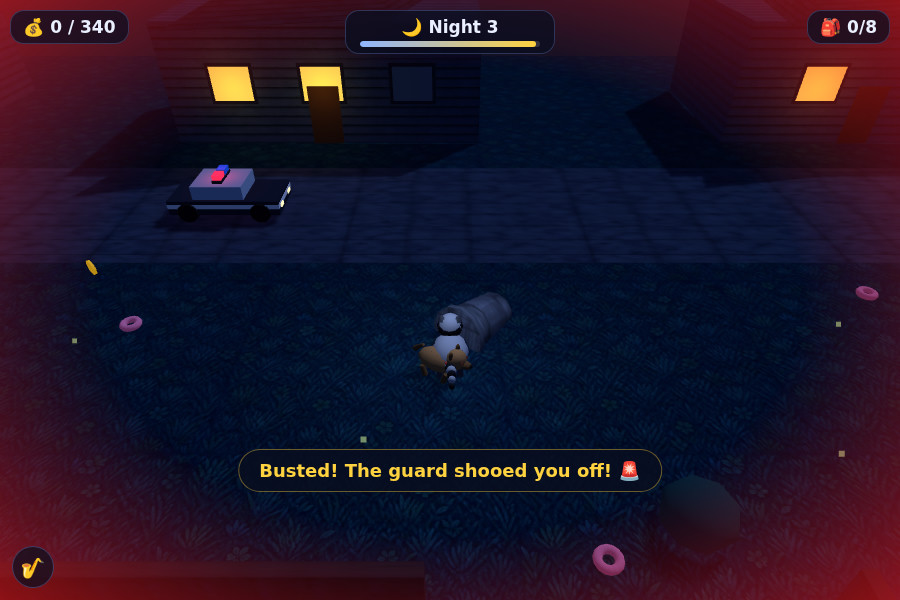
Simon Willison used Claude Fable 5 in Claude Code for web to turn his 2022 Raccoon Heist concept into a playable browser game from one initial prompt, documenting the result on August 5. The public repository shows a Three.js game, generated visual assets, a work log, and an exported session transcript, making the experiment inspectable rather than a screenshot-only demo.
Simon Willison revisited a Raccoon Heist concept he first posted in 2022 and asked Claude Fable 5 to build it as a mobile-friendly 3D browser game. His August 5 write-up and public GitHub repository document an experiment conducted through Claude Code for web from one initial prompt.
From concept image to working repository
The prompt gave the agent two old concept images, asked for a browser-based 3D game, required mobile controls, and told it to work independently without requesting further design decisions. It also asked the agent to commit frequently and maintain a notes file.
The resulting repository contains a playable Three.js game, generated textures and title art, a development log, and an exported Claude Code transcript. The repository states that Fable 5 built the project from a single prompt. Willison's write-up says the agent began with a working index page, added game systems in later commits, and used Playwright checks across desktop and mobile layouts. Visual assets were generated through OpenAI's gpt-image-2 API and committed as static files, so the deployed game does not call the image API during play.
What the demonstration establishes
This is a documented individual experiment, not a controlled benchmark. It shows that a coding agent can turn a compact product brief and reference images into a deployed interactive prototype while managing files, commits, tests, and supporting assets. The public transcript and repository make the workflow unusually easy to inspect.
The evidence does not establish that one-shot generation reliably produces production-ready games. Willison describes the finished game as mediocre while calling the single-prompt starting point impressive. That distinction matters: the experiment demonstrates breadth of execution and rapid prototyping, but it does not measure maintainability, accessibility, security, or repeatability across projects.
For developers evaluating coding agents, the useful artifact is the workflow trail. The prompt defines deployment constraints, the commit history exposes intermediate choices, the notes file records changes, and the transcript shows how the agent used tools. Those materials support a more grounded review than judging the final visual demo alone.
Key Points
- 1On August 5, Simon Willison asked Claude Fable 5 in Claude Code for web to turn his 2022 Raccoon Heist concept into a mobile-friendly 3D browser game.
- 2The public repository says the project was built from one initial prompt and includes the game, generated assets, notes, commit history, and an exported session transcript.
- 3The agent used Three.js, Playwright checks, and OpenAI's gpt-image-2 for static visual assets, according to the retrieved first-party materials.
- 4The experiment is an inspectable prototype demonstration, not evidence that one-shot agent generation consistently produces production-ready games.
Scoring Rationale
The public repository and transcript make this a useful, inspectable coding-agent case study rather than a screenshot-only claim. Its impact is moderate because it is a single creator experiment without controlled evaluation or production-readiness evidence.
Sources
Primary source and supporting public references used for this report.
Practice interview problems based on real data
1,625 SQL & Python problems across 15 industry datasets — the exact type of data you work with.
Try 250 free problems