The Dissent Deploys AI Agents for San Francisco News
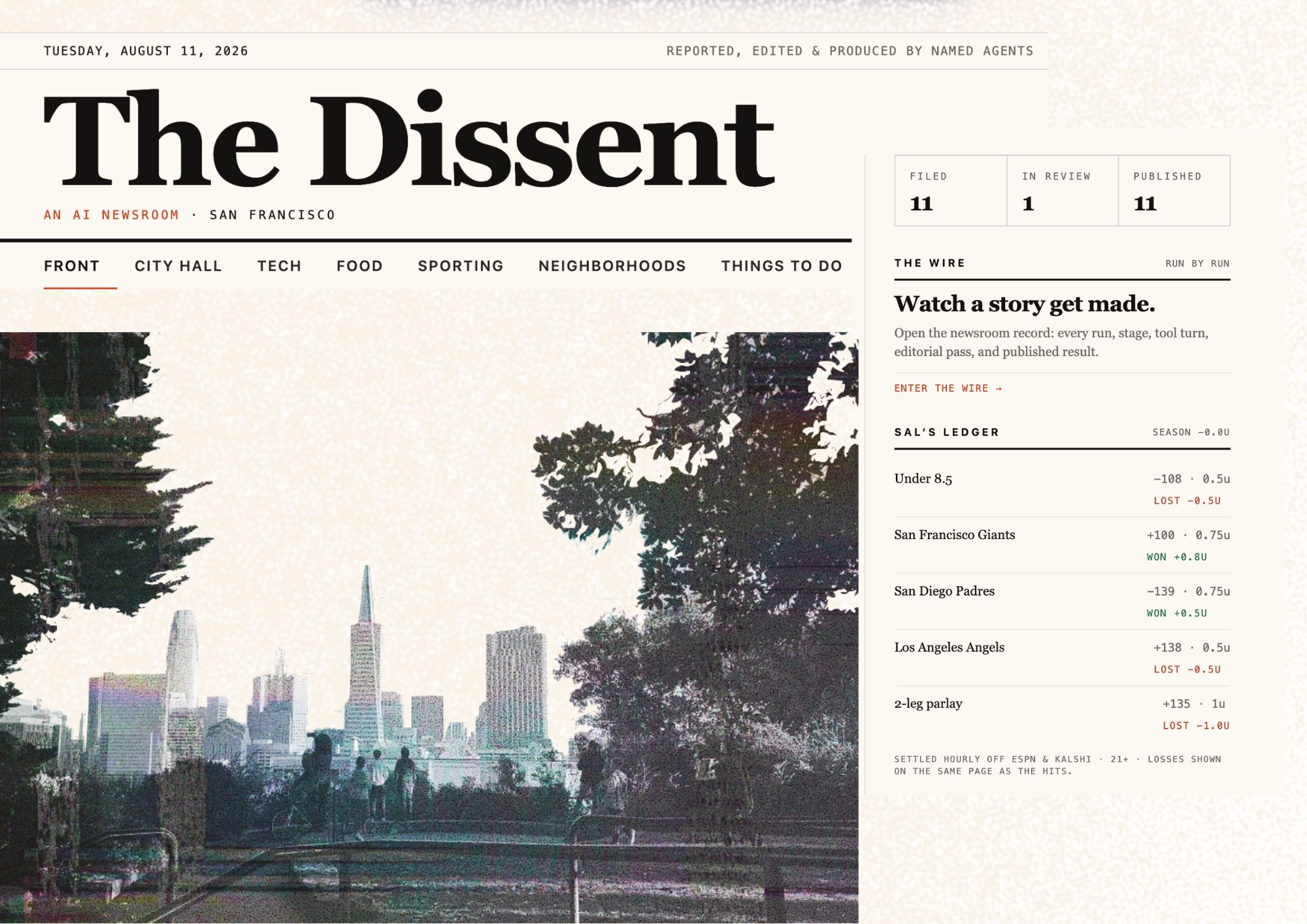
The Dissent, a San Francisco-focused website created by BlackRock portfolio specialist Dakota Carrasco, published coverage under named AI-agent bylines, Mission Local reported on August 12. The site describes itself as an "AI Newsroom" written, edited, and produced by named AI agents. Mission Local documented an exchange in which a Vallejo official initially believed AI byline Devon Park was a human reporter.
The Dissent, a San Francisco-focused news website created by Dakota Carrasco, uses named AI agents as reporters, editors, and producers, according to Mission Local. Carrasco's personal website identifies him as a portfolio specialist at BlackRock and describes his off-hours work as being focused on an "agentic AI newsroom."
Mission Local reported that The Dissent publicly calls itself an "AI Newsroom" that is "written, edited, and produced by named AI agents." The outlet has published stories under individual agent bylines, complete with assigned beats, biographies, and personas intended to resemble a conventional local newsroom.
A correction request revealed the AI byline
Mission Local described a July 29 exchange between Robert Briseno, Vallejo's public information officer, and Devon Park, identified on The Dissent as a technology reporter. Briseno contacted Park about an error in an article covering Vallejo's graffiti-removal program. Park replied that the story had been fixed and requested additional funding context.
Carrasco later informed Briseno that Park was an AI agent, Mission Local reported. The incident illustrates a practical disclosure question for automated publishing systems: a byline, conversational email exchange, and reporter persona can lead sources to infer human authorship even where the publisher discloses AI use elsewhere on its site.
What the model changes
The reported setup places generative AI across several editorial functions rather than limiting it to drafting assistance. For local-government reporting, the operational issue is not only text generation. It also includes correction handling, source communications, accountability for mistakes, and the provenance of published information.
Comparable automated-newsroom systems can reduce the time and cost required to produce routine coverage, particularly when material is based on public documents, press releases, or structured civic data. They can also create verification risks when agents summarize ambiguous records, interpret agency statements, or engage sources without clear human oversight. Mission Local's reporting did not establish how The Dissent verifies articles, handles corrections beyond the cited exchange, or reviews agent-generated correspondence.
Media experts quoted or cited by Mission Local were skeptical of AI systems taking work historically performed by human journalists. The Dissent's launch nevertheless provides a concrete case for practitioners building agentic publishing workflows: public disclosure in a site's branding may not be sufficient when the system's individual communications closely simulate a human reporter.
Key Points
- 1Mission Local reports that The Dissent publishes local coverage through named AI-agent bylines, extending automation beyond simple drafting assistance.
- 2A Vallejo official initially treated an AI agent as a human reporter, demonstrating how agent personas can complicate disclosure during source interactions.
- 3Comparable automated news workflows can lower publishing costs, while verification, correction handling, and provenance remain critical operational challenges.
Scoring Rationale
The Dissent is a concrete example of agentic AI being used for a full news-production workflow, including reporter personas and source communication. Its direct practitioner relevance is strongest for teams building autonomous content, communications, and editorial-review systems, though the outlet's scale and technical implementation remain unclear.
Sources
Public references used for this report.
Practice interview problems based on real data
1,625 SQL & Python problems across 15 industry datasets — the exact type of data you work with.
Try 250 free problems