Tesla Integrates ByteDance Doubao Into China Vehicles
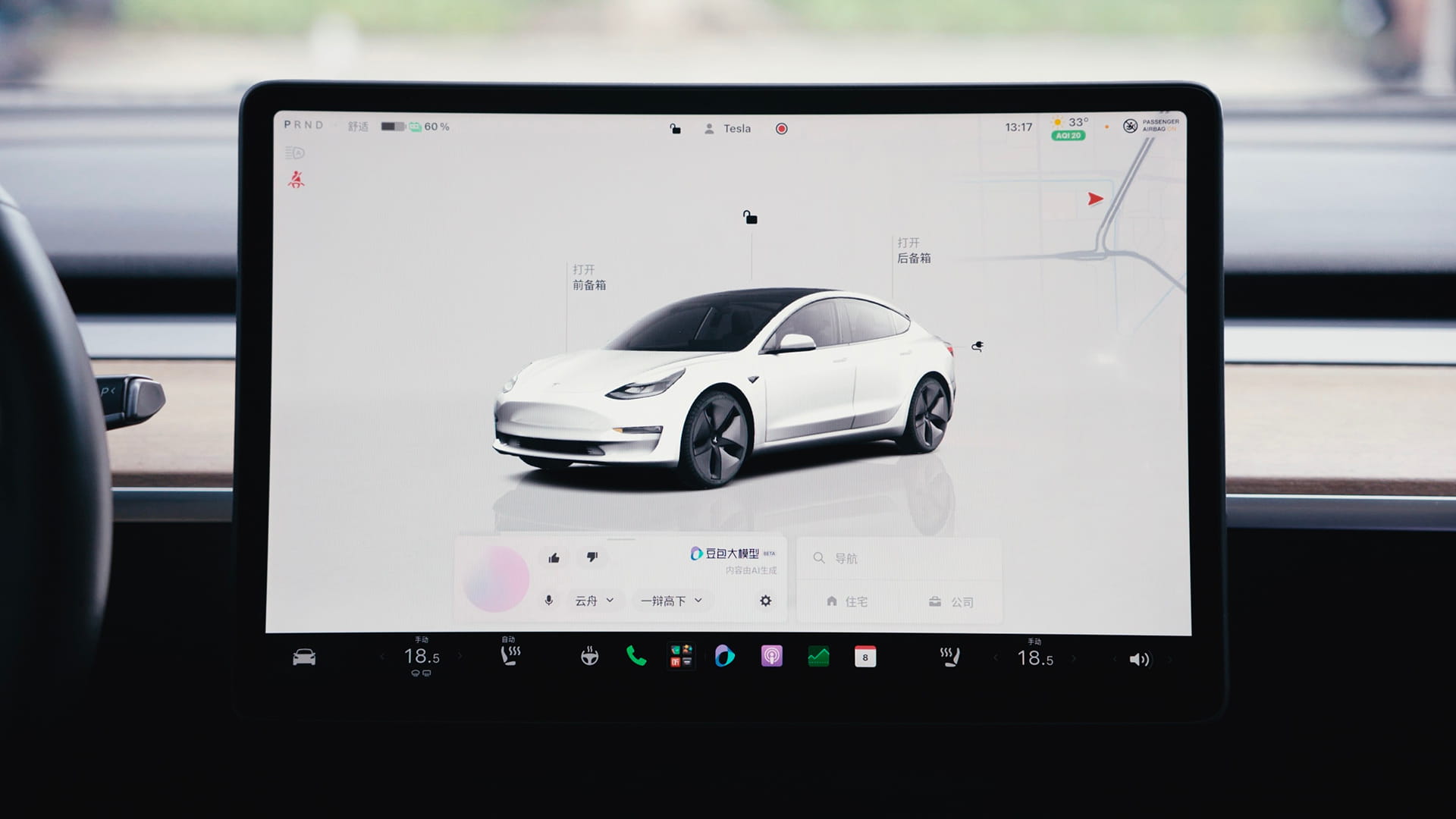
Tesla China began a phased over-the-air rollout on July 31 that adds ByteDance's Doubao large language model to Model 3, Model Y, Model S, and Model X infotainment systems, according to KR-Asia and China EV Home. The rollout is Tesla's first reported third-party LLM integration in China, though retrieved reports differ on whether Doubao operates as a standalone conversational app or also handles vehicle voice commands.
Tesla China began a phased rollout of software version 2026.14.13 on July 31, adding ByteDance's Doubao large language model to the infotainment systems of Model 3, Model Y, Model S, and Model X vehicles, according to KR-Asia and China EV Home. KR-Asia describes the release as Tesla's first third-party LLM integration in its more than decade-long presence in China.
The update gives Chinese Tesla owners access to a local AI service within the vehicle. According to KR-Asia, Doubao currently appears as a standalone app with four voice options, enabling users to chat, ask internet-connected questions, debate topics, hear stories, sing, and practice spoken languages. The report says the integration is part of a relationship with Volcano Engine, ByteDance's cloud and AI unit.
What the update includes
China EV Home reports that the rollout adds features spanning voice interaction, in-car functions, user experience, and security. Its report says Doubao replaces the prior in-car AI voice system, and that availability is limited to vehicles with AMD Ryzen processors and Premium Connectivity.
AIbase offers a different description of the feature split. It reports that Doubao handles voice-command functions including navigation, media playback, climate settings, and owner-manual queries, while DeepSeek supports casual conversation and information queries. AIbase also reports that vehicle-control commands continue to use existing control pathways rather than giving the model direct access to deeper vehicle controls.
These accounts leave an important implementation detail unresolved. KR-Asia characterizes Doubao as a standalone application, while China EV Home and AIbase describe a more integrated assistant role. The retrieved reports do not fully resolve differences in feature scope or model routing.
Local model choice and cockpit competition
The China deployment differs from Tesla's use of xAI's Grok in other markets, according to China EV Home. KR-Asia reports that Doubao could assume some cockpit functions that Grok performs in North America, while noting that Full Self-Driving has not become broadly available to Chinese owners.
A separate Caixin China Watch report from August 2025 documented an earlier ByteDance-Tesla arrangement for the China-market six-seat Model Y. That report said Doubao would handle functional commands and DeepSeek, delivered through Volcano Engine, would support conversational interaction. It also described the collaboration as partly shaped by China's regulatory environment and competition over "smart cockpit" features.
For ML and automotive software teams, the reported model split reflects a common production pattern: language models can improve conversational interfaces, but deterministic command and safety pathways are typically retained for actions that affect vehicle functions. Where multiple models are involved, practitioners generally need clear routing rules, permission boundaries, latency measurement, and auditability across the speech and control stack.
Tesla's China update is therefore notable less as an autonomous-driving release than as a production deployment of a domestically supplied LLM in a global automaker's cockpit software. Public reporting has not established whether the current Doubao integration will be connected to FSD functionality in China.
Key Points
- 1Tesla's July 31 OTA rollout adds Doubao to four vehicle lines, creating a reported production LLM deployment in its China infotainment stack.
- 2Retrieved reports disagree on Doubao's operational role, making feature routing and command permissions important unresolved implementation details.
- 3Comparable automotive AI systems generally separate open-ended conversation from deterministic vehicle-control pathways to manage latency, safety, and auditability.
Scoring Rationale
The rollout places a Chinese LLM in Tesla's production vehicle software across multiple models, making it a notable automotive AI deployment. Its relevance is strongest for teams building voice, multimodal, and safety-bounded AI systems rather than for general-purpose model developers.
Sources
Public references used for this report.
Practice interview problems based on real data
1,625 SQL & Python problems across 15 industry datasets — the exact type of data you work with.
Try 250 free problems