Pollen Robotics Launches Open-Source Microduck Robot
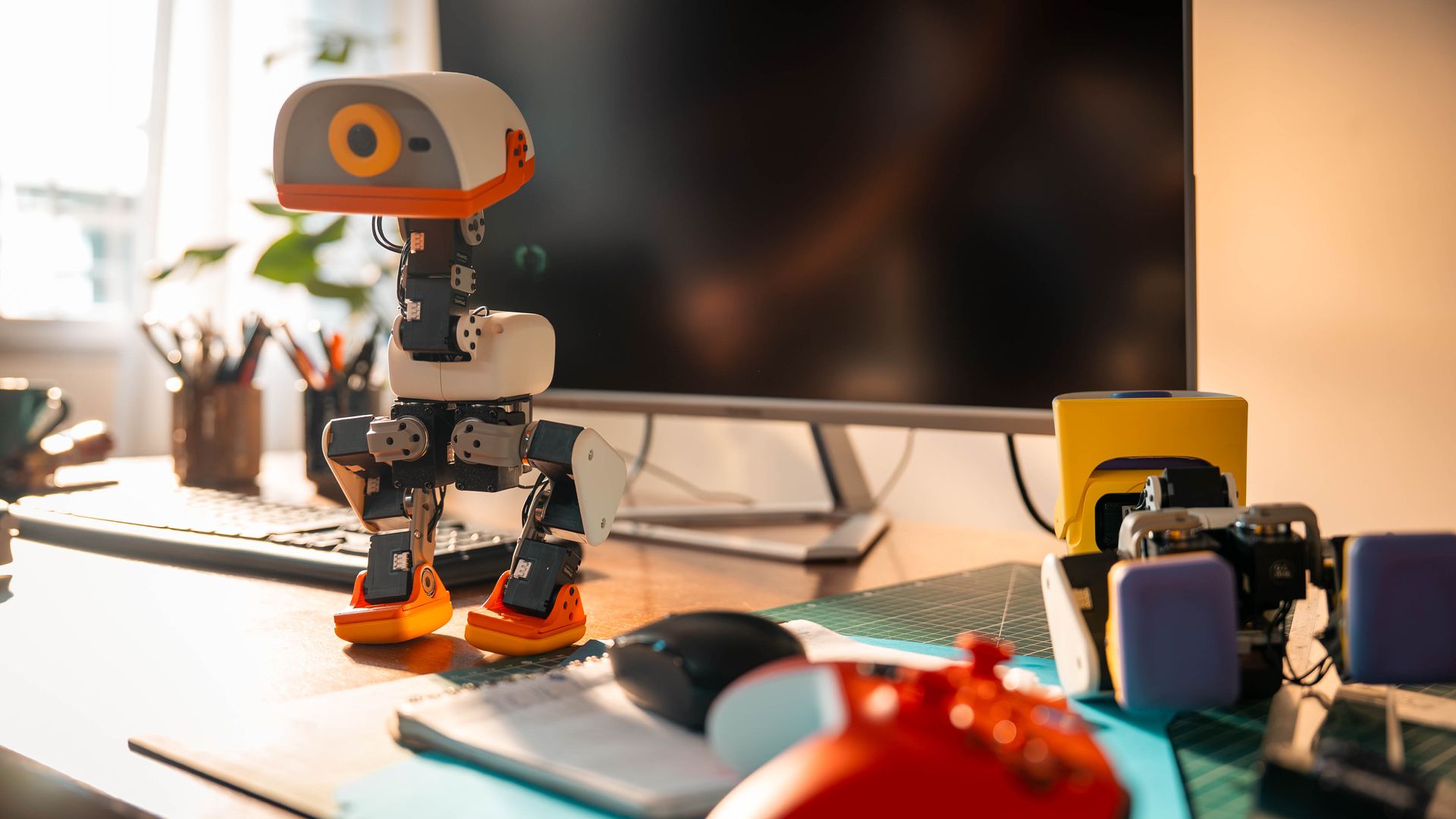
Hugging Face's Pollen Robotics opened preorders on August 27 for Microduck, a 25 cm open-source biped robot priced at $399 before taxes and shipping. Pollen Robotics says the robot's behaviors are reinforcement learning policies that users can retrain in simulation and deploy to the physical device. The company targets delivery before Christmas 2026.
Hugging Face's Pollen Robotics opened preorders on August 27 for Microduck, a 25 cm open-source biped robot priced at $399 before taxes and shipping. Pollen Robotics states that it intends to ship preorders before Christmas 2026.
Microduck is a compact, duck-like robot whose product materials emphasize reinforcement learning workflows. Its product page describes a sim-to-real development loop: users train a behavior in physics simulation, deploy it to the physical robot, adjust the simulation, retrain, and publish a resulting policy. The listed out-of-box motions include walking, sitting and standing, kicking, grabbing objects with its beak, and roller skating.
Hardware and control stack
The project's public GitHub repository describes Microduck as approximately 25 cm tall and 800 g, running on a Rockchip RK3566. According to the repository, software daemons manage a 50 Hz control loop, 15 servos, radio connectivity, a camera, and software updates. The repository also describes training in a separate codebase using MuJoCo, Proximal Policy Optimization (PPO), and export to ONNX for loading on the robot.
Axios reports that the device includes a camera, speaker, microphone, Wi-Fi, Bluetooth, and a small lidar sensor. Its reporting also describes preset behaviors including laser-pointer following, along with game-controller operation. In sample videos cited by Axios and The Verge, the robot picks up small objects, recovers from falls, and moves on rollerskates.
Hugging Face CEO Clem Delangue told Axios that Microduck is the first affordable AI robot that users can teach through reinforcement learning. He described the design as "made to move, ready to fall," adding that failure and mistakes should be considered in robot design.
An accessible sim-to-real experiment
Microduck's published software stack makes the technical proposition more concrete than a consumer-robot demonstration alone. The official documentation identifies each behavior as a retrainable policy, while the GitHub repository names the simulation environment, optimizer family, inference format, compute platform, and actuator count. That combination gives developers a starting point for examining the boundary between training-time simulation and embedded control.
In comparable robotics workflows, low-cost hardware can broaden experimentation, but sim-to-real performance remains dependent on calibration, dynamics modeling, actuator variation, and safe test procedures. Pollen Robotics' documented retraining loop explicitly includes simulation refinement after deployment, reflecting that common iteration cycle.
The device is physically small. Axios describes it as roughly 10 inches tall, 5.5 inches wide, and less than 2 pounds, limiting its practical ability to perform household tasks. Its relevance for ML practitioners instead lies in a relatively inexpensive, public implementation of reinforcement learning policy training and deployment on a legged robot.
Key Points
- 1Microduck packages MuJoCo, PPO, ONNX export, and embedded servo control into a public sim-to-real reinforcement learning workflow.
- 2The $399 preorder price lowers the entry cost for experimentation, though real-world policy transfer still requires iterative simulation refinement.
- 3Public documentation specifies a 50 Hz control loop and 15 servos, giving robotics developers concrete deployment constraints to inspect.
Scoring Rationale
Microduck provides an unusually low-cost, open-source entry point to reinforcement learning and sim-to-real robotics experimentation. Its practical utility is constrained by its small form factor, but the disclosed training and deployment stack is directly relevant to robotics developers.
Sources
Primary source and supporting public references used for this report.
Practice interview problems based on real data
1,625 SQL & Python problems across 15 industry datasets — the exact type of data you work with.
Try 250 free problems