Waymo Critiques Camera-Only Path to Autonomous Driving
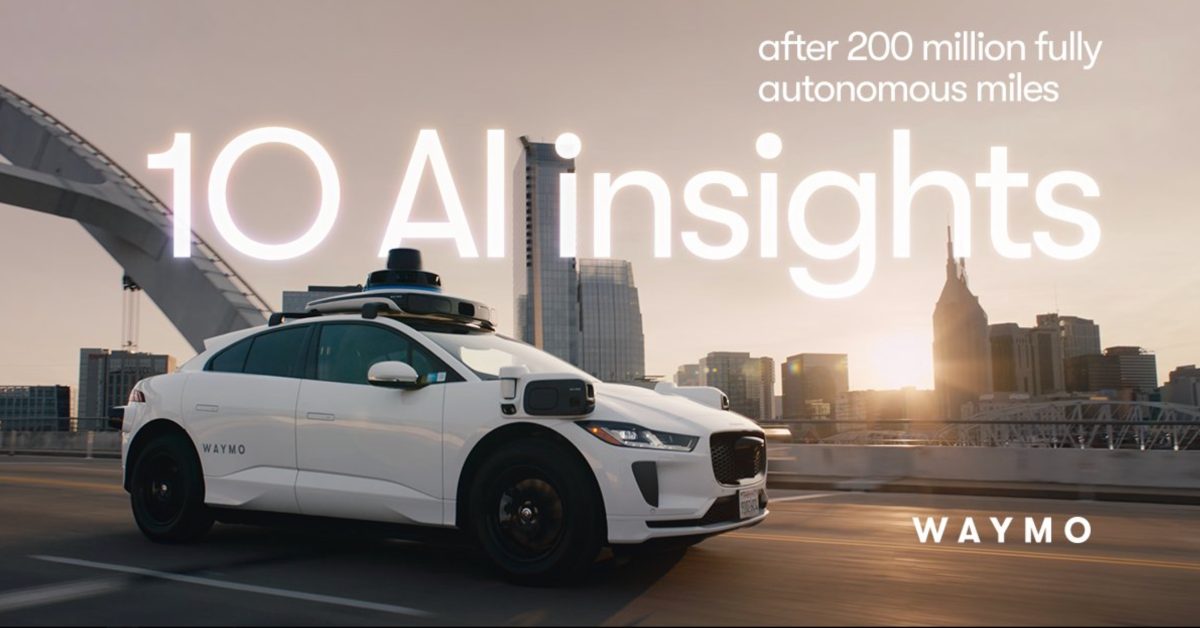
Waymo published this week 10 lessons from more than 200 million fully autonomous miles, arguing that turning a Level 2 driver-assistance system into full autonomy is a "false summit." Electrek and InsideEVs report that the post also challenged camera-only sensing and pure end-to-end neural driving systems without naming Tesla, while describing Waymo's use of cameras, lidar, radar, and high-definition maps.
Waymo published a set of 10 lessons drawn from more than 200 million fully autonomous miles, including an argument that converting a Level 2 driver-assistance system into a full-autonomy service is a "false summit." Electrek reports that the post was written by Srikanth Thirumalai and did not name Tesla, although its critiques closely track Tesla's camera-only and end-to-end Full Self-Driving development approach.
"Simply improving a driver-assist system (L2) for full autonomy is a false summit," Thirumalai wrote, according to Electrek. "True L4 maturity can only be safely achieved by a purpose-built system, validated on closed courses and hardened by the uncompromising experience of driving without a human in the car."
Sensors, maps, and model architecture
InsideEVs reports that Waymo's post calls multimodal sensors "indispensable" and states, "Cameras are incredible, but they aren't enough." The company described the Waymo Driver as using 13 cameras, four lidar units, six radars, and microphones. According to InsideEVs, the post assigns distinct functions to the sensors: cameras for signs and traffic lights, lidar for precise 3D geometry, and radar for velocity measurement and detection in conditions such as fog.
The post also advocated high-definition maps for poor visibility and complex road layouts, InsideEVs reports. Tesla's system uses a camera-only stack, while Electrek characterizes Tesla's Full Self-Driving data collection as occurring in customer vehicles with a human driver who remains legally responsible for the car.
Waymo further criticized pure end-to-end neural architectures that map raw pixels directly to steering commands. Electrek quotes the post's warning: "You can't build trust with a black box." The criticism concerns a technical design choice, not a disclosed independent comparison of the safety performance of Waymo and Tesla systems.
What the dispute means technically
The exchange illustrates a persistent autonomy engineering tradeoff. Multi-sensor stacks and high-definition maps can add redundancy and explicit environmental structure, while vision-first, end-to-end systems seek to derive driving behavior from large-scale data and learned representations. These approaches create different requirements for sensor calibration, data labeling, simulation, validation, monitoring, and failure analysis.
For ML and autonomy teams, the substantive question is not whether cameras or neural networks are useful, but how a production system handles sensor degradation, unusual road conditions, uncertainty, and safety validation. Waymo's post presents its answers based on its operational experience; the cited coverage does not provide independently audited evidence establishing that one architecture is categorically safer than another.
Key Points
- 1Waymo's 10 lessons use 200 million autonomous miles to argue that Level 4 systems require purpose-built validation rather than Level 2 iteration.
- 2The post criticizes camera-only sensing and pure end-to-end control while describing Waymo's use of cameras, lidar, radar, and HD maps.
- 3For autonomy engineers, the dispute underscores a broader industry tradeoff between sensor redundancy, mapping, model interpretability, and scalable data collection.
Scoring Rationale
The story documents a substantive public disagreement over sensor redundancy, end-to-end neural control, mapping, and validation in autonomous driving. It is relevant to practitioners designing safety-critical ML systems, though it is not a new product release, benchmark, or independently verified technical result.
Sources
Public references used for this report.
Practice interview problems based on real data
1,625 SQL & Python problems across 15 industry datasets — the exact type of data you work with.
Try 250 free problems