Orange Education Releases Prompting Generative AI Guide
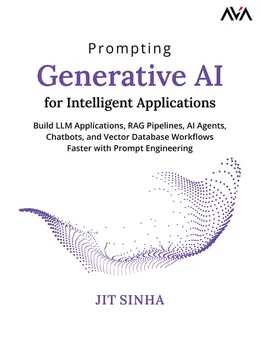
An eBook titled "Prompting Generative AI for Intelligent Applications" offers a hands-on workflow for building LLM applications, RAG pipelines, AI agents, chatbots, and vector-database workflows. Google Books lists the book as published on June 16, 2026 by Orange Education Pvt Ltd, running 453 pages with ISBN-10 8169646081 and ISBN-13 978-8169646086. The Google Books description advertises a free one-month digital subscription to www.avaskillshelf.com and highlights practical coverage of prompt engineering, embeddings, vector databases, semantic search, multi-agent orchestration, and deployment across cloud and private infrastructure. For practitioners, the book positions prompt-driven execution and end-to-end workflows as the central skillset for moving ideas into production, per the publisher description on Google Books.
What happened
The eBook Prompting Generative AI for Intelligent Applications appears as a new practitioner guide. Per Google Books, the title was published on June 16, 2026 by Orange Education Pvt Ltd and is 453 pages long, with ISBN-10 8169646081 and ISBN-13 978-8169646086. Per the Google Books listing, the publisher description advertises a free one-month digital subscription to www.avaskillshelf.com and lists hands-on coverage of prompt engineering, RAG pipelines, embeddings, vector databases, multi-agent systems, chatbots, and deployment across cloud and private infrastructure. Editorial analysis - technical context: The book's advertised scope-prompt-driven development, retrieval-augmented generation, embeddings and vector databases, and multi-agent orchestration-maps to the practical stack many teams assemble for production LLM services. Industry-pattern observations: practitioner resources that prioritize prompt chaining, embedding design, and vector-store choices typically focus on operational challenges such as latency tradeoffs, index freshness, vector dimensionality, and prompt/template versioning rather than core model architecture. Guides that include code, API examples, and deployment notes help teams translate prompts into reproducible pipelines for evaluation and monitoring.
Context and significance
For practitioners, accessible end-to-end guides reduce onboarding friction when integrating LLMs with retrieval layers and tool calls. Industry context: Reliable RAG systems require attention to embedding model selection, vector-store configuration, and retrieval heuristics; multi-agent orchestration adds complexity around state management and tool integration. A book that bundles these topics with hands-on examples can serve as a reference for engineers and data scientists designing prototypes and early production flows.
What to watch
Confirm whether the publisher provides companion code or a GitHub repository and sample datasets, which materially affect usefulness for practitioners. Observe which embedding models, vector databases, and orchestration patterns are recommended in any accompanying code. Finally, track whether the book is updated with new integrations as model APIs and vector-store features evolve.
Key Points
- 1Practical, prompt-centric guides connect prompt engineering to full RAG and deployment workflows, shortening prototype-to-production cycles.
- 2Hands-on coverage of embeddings and vector databases addresses a core operational bottleneck for semantic search and knowledge retrieval.
- 3Including multi-agent orchestration and deployment notes reflects demand for end-to-end examples that combine reasoning, tools, and infra.
Scoring Rationale
A new practitioner guide is useful to engineers and data scientists as a reference for building LLM/RAG workflows, but it is not a frontier research or platform release. The practical focus gives it modest relevance for teams adopting prompt-driven pipelines.
Sources
Public references used for this report.
Practice with real Social Media data
90 SQL & Python problems · 15 industry datasets
250 free problems · No credit card
See all Social Media problems