
Google Launches Tensor G6 Across the Pixel 11 Lineup
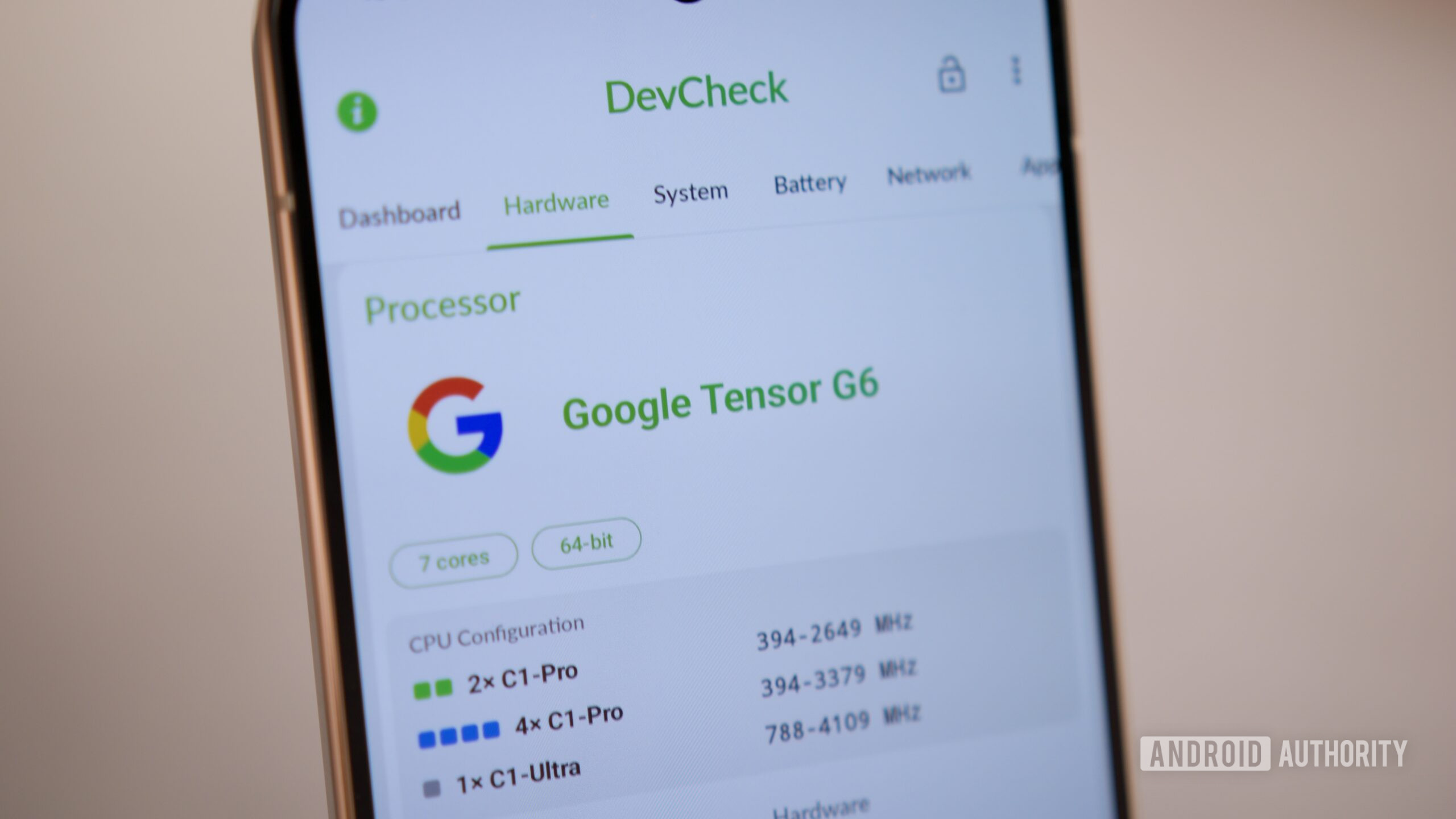
Google launched the Pixel 11 lineup on August 12 with its Tensor G6 processor across the standard, Pro, Pro XL, and Pro Fold models. Google claims up to 20% better CPU power efficiency, 25% faster web browsing, and 15% faster app loading, while the upgraded TPU enables faster on-device AI and new camera features.
Google launched the Pixel 11, Pixel 11 Pro, Pixel 11 Pro XL, and Pixel 11 Pro Fold on August 12, with every model powered by the new Tensor G6 processor. Google claims the chip can deliver up to 20% better CPU power efficiency than Tensor G5, 25% faster web browsing, and 15% faster app loading.
The company has again framed Tensor around device-level experiences rather than a conventional benchmark contest. Android Authority reports that Google co-designed the G6 silicon architecture alongside its latest DeepMind models, giving the TPU 50% more compute and higher memory bandwidth. Google says common local workloads such as notification summaries and voice transcripts can run up to 3.5 times faster while using up to 3.5 times less energy. Those are vendor claims based on pre-production hardware, not independent performance results.
On-device AI reaches the camera pipeline
The upgraded TPU and image signal processor support several new camera features. Android Authority reports that 4K Portrait Video debuts on the standard Pixel 11 and Pro models, while Instant Night Sight is designed to capture low-light images up to 4.5 times faster. The Pro models also advertise up to 120x zoom, with the standard Pixel 11 reaching 30x.
The Pro Fold has important exceptions. Although it uses Tensor G6, Google confirmed to Android Authority that its physical layout and sensor constraints prevent it from supporting 4K Portrait Video or Instant Night Sight. It retains 30x zoom and hardware-accelerated AV1 encoding.
Axios separately reports that Tensor G6 also powers Magic Capture, which analyzes roughly 500 frames from a short clip, selects promising moments, and applies light edits such as cropping or unblurring. This shifts more of the camera workflow from a single captured frame toward local selection and post-processing.
Performance claims still need independent testing
Android Authority's hands-on inspection identified a seven-core CPU configuration and a PowerVR graphics design, but Google has not published a complete low-level specification. The company also introduced the Titan M3 security chip and says the platform supports a quantum-safe boot using post-quantum cryptography.
For mobile ML teams, the most consequential changes are the claimed gains in local inference speed, energy use, and camera-pipeline integration. They could expand what applications can do without sending user data to a remote service. But deployment decisions should wait for independent measurements of sustained performance, thermals, battery impact, model quality, and feature availability across the four devices. The Fold's omissions are a reminder that sharing an SoC does not guarantee identical AI capabilities when sensors, cooling, and physical design differ.
Key Points
- 1Tensor G6 powers all four Pixel 11 models, with Google claiming up to 20% better CPU power efficiency and faster everyday performance.
- 2The upgraded TPU and ISP enable faster local AI plus camera features including 4K Portrait Video, Instant Night Sight, and model-specific zoom modes.
- 3The Pixel 11 Pro Fold lacks 4K Portrait Video and Instant Night Sight, showing that device hardware still constrains shared-SoC AI features.
Scoring Rationale
Tensor G6 materially expands on-device inference and computational-camera claims across a major consumer-device line, with direct implications for mobile ML and privacy-sensitive applications. Impact remains below major-platform level until independent benchmarks validate Google's performance and efficiency claims.
Sources
Primary source and supporting public references used for this report.
Practice with real Ad Tech data
90 SQL & Python problems · 15 industry datasets
250 free problems · No credit card
See all Ad Tech problems

