China's LineShine Tops TOP500 as No.1 Supercomputer
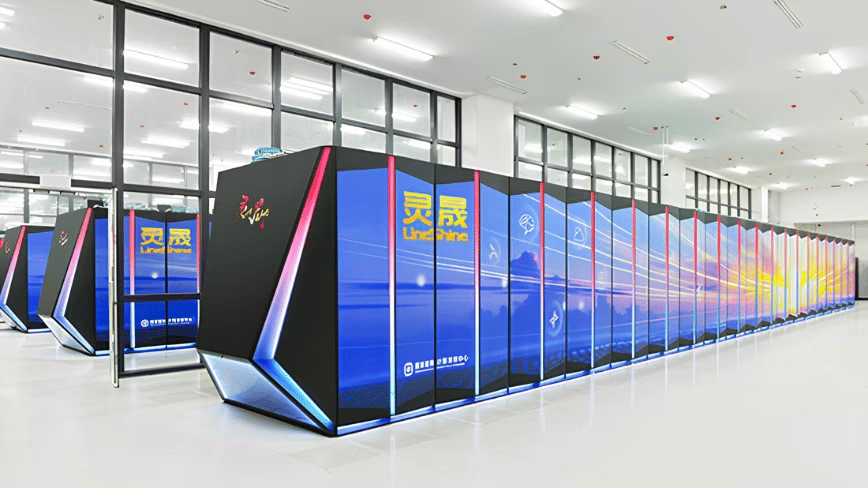
China's LineShine supercomputer took the world's No.1 spot on the TOP500 list on June 23, 2026, hitting 2.198 Exaflop/s on the HPL benchmark, about 80 percent of its 2.736 Exaflop/s theoretical peak, and displacing the US's El Capitan (1.809 Exaflop/s), which had led since November 2024, per TOP500's official announcement. Built entirely without Nvidia, AMD or Intel chips using proprietary Armv9-based LX2 processors, LineShine is the first Chinese system atop the list since 2017 and the first to exceed two sustained exaflops on CPUs alone. But TOP500 organizer Jack Dongarra and independent analysts note the milestone is narrower than the headline suggests: LineShine ranks only fourth on the mixed-precision benchmark closest to AI workloads, and the largest US AI clusters, run by hyperscalers like Microsoft and Google, do not even compete on this list.
For ML infrastructure and policy-adjacent teams, LineShine's debut is best read as two separate stories that are easy to conflate: genuine proof that China can build leadership-class HPC hardware entirely outside the Nvidia/AMD/Intel supply chain, and a much narrower, still-unresolved question of whether that hardware approach is competitive for AI training specifically. TOP500's own benchmark data answers the second question, and for now the answer is no.
What happened
TOP500 announced on June 23, 2026 at the ISC conference in Hamburg that LineShine, installed at China's National Supercomputing Center in Shenzhen, is the new No.1 system, reaching 2.198 Exaflop/s on the HPL benchmark, about 80 percent of its 2.736 Exaflop/s theoretical peak, per TOP500's official release. That displaces El Capitan (1.809 Exaflop/s, Lawrence Livermore National Laboratory), which had led the list since November 2024 and helps maintain the US nuclear stockpile, per TOP500 and The Next Web. LineShine is the first system to exceed two sustained exaflops using CPUs only, and the first Chinese system to top the list since 2017. It also leads the HPCG benchmark (data-intensive workloads) at 22.00 HPCG-Petaflop/s. The system runs 13.79 million cores across custom 304-core LX2 processors built on the Armv9 instruction set, linked by a proprietary LingQi interconnect and running Kylin OS, drawing about 42.2 megawatts for an efficiency of 52.07 Gigaflops/Watt, according to TOP500. The Next Web reports the chip work is linked to Huawei, and Data Center Dynamics reports the LX2 processors were co-developed with Huawei using Huawei Kunpeng racks across 92 cabinets, though TOP500's own release does not name Huawei directly.
Technical context
TOP500 organizer Jack Dongarra inspected the machine and called it impressive, telling The New York Times, "They upped us by developing a system that is not reliant on GPUs." On HPL-MxP, the mixed-precision benchmark closest to AI training workloads, LineShine reached 7.92 Exaflop/s for fourth place, only a 3.6x speedup over its HPL score; El Capitan still leads HPL-MxP at 16.7 Exaflop/s, a 9.2x speedup, meaning the GPU-accelerated US system remains more than double LineShine's mixed-precision throughput despite trailing on the headline HPL number. LineShine's designers have entered 14 bids for the Gordon Bell Prize and disclosed the machine was built without government funding, but per The Next Web have not disclosed who manufactured the chips or on what process node, the detail export-control regulators would most want to know.
Industry context
China stopped submitting systems to TOP500 in 2023 after the US tightened chip-export rules, so LineShine's entry is itself being read as a deliberate statement rather than a routine submission. "I'm not surprised it's the number one system," Addison Snell of Intersect360 Research told The Next Web. "What I'm surprised by is that they submitted it." Jimmy Goodrich of the University of California Institute on Global Conflict and Cooperation told The Next Web the result exposes a gap in US export policy: "The US government should have stronger controls on the export and manufacturing of CPUs for the China market. It is a loophole in the current regulations," since Washington's restrictions have focused on GPUs rather than CPUs. Goodrich also noted that the largest US AI clusters, run by hyperscalers including xAI, Microsoft, Amazon and Google, are commercial systems that are never submitted to TOP500 at all: "If the hyperscalers submitted their systems, this 'world's fastest' would not crack the top five."
For practitioners
The practical takeaway is that LineShine is a genuine engineering and geopolitical milestone for CPU-only exascale computing and Chinese chip self-sufficiency under export controls, but it is not evidence that CPU-centric architectures have closed the gap on AI training throughput, where mixed-precision performance is what matters most. Teams evaluating export-control-constrained or sovereign compute options should treat LineShine as a proof point for double-precision HPC workloads such as climate modeling and physics simulation (TOP500 notes it has already run full Earth-system and human-brain simulations), rather than a like-for-like substitute for GPU clusters in large-scale model training.
What to watch
- •Whether US export-control policy extends beyond GPUs to cover high-core-count CPUs, the "loophole" Goodrich flagged.
- •Whether LineShine's 14 Gordon Bell Prize submissions, expected at SC26 in November, reveal more about real-world application performance and chip provenance.
- •Whether additional systems built on the same LX2/LingKun platform appear on the next TOP500 list, indicating a repeatable architecture rather than a one-off entry.
Editorial analysis
The most useful framing for practitioners is Goodrich's: the TOP500 list, as a benchmark of academic and government HPC systems, structurally excludes the commercial hyperscaler clusters that actually run today's largest AI training runs, so "world's fastest supercomputer" and "most capable AI training infrastructure" are measuring different, only loosely related things. LineShine's real significance is as evidence that export controls are accelerating Chinese silicon self-sufficiency rather than preventing it, a dynamic with more consequence for long-run chip policy than for near-term AI model training capacity.
Key Points
- 1China's LineShine hit 2.198 Exaflop/s on TOP500's HPL benchmark, taking the No.1 spot from El Capitan using CPU-only Armv9 chips built without Nvidia, AMD or Intel silicon.
- 2TOP500 organizer Jack Dongarra called the CPU-only design impressive, but LineShine ranks only fourth on the mixed-precision benchmark closest to AI training workloads.
- 3Analysts note America's largest AI clusters, run by hyperscalers like Microsoft and Google, never compete on TOP500, so the ranking understates current US AI compute capacity.
Scoring Rationale
Verified directly against TOP500's official release and corroborated by ~20 independent outlets across US, European, Chinese and Indian press: a genuine CPU-only exascale milestone with real chip-policy significance. Held near the prior score, nudged slightly up given how well-verified and widely corroborated the result is, while the added HPL-MxP/hyperscaler-exclusion context tempers any overstated AI-capability reading.
Sources
Public references used for this report.
View 17 more sources
- China Takes Supercomputer Crown From U.S. For First Time Since 2017nytimes.com
- China beats US with world's fastest supercomputer, but race not geared for AI workreuters.com
- China's LineShine just topped the global supercomputer ranking: what you need to knownature.com
- Chinese supercomputer leapfrogs best US machines to be ranked world's fastesttheguardian.com
- China bypasses US GPU bans with LineShine: CPU-only monster packs Huawei-designed Armv9 corestomshardware.com
- China's LineShine beats US El Capitan in Top500 supercomputer rankingsscmp.com
- Chinese Supercomputer Overtakes U.S. as World's Fastestwsj.com
- Chinese supercomputer powered by homegrown chips tops US models in global rankingcnn.com
- China takes US crown for world's fastest supercomputeraljazeera.com
- China's supercomputer returns to top of global rankingglobaltimes.cn
- China Takes Back Top Spot In Latest Supercomputer Rankingengadget.com
- Surprise! Chinese LineShine Takes Number 1 on TOP500hpcwire.com
- Arm CPUs Take Number 1 in Latest Top500 List with Chinese LineShineservethehome.com
- China's LineShine Debuts as World's Fastest 2 ExaFLOP Supercomputertechpowerup.com
- China's LineShine dethrones El Capitan as the world's fastestnetworkworld.com
- Computer wars heat up: Chinese supercomputer surpasses US for world's fastestfoxbusiness.com
- After 9 years, Chinese supercomputer beats America's in world's fastest rankingtimesofindia.indiatimes.com
Practice with real Health & Insurance data
90 SQL & Python problems · 15 industry datasets
250 free problems · No credit card
See all Health & Insurance problems