
ATLANT 3D Launches NANOFABRICATOR PRO for Materials Validation
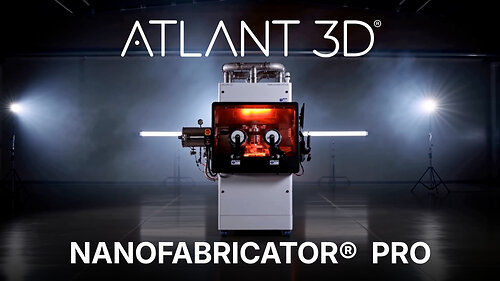
ATLANT 3D launched NANOFABRICATOR PRO on August 18, 2026, a platform combining AI-driven materials discovery with atomic-scale fabrication, experimental validation, and device prototyping. According to ATLANT 3D, the system uses its Direct Atomic Layer Processing technology to turn digital material candidates into controlled physical experiments and preserve process data. Industry coverage reports that the platform is SEMI-compliant and manufactured in the United States by Automated Industrial Robotics.
ATLANT 3D has launched NANOFABRICATOR PRO, a physical platform intended to connect AI-driven materials discovery with atomic-scale fabrication, experimental validation, and device prototyping. The Copenhagen-based company describes the system as the "world's first and only" physical platform for AI-driven materials discovery, a positioning claim reported on its product page and in coverage by VoxelMatters.
The platform is built on ATLANT 3D's proprietary Direct Atomic Layer Processing (DALP) technology. According to the company, users can define material patterns, processing locations, parameters, and sequences in software, then execute controlled experiments that fabricate AI-generated material candidates. ATLANT 3D states that NANOFABRICATOR PRO supports more than 450 compatible material families.
The product addresses a practical bottleneck in computational materials science: a model can propose compositions or structures, but the candidates still require fabrication and characterization under real process conditions. ATLANT 3D's product page notes that precursor chemistry, substrate choice, temperature, layer sequence, interface conditions, and process windows must be established experimentally before a predicted material becomes a functional, manufacturable technology.
Atomic-scale process and semiconductor applications
3Druck.com reports that DALP differs from conventional atomic layer deposition because it deposits material locally and programmably rather than uniformly coating an entire surface. The outlet describes this as enabling targeted micro- and nanostructures and material combinations. That capability is relevant to semiconductor devices, where interfaces and layer-level process variation can strongly affect electrical, optical, and thermal performance.
Engineering.com reports that NANOFABRICATOR PRO targets semiconductor technology, advanced packaging, quantum technologies, and related applications. VoxelMatters reports that the system can produce multiple materials and process variations on a single substrate, rather than requiring one process condition for an entire substrate.
According to VoxelMatters and Engineering.com, Automated Industrial Robotics (AIR) industrialized the platform, manufactures it in the United States, and the system is SEMI-compliant for advanced semiconductor manufacturing. Bob Fung, president of Automated Industrial Robotics Silicon Valley, said in comments carried by VoxelMatters that the partnership combines engineering and U.S. manufacturing capabilities to deliver the platform.
Closing the experimental feedback loop
ATLANT 3D states that the platform records digital recipes, fabrication parameters, and physical results to create a path from computational design through process transfer and manufacturing integration. The company also states that characterization results can be returned to improve later experiments, recipes, and material designs.
Dr. Maksym Plakhotnyuk, ATLANT 3D's CEO and founder, said in a statement published by VoxelMatters: "AI is fundamentally changing how new materials are discovered. The next frontier is turning those discoveries into real-world innovations." He added that the company and AIR were introducing the system to support next-generation platforms with integrated metrology.
Engineering.com reports that ATLANT 3D intends to develop self-driving capabilities around NANOFABRICATOR PRO, including integrated metrology and additional processing solutions. The company's public materials do not provide benchmark data for throughput, yield, characterization accuracy, or the degree of automation in a closed-loop workflow.
For materials-informatics teams, comparable closed-loop platforms are most useful when experimental metadata, process provenance, and measurement outputs remain machine-readable across successive design cycles. ATLANT 3D's emphasis on preserving recipes and physical results addresses that general reproducibility requirement, although independent performance validation of the new platform has not been reported in the retrieved coverage.
Key Points
- 1NANOFABRICATOR PRO links AI-generated material candidates to programmable atomic-scale fabrication, addressing the experimental validation stage that prediction models alone cannot complete.
- 2ATLANT 3D reports compatibility with more than 450 material families, while coverage places initial applications in semiconductors, advanced packaging, and quantum technologies.
- 3Closed-loop materials platforms generally depend on traceable process and measurement data, making recipe preservation central to reproducibility and model-guided experimentation.
Scoring Rationale
The launch addresses an important physical-validation bottleneck for AI-driven materials discovery, particularly in semiconductor and advanced-device R&D. Its relevance is substantial for teams building closed-loop experimentation systems, although independent throughput and performance benchmarks have not yet been reported.
Sources
Primary source and supporting public references used for this report.
View 5 more sources
- ATLANT 3D launches NANOFABRICATOR PRO for AI-driven materials discoveryvoxelmatters.com
- World’s first nanofabricator platform prints atomic-scale semiconductor materialsinterestingengineering.com
- ATLANT 3D Scales Atomic-Level Additive Manufacturing for Chips and AI3dprint.com
- ATLANT 3D launches AI materials discovery platformengineering.com
- ATLANT 3D combines AI-driven materials discovery with manufacturing at the atomic scale3druck.com
Practice interview problems based on real data
1,625 SQL & Python problems across 15 industry datasets — the exact type of data you work with.
Try 250 free problems
