US Army Tests Autonomous F-250 Breaching System
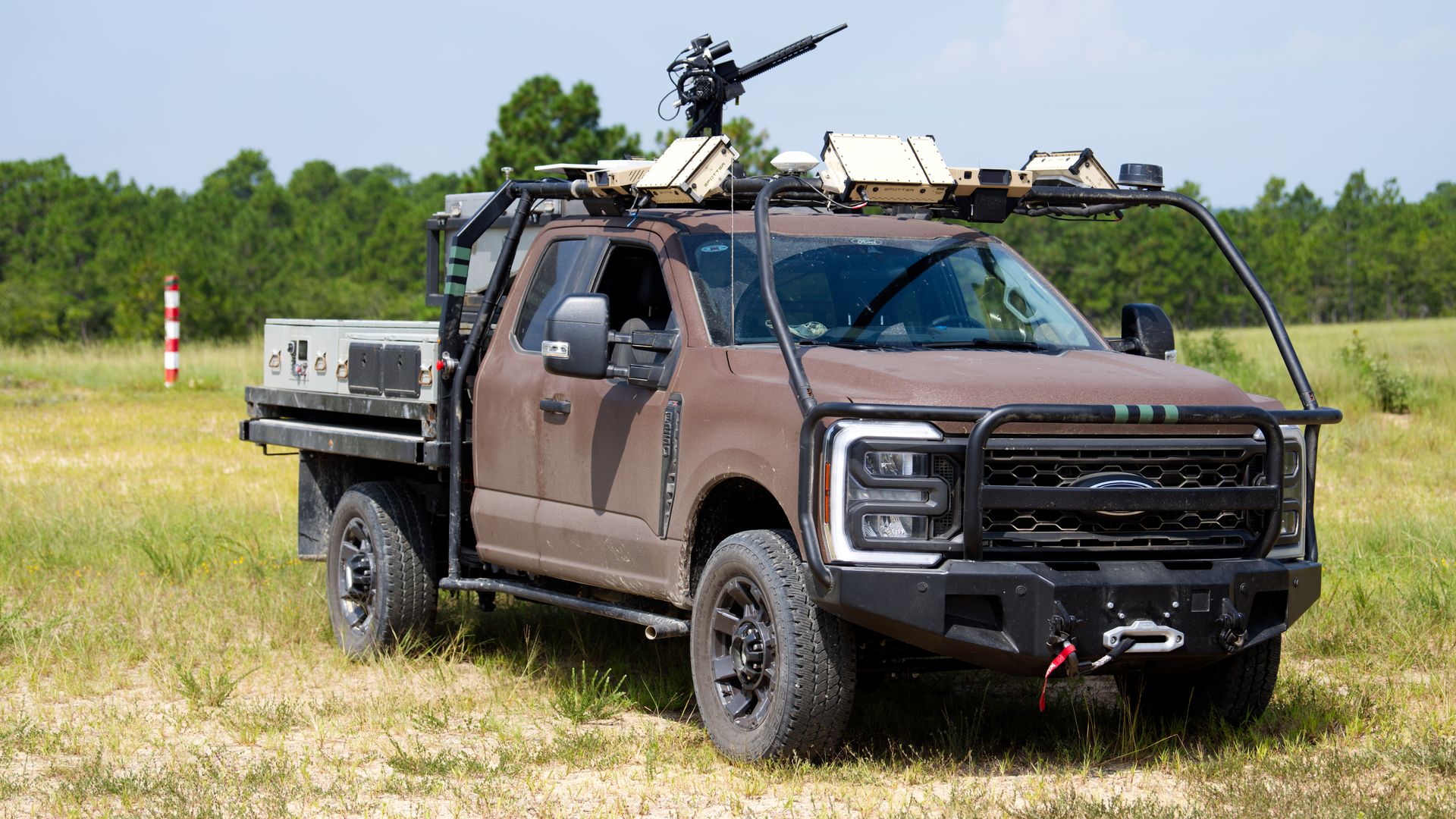
The U.S. Army tested semi-autonomous Ford F-250 vehicles, breaching payloads, drones, and counter-drone systems during Project Sandhills 2.0 at Fort Bragg from August 17 to 28. An Army account says the exercise linked the systems under unified command and control. Axios reported that Forterra added self-driving, sensing, and communications capabilities to the F-250 platform, while 9 Mothers supplied the Edda turret.
The U.S. Army used Project Sandhills 2.0 at Fort Bragg, North Carolina, to test autonomous and semi-autonomous systems for combat-engineering tasks from August 17 to 28. The 20th Engineer Brigade's experimentation campaign brought together soldiers and industry developers to assess how lower-cost robotic systems could support breaching while reducing exposure to high-risk work.
The Army described a combined exercise rather than a single-vehicle demonstration. It included autonomous trucks, robotic breaching payloads, drone swarms, mine-detection systems, and counter-drone tools connected through a unified command-and-control architecture. The Army said soldier and industry feedback from the event is intended to inform future capability development.
What the F-250 platform did
Army imagery from the exercise shows an Edda counter-unmanned-aircraft-system turret mounted on a semi-autonomous Ford F-250. The Army says the turret combines acoustic and visual tracking with a human-authorized effector to defend breaching assets against small drones. In a separate breaching lane, soldiers built digital routes and dispatched autonomous trucks to support obstacle clearing.
Axios reported that Forterra ruggedized the F-250s and added self-driving, sensing, and communications capabilities. The report identified Texas-based 9 Mothers as the supplier of Edda, a 12-gauge counter-drone turret, and described another F-250 placing a slurry line charge during the event. These accounts document a field experiment, not a published production-fielding decision.
What the public record does and does not show
The exercise is a useful example of the Army testing ground autonomy, robotic breaching, and counter-drone defense as one operational problem instead of as isolated products. The released material does not provide comparative autonomy benchmarks, detection rates, electronic-warfare results, operator-to-vehicle ratios, or a system architecture.
That distinction matters for robotics practitioners. The available evidence supports that the Army evaluated integrated systems at Fort Bragg; it does not establish how the platforms will perform outside the tested conditions or whether they will move into operational deployment. The next meaningful public milestones would be disclosed test results, procurement decisions, or fielding announcements.
Key Points
- 1Project Sandhills 2.0 combined autonomous breaching, counter-drone defense, drones, and mine detection in an Army experimentation campaign at Fort Bragg.
- 2Army reporting shows an Edda counter-UAS turret on a semi-autonomous F-250 and describes human authorization for its effector.
- 3The available public material documents a field experiment, not technical benchmarks or a production-fielding decision.
Scoring Rationale
The exercise is a notable public demonstration of integrated ground autonomy, robotic breaching, and counter-drone defense in a military setting. It is relevant to robotics and autonomy practitioners, although the disclosed evidence does not include technical benchmarks, system architecture, or a confirmed production deployment.
Sources
Primary source and supporting public references used for this report.
Practice interview problems based on real data
1,625 SQL & Python problems across 15 industry datasets — the exact type of data you work with.
Try 250 free problems