Ant Group Open-Sources SingGuard-NSFA Agent Guardrails
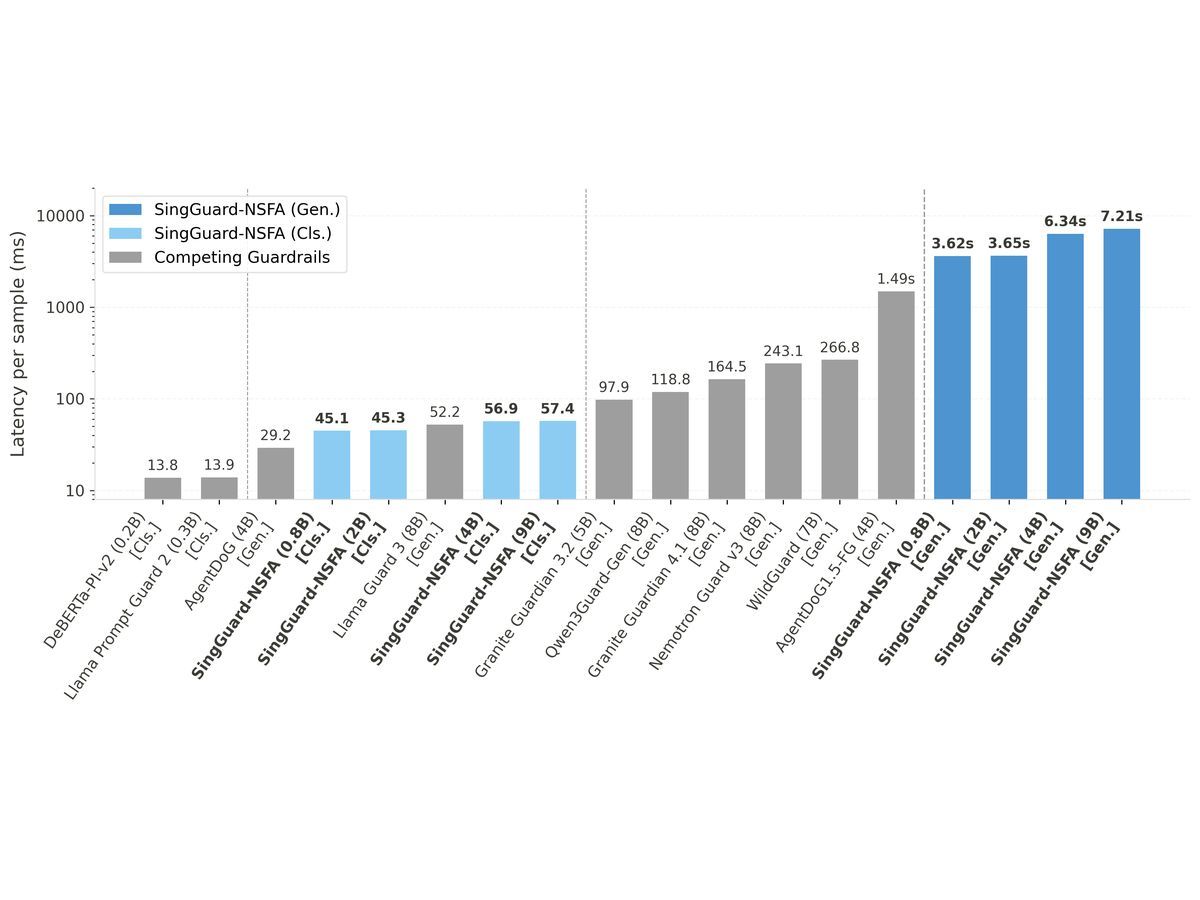
Ant Group's AI Security Lab has open-sourced SingGuard-NSFA, a family of guardrail models designed for prompt injection, tool misuse, malicious code requests, sensitive-data theft, resource abuse, hazardous actions, and response leakage in agentic systems. The public repository includes four model sizes, a technical report, benchmark artifacts, and an Apache-2.0 license. The team reports broad multilingual coverage and low-latency classification, but those results have not been independently reproduced. LDS recommends evaluating the models on local tools, languages, attack chains, benign edge cases, and multi-turn state, because the published design emphasizes single-turn text and cannot by itself enforce identity, tool permissions, transaction limits, or runtime isolation.
What happened
Ant Group's AI Security Lab has open-sourced SingGuard-NSFA, a guardrail framework aimed at risks created when language models can invoke tools, run code, and execute multi-step plans. The public repository includes four model sizes, a technical report, benchmark material, and an Apache-2.0 license.
The framework classifies prompt injection, malicious code requests, sensitive-information theft, dangerous tool use, resource abuse, hazardous action generation, and response leakage. The authors provide both a generative reasoning mode for offline analysis and classification heads for lower-latency interception. Its benchmark and latency results are author-reported and have not been independently reproduced.
Security context
The taxonomy is broader than ordinary content moderation because it focuses on what an agent may do, not only what a model may say. That is useful, but the repository also states a single-turn text scope. Many high-risk failures depend on state across turns, tool output, identity, authorization, and the side effects of an action. A text classifier therefore belongs inside a larger control system rather than acting as the final security boundary.
| Control layer | SingGuard can help assess | Separate control still required |
|---|---|---|
| Input | Injection and malicious intent | Trusted-context separation |
| Output | Hazardous instructions and leakage | Secret redaction and data policy |
| Tool call | Suspicious requested action | Capability allowlists and approval |
| Runtime | Limited textual signals | Sandboxing, quotas, and isolation |
| Audit | Interpretable risk labels | Immutable action and identity logs |
For practitioners
Teams should build an evaluation set from their actual agent tools and user languages. Include benign administrative requests that resemble attacks, indirect injection inside retrieved documents, encoded instructions, tool-output poisoning, multi-turn escalation, and requests that become dangerous only when combined with existing permissions. Report false positives and false negatives by risk type instead of relying on one aggregate score.
Latency should be measured end to end on the intended hardware, including tokenization, batching, routing, and fallback behavior. Reviewers should also test version pinning, model loading, degraded-mode behavior, and whether an unavailable guardrail causes the agent to stop safely.
Editorial analysis
LDS sees SingGuard-NSFA as a useful open component because it exposes models, taxonomy, and technical artifacts rather than only an API claim. Its biggest limitation is architectural: classification cannot replace least privilege, explicit authorization, transactional limits, runtime isolation, and post-action verification.
What to watch
Watch independent reproductions, real-world false-positive studies, multi-turn and multimodal coverage, adversarial robustness, signed model releases, stable versioning, and integrations that combine classification with enforceable tool policies.
Key Points
- 1Ant Group's AI Security Lab released four SingGuard-NSFA guardrail models, benchmark artifacts, and a technical report under the Apache-2.0 open license.
- 2The framework targets agent-specific risks including prompt injection, tool misuse, malicious code, resource abuse, and sensitive-information leakage.
- 3LDS recommends local, multilingual, multi-turn, tool-grounded testing because a text classifier cannot replace identity, permissions, isolation, and action auditing.
Scoring Rationale
An impact score of 6.0 reflects a substantive open agent-security release with public artifacts, tempered by author-only benchmarks and a single-turn text scope.
Sources
Primary source and supporting public references used for this report.
Practice interview problems based on real data
1,625 SQL & Python problems across 15 industry datasets — the exact type of data you work with.
Try 250 free problems