
You send a hiring manager your GitHub link at 3pm on a Tuesday. Forty seconds later, they've already decided whether to continue reading or close the tab. Not forty minutes. Forty seconds. They opened your profile page, glanced at your pinned repos, clicked one README, scanned the first paragraph, and checked whether there's a live demo link. That's the entire review. Everything below the fold doesn't exist.
A portfolio led by a Titanic classifier or a basic sentiment-analysis notebook is unlikely to differentiate a candidate because reviewers see those projects frequently. Not because the work is bad, but because a hundred other candidates this week submitted the exact same project with the exact same 83% accuracy and the exact same line: "Used logistic regression to predict survival." It signals nothing. It says you learned the basics. It doesn't say you can build things companies actually need.
In 2026, AI engineer is the fastest-growing job title in the U.S. according to LinkedIn's Jobs on the Rise 2026 report. A companion LinkedIn Skills on the Rise 2026 report names AI engineering, prompting, and model tuning as the three fastest-growing skill categories. Demand is real. But so is the competition. The portfolios that convert to offers aren't just technically competent — they look like the work of someone who already does the job.
This guide tells you exactly what to build, how to present it, and what to stop wasting time on.
What Hiring Managers Actually Look For
When a hiring manager opens your GitHub, they're running a fast mental checklist — not scoring a rubric. The questions happen in about five seconds each:
Can I tell what this project does without reading the code? If the README doesn't explain the problem, the approach, and the result in the first 200 words, they'll move on. README quality is the proxy for communication quality. Hiring managers assume your documentation reflects how you'll explain your work in meetings.
Does this project exist in production, or is it a notebook? A live demo link — even a free Hugging Face Space or Streamlit Community Cloud deployment — signals a completely different level of seriousness than a repo with only Jupyter notebooks. It shows you understand the gap between a model that runs on your laptop and one that serves real requests.
Does this show ML or software engineering? ML-only portfolios (notebooks, .ipynb files, matplotlib charts) read as data science portfolios. ML engineering portfolios show Dockerfile, requirements.txt, tests/, CI config, model versioning, and serving infrastructure. Both matter, but ML engineering commands the higher salary.
Does this project make sense as a business problem? A fraud detection system that saves the company 0.3% in false positive chargebacks is a business problem. "MNIST accuracy: 99.1%" is not. Hiring managers are trying to hire someone who will eventually build things that affect revenue, safety, or user experience. The faster your portfolio makes that clear, the better.
Pro Tip: A readable commit history can strengthen the evidence that a project was developed iteratively rather than uploaded as a finished coursework bundle. Frequent, meaningful commits with clear messages ("Add FAISS indexing for hybrid retrieval, drop latency from 340ms to 85ms p95") signal an engineer who thinks in iterations. Irregular bursts of commits or single massive pushes signal someone who batch-uploaded coursework.
Why 90% of DS Portfolios Fail
The failure mode is almost universal: the table-stakes trap. You built what you were taught, and you taught yourself using beginner resources that all converge on the same five datasets.
The projects you've seen in every tutorial — Titanic, MNIST, Iris, California housing prices, IMDB sentiment analysis — were designed for teaching, not for hiring. They're solved problems with known solutions and no business context. When every candidate who completed a 3-month bootcamp has the identical Titanic notebook, those projects carry zero signal. They confirm you can follow a tutorial. They don't confirm you can formulate a problem, source data, build a system, and measure its impact.
Common Mistake: "I have 20 projects on GitHub" is not the same as "I have 3 strong projects." Quantity signals you're stacking up for optics. A hiring manager who sees 20 repos and clicks three, finding notebooks with no READMEs, draws the worst possible conclusion: high volume, low depth. Three exceptional projects beat twenty mediocre ones every time.
The other version of this trap is the Kaggle-only portfolio. Kaggle competitions are genuinely useful for learning modeling techniques and they're the right place to practice structured experimentation. But a portfolio built entirely of competition submissions reads as academic. Kaggle provides the data, the problem statement, and the evaluation metric. Real jobs require you to define all three. Hiring managers know the difference.
What they actually want to see is that you made a decision. What problem did you choose to solve and why? What data did you find or build? What did you not build, and why not? Those choices reveal engineering judgment, which is what you're actually being hired for.
 Click to expandPortfolio anatomy showing the four clusters that make a strong ML portfolio
The 5 Projects That Dominate 2026 Interviews
These aren't arbitrary recommendations. They map directly to the skills that appear in most ML engineering job descriptions right now: RAG, LLMs, MLOps, model serving, and edge deployment. Building one of each gives you complete coverage. Three strong ones from this list beats ten generic ones.
RAG Pipeline with a Custom Knowledge Base
Why it works: RAG is the dominant production pattern in AI engineering right now. According to LinkedIn's 2026 data, LangChain, retrieval-augmented generation, and PyTorch are the three most common skills listed on AI engineer profiles. Every serious hiring manager asking AI/ML questions in 2026 either works with RAG or will soon. A well-built RAG project demonstrates vector databases, chunking strategy, embedding models, retrieval, and system prompt design — roughly six distinct skills in one repo.
What makes it credible: The domain matters enormously. "RAG over PDFs" is generic. "RAG over SEC 10-K filings to answer competitive intelligence questions," or "RAG over clinical trial protocols to surface inclusion/exclusion criteria" — these immediately communicate domain thinking. Use a real document set that has a genuine retrieval challenge: mixed formats, long documents, tables, variable quality. Build hybrid retrieval (dense + sparse). Evaluate your retrieval quality with RAGAS metrics: context precision, faithfulness, and response relevancy. Show the evaluation results in your README.
What to show in the README:
- The specific document corpus and why it's interesting
- Your chunking strategy and why you chose it over alternatives
- Your embedding model and the retrieval architecture (dense, sparse, hybrid)
- RAGAS evaluation results (actual numbers, not "good results")
- A working Hugging Face Space or Streamlit demo
The detail that separates a strong RAG project from a tutorial repo is the evaluation section. Most people skip it entirely. The 10% who show RAGAS results — context precision, faithfulness, response relevancy — with honest analysis of failure cases immediately look more experienced. Our RAG deep-dive covers the full architecture.
Pro Tip: One common failure mode in RAG is chunk boundary problems — a paragraph is split between two chunks and neither chunk has enough context to answer the question. Show that you identified this, explain what chunking strategy you used to mitigate it, and show before/after retrieval quality metrics. That's the kind of engineering judgment that gets callbacks.
Fine-Tuned Domain LLM with LoRA
Why it works: Full fine-tuning of large models is off the table for most practitioners on personal compute budgets. LoRA (Low-Rank Adaptation) changes that. With LoRA via Hugging Face's PEFT library, you can fine-tune a 7B model like Mistral or Llama on a consumer GPU in a few hours, producing adapters that are tens of MBs rather than the full ~14GB model. This project proves you understand parameter-efficient fine-tuning, dataset curation, instruction formatting, and evaluation — and it demonstrates you know when fine-tuning is the right tool versus when RAG or prompt engineering is sufficient.
What makes it credible: The dataset is everything. "Fine-tuned on a customer support dataset" is table stakes. "Fine-tuned Mistral-7B-Instruct on 2,400 annotated legal contract clauses to classify force majeure and termination provisions with 89% accuracy vs. 67% for the base model" is a portfolio project. The domain specificity and the baseline comparison are what make it real. Push your LoRA adapter weights to Hugging Face Hub — it's a verifiable artifact and signals that you know the production workflow.
What to show in the README:
- Dataset source, size, and how you formatted it for instruction fine-tuning
- Base model and LoRA configuration (rank, alpha, target modules)
- Training run on a real GPU (Colab T4 counts; log it with W&B or MLflow)
- Evaluation: your fine-tuned model vs. base model on a held-out test set
- Link to your adapter on Hugging Face Hub
You don't need a 70B model or a multi-GPU cluster. A well-documented LoRA fine-tune of Mistral-7B on a targeted domain problem is more impressive than an undocumented GPT-4 fine-tune via the API.
End-to-End MLOps with Drift Monitoring
Why it works: This project is the clearest signal that you understand what happens after a model ships. Most junior candidates can train a model. Far fewer understand that production models decay. Concept drift is real — the distribution of input data shifts over time, model performance degrades, and if nobody's watching, the company is making decisions from a broken system. A project that includes drift monitoring says: I've thought about what goes wrong after deployment, and I built a system that tells you when it does.
What makes it credible: Pick a real-world problem with time-varying behavior: credit scoring, demand forecasting, click-through prediction. Train a baseline model with MLflow tracking (or Weights & Biases). Serve it with a simple FastAPI endpoint. Set up Evidently AI to monitor input data distribution and model performance over time. Inject synthetic drift — deliberately corrupt 20% of your test data to simulate a distribution shift — and show that your monitoring dashboard catches it. Provide a Dockerized setup so the whole thing can run with docker-compose up.
What to show in the README:
- The full pipeline diagram (training → experiment tracking → serving → monitoring)
- MLflow or W&B experiment tracking screenshots
- Evidently dashboard showing drift detection in action
- Docker Compose or equivalent for reproducible setup
This project type is particularly effective when applying to mid-to-large companies with existing ML platforms. It signals that you'll integrate with their MLOps tooling, not fight it.
Common Mistake: Showing a monitoring dashboard with zero drift detected is not a portfolio project — it's a setup guide. Inject synthetic drift, show the alerts trigger, and ideally show a retraining pipeline that responds to the alert. The whole point is demonstrating that the system works end to end, including failure modes.
Real-Time Inference with Latency Constraints
Why it works: Understanding that a model serving p95 latency of 800ms is unusable for a user-facing application — and knowing how to fix it — is a fundamentally different skill from building a model that scores 92% on a test set. Real-time inference projects prove you think about cost, throughput, and user experience, not just accuracy. They also prove you can profile, benchmark, and optimize, which is actual production engineering.
What makes it credible: Build a FastAPI service serving a real model: object detection with YOLO, named entity recognition with a transformer, or a text classification model for a business use case. Benchmark it honestly: record p50, p95, and p99 latency under simulated load using a tool like Locust or k6. Then optimize — try async endpoints, model quantization with ONNX, or batching — and benchmark again. Show the before/after numbers in your README. Deploying to a cloud provider (GCP Cloud Run, AWS Lambda, Railway) and providing a public endpoint adds significant credibility.
What to show in the README:
- The inference architecture (model + serving framework + API)
- Benchmarking methodology and load test results (actual latency numbers)
- At least one optimization step with measurable improvement
- Docker container with documented memory and CPU requirements
- Live API endpoint (even a free-tier deployment)
A README that says "Reduced p95 latency from 640ms to 95ms using ONNX quantization and async request handling" tells the hiring manager something concrete. A README that says "Built a fast REST API for ML inference" tells them nothing.
Edge AI Deployment
Why it works: Edge AI — running models on-device or on hardware with limited compute — is one of the fastest-growing areas in ML engineering right now. The 2026 edge AI market covers everything from Raspberry Pi inference to mobile deployment to browser-based ML with WebAssembly. A candidate who can convert a PyTorch model to ONNX, profile its size and speed on target hardware, and report the trade-off between quantized and full-precision performance is addressing a genuine engineering challenge that most bootcamp graduates have never touched.
What makes it credible: Take a real model — image classification, keyword spotting, anomaly detection — and port it to an edge target. Convert to ONNX or TFLite. Quantize to INT8. Benchmark on actual constrained hardware: a Raspberry Pi 4, an Arduino Nano BLE (with TensorFlow Lite Micro), a phone via TFLite or CoreML, or even a browser via ONNX Runtime Web. Report model size before and after, inference latency, and accuracy drop from quantization. If you don't have hardware, ONNX Runtime in a Docker container with CPU-only mode and explicit memory limits is a reasonable simulation with full documentation of the constraints.
What to show in the README:
- Model architecture and why it was chosen for edge deployment (size, ops)
- Conversion pipeline (PyTorch → ONNX → TFLite or CoreML)
- Quantization steps with accuracy vs. size trade-off table
- Actual benchmark results on target hardware or simulated constraints
- Size: original model vs. quantized model (e.g., "37MB → 9MB with INT8 quantization")
Edge AI expertise is genuinely rare in early-career portfolios. A single solid edge deployment project can differentiate you from 90% of candidates applying for roles at companies doing mobile ML, IoT, or embedded AI.
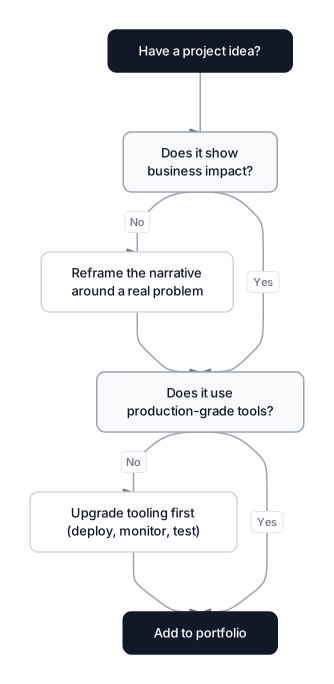 Click to expandProject selection decision tree for choosing what to build next
The Storytelling Formula That Works
Every project in your portfolio needs to answer four questions, in this order:
Problem. What is the business or domain problem you're solving? Not "I wanted to learn RAG." Rather: "E-commerce customer support teams spend 40% of their time answering questions already answered in the product documentation. I built a system to route those queries automatically." A specific, relatable problem makes the reader care before they've read a line of code.
Approach. What did you build, and why did you make the choices you made? The choices are the interesting part. Why LlamaIndex over LangChain for this retrieval problem? Why Mistral-7B over Llama-3.1-8B? Why did you chunk at 512 tokens instead of 256? These decisions reveal engineering judgment. If you made the obvious choice without considering alternatives, say that — "I chose FAISS for its simplicity given the dataset size of 15K documents; Pinecone would be warranted above 1M." That's a more impressive sentence than "I used FAISS."
Result. What does the system do? Show it. A live demo is worth ten screenshots. Screenshots are worth ten paragraphs of description. Give the reader something to interact with.
Measured impact. What's the number? Not "the model works well" — the number. Retrieval precision went from 0.61 to 0.84 after adding a cross-encoder reranker. Inference latency dropped from 340ms to 92ms p95 after quantization. The fine-tuned model achieved 89% accuracy vs. 67% for the base model. The monitoring dashboard detected synthetic drift within 48 hours of injection with zero false positives in the two weeks prior.
These four elements take about 150-200 words in a README. They're the difference between a repo that gets read and one that gets closed.
GitHub Profile Optimization
Your GitHub profile is a storefront, not a file cabinet. The first thing most hiring managers see is your profile page — your pinned repos, your contribution graph, and your profile README. These get about 20 seconds of attention.
Pinned repos. You can pin up to six. Use this aggressively. Pin your three to five best projects. If you have older repos from courses or tutorials, unpin them even if they have more stars. A pinned Titanic notebook tells the hiring manager what to think about you more loudly than any cover letter.
Profile README. GitHub supports a special username/username repo that displays as your profile README. Keep it brief: one sentence on what you're building, links to your three best projects with one-line descriptions, and your contact/personal site. Many strong candidates skip this entirely — doing it at all puts you ahead.
Commit history. A contribution graph that's mostly empty with occasional dense spikes looks like coursework dumps. Small, consistent commits over months signal actual engineering work. When you're building a portfolio project, commit every meaningful step: data loading, baseline model, evaluation harness, deployment configuration, monitoring setup. This is also just good engineering practice.
Repository hygiene. Every portfolio repo needs a requirements.txt or environment.yml, a .gitignore, and a README with at minimum: what it does, how to run it, and what results it produces. Code should run without modifications. If a hiring manager clones your repo and it fails in three commands, the review is over.
Pro Tip: Add a docs/ folder or a GitHub Pages site to at least one project with proper technical documentation. It takes a few hours and signals professional-grade engineering. Most candidates don't do it.
Where to Host and Present Your Work
You need at least one live, interactive demo. Here's the honest comparison:
| Platform | Best For | Cost | Limitations |
|---|---|---|---|
| Hugging Face Spaces | ML demos, model inference, LLM apps | Free (CPU tier) | Free tier sleeps after inactivity |
| Streamlit Community Cloud | Python apps with rich UI | Free | Limited resources, public repos only for free tier |
| Railway | FastAPI services, full-stack apps | 30-day trial, then $5/month | Easiest non-HF option for APIs |
| Render | Docker containers, REST APIs | Free tier, sleeps | Good for MLOps demos |
| Personal site (Vercel + Next.js) | Portfolio hub, project showcase | Free | Requires frontend work |
For most ML portfolio projects, Hugging Face Spaces with Streamlit is the easiest path to a working public demo. The free CPU tier provides 2 vCPUs and 16GB RAM. For the MLOps drift monitoring project, Railway or Render are better fits because you need persistent services. For the real-time inference project, deploying a FastAPI container to Cloud Run or Railway gives you a real API endpoint you can link to.
A personal website isn't mandatory, but it pays off at the senior-engineer level. Keep it minimal: project descriptions with links, a one-paragraph bio, contact information. The site itself isn't the portfolio — the projects are. Don't spend three weeks building a portfolio site when you could spend three weeks building the projects themselves.
The Signal vs. Noise Test
The actual question a hiring manager asks isn't "is this impressive?" — it's "does this tell me anything?" A repo can be technically solid and still communicate nothing useful about the candidate.
High-signal signals:
- Production deployment with a live URL
- Benchmarks with real numbers (latency, accuracy, throughput)
- A README that explains trade-offs, not just decisions
- Honest evaluation including failure analysis
- Version history that shows a real development arc
Low-signal signals:
- High accuracy on well-known benchmark datasets
- Long lists of libraries in the README without explaining why they were chosen
- A notebook that produces a chart with no explanation of what it means
- Star counts from sharing in data science Discord servers (stars are vanity metrics)
- A README that reads like documentation from the library you used
A repo with 300 stars and an empty README tells a hiring manager: this person knows how to market to the data science community. A repo with 3 stars, a clear problem statement, honest evaluation metrics, and a working demo tells a hiring manager: this person knows how to build things. The 3-star repo gets the callback.
Common Mistake: Copying the README structure from popular ML libraries: "Installation," "Usage," "Contributing," "License." That format is designed for open-source libraries consumed by developers, not for portfolio projects evaluated by hiring managers. Your README should lead with the problem and the result, not with pip install.
When to Apply vs. When to Keep Building
This is the question that gets people stuck for months. Here's a direct answer:
Apply now if:
- You have two or three projects from the list above (even if imperfect) with live demos
- Your GitHub has consistent commit history over the past 3+ months
- You can explain every line in your projects and the reasoning behind every choice
- Your projects cover at least two of the five categories above
Keep building if:
- Your only projects are tutorial reproductions with no customization
- Your most recent commit was more than 6 weeks ago
- You can't answer "what would you change if you had another week?" for any of your projects
- Every project uses the exact same stack (notebooks, sklearn, matplotlib — nothing deployed)
The honest reality is that most job searches take 8-16 weeks even with a strong portfolio. Starting to apply while you're building your third project is the right move — early applications produce useful feedback about what skills interviewers are actually asking about, which informs what you build next.
Pro Tip: Once you have two solid projects, start applying and continue building simultaneously. An interview at week 4 of your job search that goes to a take-home assessment is useful signal even if you don't get the offer. Use it to find out what's missing.
Common Mistakes Worth Naming Explicitly
"I'll add the README later." Later doesn't come. Write the README before you write the first line of code. Start with the problem statement and what success looks like. Then build. The README acts as your spec, and the discipline of writing it first makes the code better.
Building what's interesting to you, not what proves what you know. If you want to demonstrate production ML skills but spend three months on a generative art project, you've spent three months not demonstrating production ML skills. This isn't a creativity contest. It's a skills demonstration.
Over-polishing one project at the expense of coverage. A single 10/10 project is weaker than two 8/10 projects that cover different skills. Breadth of coverage matters in the initial screen. Depth matters in the interview.
No unit tests, no CI. Even two tests that verify your data preprocessing doesn't produce NaN values and that your model API returns valid JSON tells a hiring manager you write testable code. Most candidates have zero tests. Adding any at all is a meaningful signal.
Pushing personal projects to your work account or vice versa. Keep your portfolio GitHub separate and clearly personal. Hiring managers sometimes do look at commit timestamps. Commits to your personal portfolio during work hours at your current employer is a detail worth avoiding.
Conclusion
The gap between a portfolio that gets ignored and one that gets callbacks is usually not about technical sophistication. It's about specificity, deployment, and business framing. You don't need a novel algorithm. You need three projects that a hiring manager can understand in 40 seconds, interact with in 30 more, and feel confident recommending for an interview.
Start with the RAG pipeline — it's the most immediately applicable to current hiring, it covers the most skills in a single project, and it's genuinely useful to have running even after you've landed the job. Then add the MLOps project for companies with mature ML platforms. Then the real-time inference project for any company where latency matters. Each project you add to this list doesn't just improve your portfolio — it improves your ability to have technical conversations in interviews, because you've actually built the thing being discussed.
For the technical foundations behind these projects, our RAG deep-dive is the most thorough single resource on building production-quality retrieval systems. If you're working on the AI engineer path more broadly, the AI Engineer Roadmap for 2026 covers the complete skill stack and what companies expect at each experience level. And when you're ready to prepare for the actual interviews, the LLM and Agentic AI Interview Questions guide covers the technical questions that come up in nearly every AI/ML system design round.
Build something specific. Deploy it. Write the README like you're explaining it to a skeptical senior engineer. Then apply.
Career Q&A
How many projects do I actually need before I start applying? Two is enough to start. You need enough to demonstrate breadth — at least two different skill areas — and enough to fill a technical conversation. The mistake most people make is waiting for five or six projects before applying, which costs months. Apply with two solid projects while building your third. Early rejections give you signal about what's missing.
My current portfolio is mostly Kaggle and course projects. Should I delete them? Unpin them, don't delete. Your pinned repos are your storefront — only your best, most relevant work should appear there. Keep the old projects because they show your learning arc and some interviewers do scroll down. But they should never be the first thing a hiring manager sees.
Does my GitHub star count matter? Not directly. Stars measure social media performance in data science communities, not engineering quality. A project can have 500 stars because you posted it to Reddit with a compelling title, and it can still be a shallow notebook. What matters to hiring managers is the quality of the README, the existence of a live demo, and the evidence of real engineering decisions. Focus on those.
Should I contribute to open source projects instead of building my own? Both, but open source contributions complement original projects — they don't replace them. A merged pull request to a popular ML library (LangChain, Evidently, Hugging Face transformers) shows you can work in existing codebases and communicate with maintainers. Original projects show you can define and solve a problem. Senior roles look for both. If forced to choose, build original projects first and contribute to open source once your portfolio is strong.
How do I present portfolio projects during phone screens? Use the problem-approach-result-impact formula every time. Start with the problem in one sentence, your key technical decisions in two sentences, and the result in one number. Keep it to 90 seconds. Then stop and let the interviewer ask questions. The mistake is starting with the dataset or the library stack — start with the business problem.
I got ghosted after sharing my portfolio link. What went wrong? Usually one of three things: the README doesn't communicate the problem clearly in the first paragraph, there's no live demo or working output, or the project choice signals table-stakes skills (MNIST, Titanic, Iris). Review each pinned repo from the perspective of someone seeing it for the first time. If you can't explain what it does and why it matters in 30 seconds of reading, rewrite the README before the next application.
How long does it realistically take to go from a weak portfolio to one that gets callbacks? Six to ten weeks of serious part-time effort. One RAG project with evaluation metrics and a working Hugging Face Space takes three to four weeks if you're building something nontrivial. Add a FastAPI inference service with benchmarks: another two to three weeks. The MLOps project adds another two to three. That's a complete, differentiated portfolio. The constraint is usually motivation, not time.
Sources
- LinkedIn Jobs on the Rise 2026: The 25 Fastest-Growing Roles in the U.S. (Jan 2026)
- LinkedIn Skills on the Rise 2026 (Feb 2026)
- AI-related Jobs Top LinkedIn's Fastest-Growing Roles List for 2026 — Dice.com (Jan 2026)
- AI Has Already Added 1.3 Million Jobs, LinkedIn Data Says — World Economic Forum (Jan 2026)
- ML Engineer Portfolio Projects That Will Get You Hired in 2025 — Santosh Rout, Medium (Nov 2025)
- Signal vs. Noise: What Actually Gets You Rejected in ML Interviews — InterviewNode (2025)
- ML Serving and Monitoring with FastAPI and Evidently — EvidentlyAI Blog (2025)
- Hugging Face PEFT: Parameter-Efficient Fine-Tuning (2025)
- Edge AI: TensorFlow Lite vs. ONNX Runtime vs. PyTorch Mobile — DZone (2025)
- Using GitHub as a Portfolio When Applying for Jobs — GitHub Community Discussion (2025)
- The Ultimate Guide to Building a Machine Learning Portfolio — Machine Learning Mastery (2025)
- 7 Best Free Platforms to Host Machine Learning Models — KDnuggets (2025)