
Most people believe management is the only path to real money in tech. It's one of the most persistent myths in engineering careers — and Levels.fyi data from 2025 demolishes it in a single row.
At Google, the median total compensation for an L6 Staff Engineer is $579,576.
The Engineering Manager at the same L6 level earns a median of $590,551 — a gap of roughly eleven thousand dollars on a half-million-dollar package. For all practical purposes, they're identical: same salary band, same equity treatment, same bonus structure.
You don't have to become a manager to earn manager money. But the decision you make at the senior level has consequences that last years, and the cost of choosing wrong is not symmetric.
The Myth That Management Equals Money
It made sense in a different era. Before tech companies built proper IC ladders, the only way to get promoted past senior engineer was to start managing people. The title change came with a comp bump that confirmed the narrative: management is advancement, IC is stagnation.
That structure is largely gone at major tech companies, but the cultural memory hasn't faded. Engineers still feel pressure to "step up" to management as proof they've grown. Skip-level managers still ask senior ICs when they plan to take on people leadership. The mythology persists even as the compensation data tells a different story.
The reality is that most FAANG-tier companies introduced parallel IC and management tracks precisely to retain their best technical contributors. L6/E6 at Google and Meta is a Staff Engineer on the IC track or an Engineering Manager on the management track. The level is the same. The pay band is the same. The prestige, in the eyes of the company, is the same.
Compensation Structures at FAANG: What the Data Shows
The clearest way to see this is to compare equivalent levels directly.
Google: An L6 Staff Engineer earns a median $579,576 total compensation. The L6 Engineering Manager lands at a median of $590,551 (Levels.fyi, March 2026, US submissions) — essentially the same number. At L7, the gap opens slightly in favor of the management track in base salary, but equity grants can tip it back toward IC.
Meta: An E6 Staff Engineer carries a median total compensation of $774,997. Meta's Engineering Manager comp at equivalent levels has a broader reported range partly because management titles don't map cleanly to E-levels in public databases, but senior EM packages at Meta fall in the $700K to $900K range for comparable seniority.
Amazon: The IC and management tracks converge at the top levels, just as they do at Google. Amazon's Principal SDE (L7 IC) earns a median $653,817. The Senior SDM (L7 management) — the correct peer comparison, since both carry the L7 designation — shows a median of $651,147 (Levels.fyi, March 2026). The two tracks are within $3,000 of each other. The L6 SDM is a lower level entirely — the apples-to-apples comparison at L7 shows the same parity seen at Google.
Netflix: The company famously doesn't use traditional levels, but compensation data is instructive. L6 engineers earn a median $727,500; L7 earns a median of $1,148,340. Netflix's Software Engineering Manager roles show a range of $670K to $1.2M TC (Levels.fyi, March 2026). Again, the top of the IC range matches or exceeds management.
| Company | IC Level | IC Median TC | Manager Equivalent TC |
|---|---|---|---|
| L6 Staff | $580K | $591K (L6 EM) | |
| Meta | E6 Staff | $775K | $700K-$900K (EM) |
| Amazon | L7 Principal | $654K | $651K (L7 Senior SDM) |
| Netflix | L6 | $728K | $670K-$1.2M (SEM) |
| OpenAI | L5 | $1.09M | Not published separately |
Source: Levels.fyi, Q1 2026 US submissions
Key Insight: The "management premium" exists in aggregate salary surveys because they don't control for level. When you compare L6 IC to L6 EM — the same band — parity is the rule, not the exception. Amazon illustrates this especially clearly: once you align levels correctly, the gap disappears.
The AI/ML Premium That Changes the Calculation
If you're a data scientist or ML engineer rather than a general software engineer, the calculus favors the IC track even more strongly right now.
Levels.fyi's Q3 2025 AI Engineer Compensation Trends report shows that Staff-level AI specialists earn 18.7% more than their non-AI peers in 2025, up from 15.8% in 2024. The premium is growing, not shrinking.
At Intuit, the disparity at the Staff level is stark. A Staff ML Engineer's reported range reaches toward $948K at the high end on Levels.fyi, while the median Staff Software Engineer (non-AI) at Intuit sits around $338,932. That's not a small AI premium. That's a different compensation universe.
OpenAI's L5 engineers have a median total compensation of $1,094,250. That's a role that spans the senior-to-staff boundary at a specialized AI company. The L6 median lands at approximately $1.24 million. These are numbers that no management track, at any traditional tech company, gets close to matching at equivalent seniority.
The market is signaling something specific: senior technical expertise in AI and ML is scarce and valued at a premium that compounds as you move up the IC ladder. Moving into management means trading out of the specialization premium at exactly the moment it's accelerating.
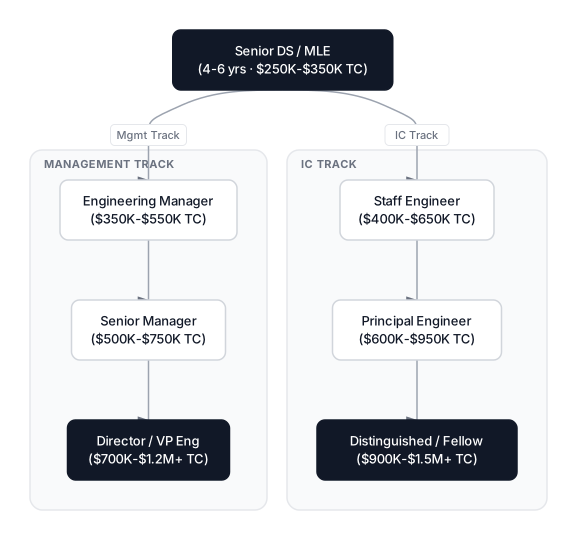 Click to expandIC vs Management career path branching from senior engineer level
What Tuesday Actually Looks Like on Each Track
Compensation parity at the level doesn't mean the jobs are similar. They're different in almost every dimension that matters for day-to-day satisfaction.
Staff Engineer, Tuesday: You spend the morning in a design review for an ML pipeline you're architecting. You wrote the technical spec, and two other teams are building against it. After lunch, you do a deep-dive code review on a prototype from a junior engineer, leaving detailed comments that amount to a mini-tutorial on distributed feature stores. Mid-afternoon is a calibration meeting where you're a technical voice on promotion cases. Late afternoon you write. Maybe it's documentation, maybe an internal post-mortem on a model degradation issue you diagnosed last week. The work is mostly self-directed. No one is managing your time.
Engineering Manager, Tuesday: You start with a 1:1 with an engineer who's struggling on a project. The real issue is interpersonal — they have friction with a partner team — and you spend 40 minutes navigating that. Then a project status sync that's more alignment meeting than technical discussion. Lunch with a PM to understand upcoming roadmap priorities. Afternoon: writing performance reviews, because it's the week before calibration. An hour triaging recruiting pipeline tasks. A quick escalation to resolve a blocked dependency. You don't write a single line of code.
Neither day is bad. But they're completely different jobs. Engineers who take management roles expecting to keep the technical identity often find themselves in crisis around month eight, when the realization hits that their "management role" is actually a full-time people operations job.
Common Mistake: Assuming a technical lead or "player-coach" manager role stays technical. At most companies above 50 engineers, the player-coach model collapses under headcount growth. The management responsibilities scale; the coding time doesn't.
The Irreversibility Problem
This is the part of the IC vs. manager conversation that almost nobody talks about directly.
When you become an engineering manager, your technical skills start to atrophy. Not hypothetically — structurally. You stop writing production code. You stop designing systems from scratch. You stop staying current on the evolving tooling. The Stack Overflow blog documented this clearly: many managers "do not continue to code," and "engineers who pride themselves on the depth of their technical expertise may find this especially challenging." The article's author, a former startup CTO, describes eventually having to let go of coding on nights and weekends as management consumed his time.
For ML engineers and data scientists, the atrophy is accelerated because the field moves faster than almost any other engineering discipline. A two-year gap in hands-on LLM engineering or production ML systems work in 2024-2026 is enormous. The tooling, the deployment patterns, the fine-tuning approaches, the agent frameworks — they've all changed substantially.
This means the "management-to-IC return" isn't just a career pivot. It's closer to a re-entry. Most engineers who return to IC roles after two or more years in management describe the transition as 12 to 24 months of rebuilding credibility and catching up on technical fundamentals. You come back junior relative to the people who kept building while you were running performance cycles.
The asymmetry matters: going from IC to management takes weeks. The return trip takes years.
Worth Knowing: Some companies (notably Google and Meta) have explicit "return to IC" processes for managers who want to revert. But even with institutional support, the technical re-entry clock starts at zero. Your management experience gives you soft skills and organizational context, not up-to-date ML engineering skills.
The Staff Engineer Ladder: How to Climb Without a Manager Title
Staff Engineer is not a single destination. It's the beginning of a separate progression that goes as deep as the IC track goes.
At most FAANG companies, the IC ladder above senior looks like this:
-
Staff Engineer (L6/E6): Cross-team technical leadership. You own a technical area, not just a project. You influence engineering decisions beyond your immediate team. Your scope is roughly equivalent to a manager with 8-15 direct reports.
-
Senior Staff / Principal Engineer (L7/E7): Org-wide or division-wide technical influence. You set technical direction that multiple teams build against. You're involved in hiring bars, architecture decisions, and sometimes external technical representation (papers, talks, open-source). Google calls this L7. Meta calls it E7. The compensation jumps significantly here.
-
Distinguished Engineer / Fellow (L8+/E9): Fewer than a few hundred people in the world hold these titles at major tech companies. Company-wide or industry-wide influence. Multi-year strategic bets. The comp at this level at companies like Google and Meta is routinely $1M+ TC.
In AI and ML, the path to Principal carries an additional premium because the population of people who can do this work at the depth required is genuinely small. A Principal ML Engineer at a company working on large-scale model infrastructure is solving problems that don't have reference implementations anywhere. That scarcity shows up in the comp.
The practical question for a senior DS or MLE is: what does it take to get to Staff? The promotion from senior to staff is usually the hardest in the IC ladder. It requires demonstrating impact beyond your team, which means:
- Technical leadership on a project that spans two or more teams
- Architectural decisions with multi-year consequences
- Mentorship that's measurable: junior engineers you worked with got promoted
- Technical credibility outside your immediate org (internal talks, design documents that got adopted)
None of that requires a manager title. All of it requires staying hands-on.
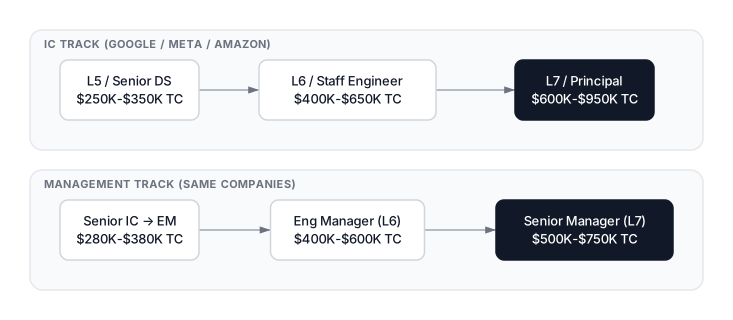 Click to expandCompensation comparison IC vs Management across levels at FAANG
Who Should Choose Management
With compensation parity established and the reversibility problem on the table, why would anyone choose management? A lot of people should, actually — but for the right reasons.
Management is the right choice when:
You find the people problems more interesting than the technical problems. Not occasionally — consistently. If you spend your 1:1s with junior engineers thinking about how to help them grow and leave those conversations energized rather than drained, that's a genuine signal. Some people are wired for it.
You want organizational scale, not technical depth. The engineering manager track leads to Director and VP roles where you're shaping team structures, setting strategy, and influencing company direction. If that's what you actually want — genuine people leadership and organizational authority — the IC track is a dead end for you. Staff engineers do not have headcount authority. They have technical influence, which is real but different.
You're at a company where the IC ladder isn't real. Many companies beyond the top 30 in tech have manager titles that pay more than IC titles at equivalent seniority because they never built a credible Staff/Principal ladder. If you're at a company where "Staff Engineer" is a title given as a consolation prize to senior engineers who don't manage, management is legitimately the path to higher comp.
Your technical skills are not your competitive differentiator. This is uncomfortable to say, but it matters. If you're a solid senior engineer but not a genuinely exceptional technical contributor, the IC ladder becomes difficult above Staff. Management offers a different vector for advancement where interpersonal skill and organizational judgment matter as much as technical depth.
Stay on the IC track when:
You are genuinely exceptional at building things. Not self-assessed — evidenced by the fact that other engineers come to you for architectural direction and your technical judgments have been consistently correct in production. Exceptional ICs often don't self-identify as exceptional because they're always measuring themselves against the next level up.
The thought of running performance reviews, navigating team conflict, and managing headcount makes you genuinely uneasy. That's not weakness. That's self-knowledge. Engineering management is a hard job that's hard in a specific way. Reluctant managers make bad managers.
You're in AI/ML right now. The premium on senior IC AI/ML skills is at a multi-year high. The market is specifically paying for deep technical expertise in ML systems, model training, inference optimization, and production AI infrastructure. The time to cash in on a scarce skill is while the premium exists.
You want to stay technical through your career. Some people in their late 30s and 40s look at Staff and Principal engineers and see people who still love building things. Some look at Directors and VPs and see people who've found a different kind of meaning. Know which one you're looking at.
Figuring Out What Your Company Actually Supports
Compensation parity at Google or Meta doesn't automatically transfer to your employer. The most important career decision you can make right now is to assess whether your company has a real IC ladder or a nominal one.
Ask your manager directly:
- "Who is the most senior IC in the company? What level are they at and what does their scope look like?"
- "Have any Staff or Principal engineers been promoted in the last two years? What did they do to get there?"
- "Is there a documented career ladder that defines what Staff Engineer looks like at this company?"
- "When engineers here get promoted past senior, does it typically happen on the IC track or the management track?"
The answers tell you more than any publicly available benchmark. If your manager can't name a recent Staff promotion on the IC track, the IC ladder is probably theoretical at your company. If the Senior Staff Engineer has been at the same level for five years, there's a ceiling.
At companies where the IC ladder is underdeveloped, management genuinely is the path to higher comp — not because of any policy, but because the structural support for IC advancement doesn't exist. That's a separate problem, but it's a real one.
Pro Tip: If you're at a company with a weak IC ladder and you want to stay on the IC track, consider whether this is the right company for that goal. Moving to a company with a real Staff+ ladder is often faster than trying to build one from the inside.
Decision Framework: The Three Questions
Before making the IC/manager decision, get clear answers to three questions:
1. What kind of work makes you lose track of time? Design documents and architecture reviews, or 1:1s and team calibration discussions? There's no right answer, but the answer matters enormously for whether you'll be good at the job three years in.
2. Where is your company's comp ceiling for each track? Check Levels.fyi for your specific company. Look at the actual Staff and Principal comp data. Look at the EM and Senior Manager comp data. If there's a meaningful gap favoring management at your company, that's real information. If they're equivalent, the technical track preserves more options.
3. Can you actually return if you change your mind? This deserves a direct conversation with your manager and your skip. Get specifics: "If I take on this management role and decide in two years I want to return to IC, what does that process look like here? Has it happened?" Vague reassurances are not reassurances. Specific examples of people who've done it are.
Conclusion
The compensation myth is the easiest part to settle. At Google, Meta, Amazon, and Netflix, Staff-level ICs and Engineering Managers occupy the same pay band. The data from Levels.fyi in 2026 is consistent: parity is the rule at L6/E6 equivalents and at L7 equivalents — once you align the levels correctly, the IC vs. management gap shrinks to near zero. In ML and AI roles, the IC specialization premium pushes things further in favor of the technical track.
The harder question is the reversibility one. Going IC to management takes an afternoon of calendar changes. The return trip takes two years of technical rebuilding. That asymmetry should be the primary factor in your decision, not comp projections.
If you're a senior DS or MLE who's genuinely good at building things and not yet certain that people leadership is where you want to spend your working hours, the IC track deserves serious consideration as a first-class option, not a fallback.
For deeper reading on the technical skills that keep IC careers advancing, see the machine learning fundamentals and production ML systems content on LDS. If you're evaluating a management offer alongside the salary data here, the data scientist salary guide covers the broader compensation picture with percentile breakdowns.
Career Q&A
When is the "right" time to make the IC vs. manager choice?
The fork typically becomes real at 5 to 7 years of experience, when a senior engineer is ready for promotion. Before that, the choice is somewhat abstract. After that, the window for a clean IC track to Staff starts narrowing if you take on management responsibilities without a clear plan to return. If you're at that fork now and genuinely unsure, default to staying IC for 12 more months while you build Staff-level scope. You can always make the management move later; rebuilding technical credibility is harder.
My manager is pushing me toward management. How do I push back without damaging my relationship?
Be direct and positive rather than defensive. "I appreciate the confidence — I'm genuinely interested in growing my impact. Right now I think I create more value staying technical and building toward Staff. I'd like to revisit this in 12 months if the company's IC ladder supports it." That frames your choice as forward-looking rather than reluctant, and it invites a real conversation about whether the IC ladder at your company can actually support that growth.
Can I negotiate differently if offered a management role versus an IC promotion?
Yes, and you should. Management roles often have more flexibility on base salary (companies sometimes pay a small base premium to attract reluctant managers). IC promotions at FAANG tend to come with larger equity refresh grants. When negotiating a management offer, push on the base if you're leaving a higher-paying IC band. When negotiating a Staff IC promotion, the equity refresh is the primary lever — ask specifically about the refresh schedule and size, not just the new total comp figure.
How do I build Staff-level scope without a manager title?
Identify a technical problem that spans two or more teams and propose to own it. Write the design document. Run the technical review. Drive the implementation. The mechanism is less important than the outcome: you need evidence that your technical judgment shaped something that multiple teams built against. One clear example of that — written up in a brag document that your manager can take into calibration — is worth more than three years of strong execution on single-team projects.
If I've been a manager for 18 months and want to return to IC, what's realistic?
Honest answer: the re-entry is real work. At 18 months, your core skills are probably intact but noticeably rusty. Start shipping code on side projects immediately — not toy code, production-quality work you'd be comfortable showing a technical interviewer. At 18 months out you can likely re-enter at senior level at a top company. Getting back to Staff after a management stint typically takes an additional 18 to 24 months of strong IC performance. The return is possible; it just doesn't happen automatically.
Does the AI specialization premium apply to managers who manage AI teams?
Partially. Engineering managers who lead ML infrastructure or AI research teams do command a premium over general EMs, but it's much smaller than the IC premium. The premium in AI/ML is specifically on people who can do the technical work at depth — architecture, training, optimization, debugging production model failures. A manager who can describe these things is not the same as a Staff engineer who can do them. If you have genuine AI/ML technical depth, staying IC preserves the full premium.
What's the one question to ask in an interview to gauge a company's IC ladder quality?
"Can you tell me about someone at the Staff or Principal level here who was promoted in the last 18 months? What kind of work did they do to get there?" The specificity and confidence in the answer tells you everything. Companies with real IC ladders can answer this immediately with names and examples. Companies with nominal IC ladders get vague, or give you an example from three years ago.
Sources
- Levels.fyi Google L6 Software Engineer Salary (March 2026)
- Levels.fyi Google Manager (L6) Software Engineering Manager Salary — United States (March 2026)
- Levels.fyi Meta E6 Software Engineer Salary (March 2026)
- Levels.fyi Amazon Principal SDE Salary (March 2026)
- Levels.fyi Amazon Senior SDM Software Engineering Manager Salary (March 2026)
- Levels.fyi Netflix L6 Software Engineer Salary (March 2026)
- Levels.fyi Netflix L7 Software Engineer Salary (March 2026)
- Levels.fyi Netflix Software Engineering Manager Salary (March 2026)
- Levels.fyi OpenAI L5 Software Engineer Salary — United States (March 2026)
- Levels.fyi OpenAI L6 Software Engineer Salary (March 2026)
- Levels.fyi Intuit Machine Learning Engineer Salary (March 2026)
- Levels.fyi Intuit Staff Software Engineer Salary (March 2026)
- AI Engineer Compensation Trends Q3 2025 (Levels.fyi, October 2025)
- End of Year Pay Report 2025 (Levels.fyi, January 2026)
- What you give up when moving into engineering management (Stack Overflow Blog, Feb 2022)
- 2024 Stack Overflow Developer Survey — Professional Developers (Stack Overflow, Jun 2024)
- Staff Engineer vs Engineering Manager — Alex Ewerlöf Notes (2024)