
The companies laying off the most people right now are the same ones announcing the biggest AI investments in history. Meta is reportedly planning cuts of up to 15,800 roles — roughly 20% of its entire workforce — while simultaneously committing up to $135 billion in AI capital expenditure for 2026. Amazon has cut 30,000 corporate jobs since October 2025. Salesforce, Workday, and Block have all announced significant reductions in recent months. And yet: demand for LLM and AI engineering skills has grown over 300% since 2023 per multiple labor market reports, the BLS projects data scientist employment will grow 34% by 2034, and tech companies cannot hire AI engineers fast enough to meet demand.
This is not a contradiction. Once you see what's actually being cut versus what's actually being built, the pattern becomes clear — and for the right practitioners, it points toward a more durable career than the one that existed before the restructuring started.
The Q1 2026 Layoff Wave
The pace of Q1 2026 layoffs has been striking. As of mid-March, 55,775 tech workers had lost jobs in the first 74 days of the year — roughly 736 per day — across 171 companies, according to layoffs.fyi tracking data. Of the approximately 45,000 confirmed cuts where reasons were stated publicly, 9,238 (20.4%) were explicitly attributed to AI and automation by the companies themselves.
The stock market's reaction to the Meta news — shares up 3% on reports of mass layoffs — tells you everything about how investors are reading these moves. Cost cuts plus AI investment is the formula Wall Street is rewarding in 2026.
What the Cuts Are Actually Targeting
The layoffs look indiscriminate from the outside. They are not.
Across Amazon, Salesforce, Microsoft, and Workday, the cuts are concentrated in three categories: middle management layers that accumulated during 2020-2022 hypergrowth, customer support and operations roles where AI agents now handle 60–80% of inbound volume, and QA and testing functions where AI-generated test suites have reduced the need for dedicated manual testers.
Key Insight: Amazon's policy now requires managers to carry at least eight direct reports, up from roughly six. The company is not trying to shrink — it's trying to remove the coordination overhead that grew when headcount was expanding 30% per year and humans needed to manage other humans. AI tools reduce that overhead.
At Meta, the specific teams absorbing cuts follow a similar logic. Reality Labs lost ~1,500 roles in January 2026 — roughly 10% of the division — as the VR/AR bet deemphasizes traditional product development. The research unit FAIR saw ~600 positions eliminated in October 2025 as part of the same pivot toward AGI-focused teams. The common thread: roles that produced outputs that AI systems can now replicate at lower cost, or roles that existed to coordinate work AI now handles autonomously.
What is not being cut, at every company running these layoffs: ML infrastructure engineers, LLM product engineers, MLOps specialists, AI safety researchers, and data scientists embedded in the AI product teams. The demand signal for those roles, measured in job postings and compensation, has moved in the opposite direction.
The AI Capex Paradox
Meta's $72.22 billion capex in 2025 already dwarfed anything in the company's history. The 2026 guidance of $115 to $135 billion — disclosed in the Q4 2025 earnings call with CFO Susan Li describing Meta as "capacity constrained" — nearly doubles it. That money goes into GPU clusters, data centers, power infrastructure, and the engineering teams required to run them.
This is the paradox: to spend $135 billion effectively on AI infrastructure, you need far fewer general-purpose software engineers and program managers than you did to build social media features in 2019. But you need many more ML infrastructure engineers, model evaluation specialists, and distributed systems engineers than you have. The investment creates a skills mismatch, not a headcount shortage.
The same dynamic applies at Amazon. AWS is building out AI training infrastructure at a scale that requires enormous capital and a specific type of engineer. The 30,000 corporate cuts are financing, in part, the hiring of the people who will run those systems.
Worth Knowing: Meta stock rose on layoff reports partly because analysts could do the arithmetic: 15,000 roles at an average all-in cost of $350,000 per year equals roughly $5 billion in annual savings. At a 20x earnings multiple, that's $100 billion in market cap created by cutting headcount — a math that will encourage more of this behavior across the industry.
The Roles That Are Growing
The headline layoff number obscures the hiring happening simultaneously. LinkedIn's Economic Graph data shows AI has added over 1.3 million jobs globally, with specialized skills like LLM engineering seeing demand grow over 300% since 2023. AI and ML now rank among the fastest-growing hiring categories on the platform, with AI engineer postings rising faster than any other software role through 2025.
The specific roles seeing the most demand:
LLM Engineers and AI Product Builders. Companies need engineers who can build with foundation models: RAG pipelines, agent orchestration, fine-tuning workflows. These roles sit at the intersection of software engineering and ML, and they command premiums. The average LLM engineer salary hit approximately $206,000 in 2025, a jump of nearly $50,000 from the prior year (Rise AI Talent Report, 2026).
MLOps Specialists. Every company running AI in production needs the infrastructure to monitor, retrain, and deploy models reliably. MLOps roles range from $160,000 to $350,000 in total compensation at companies running AI at scale, per Signify Technology's 2026 ML salary benchmarks.
AI Safety Researchers. Demand here is narrower but compensation is exceptional: AI safety and alignment specialists have seen a 45% salary increase since 2023. The supply of credentialed people is thin.
Data Scientists at Non-Tech Verticals. This is the largest volume opportunity and the most underappreciated. Healthcare AI, financial risk modeling, manufacturing predictive maintenance, and energy grid optimization are all adding DS headcount aggressively. Financial services and manufacturing each approached 100,000 active ML-related roles in 2025, per Robert Half's technology hiring report.
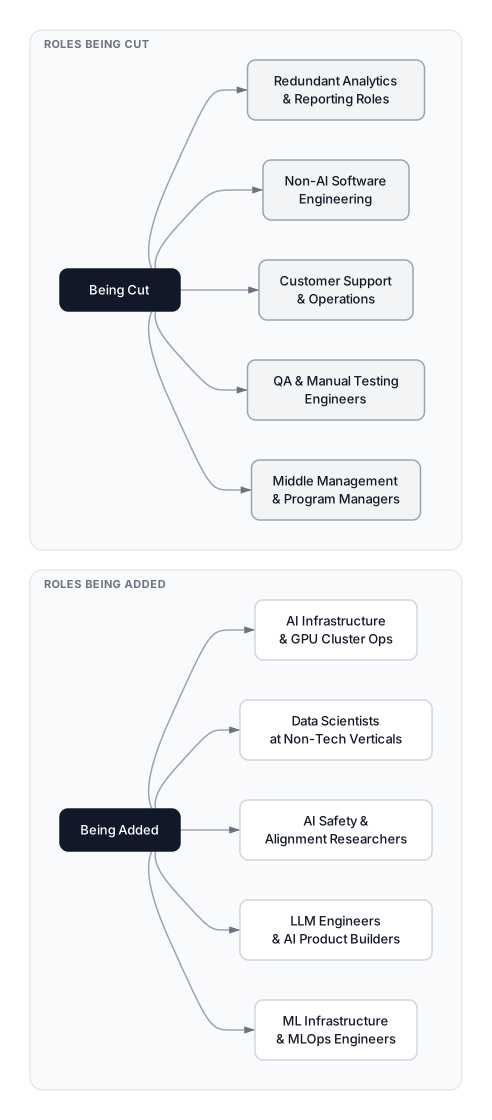 Click to expandRoles Being Cut vs. Roles Being Added in 2026
Where the Non-Tech Industry Demand Is
The narrative around tech layoffs focuses almost entirely on Silicon Valley. But the geography of DS hiring has shifted significantly since 2022, and that shift is where the absorption happens.
Healthcare is the single largest growth sector. Clinical AI — model-assisted diagnosis, imaging analysis, patient outcome prediction — requires domain-fluent data scientists who can work with messy EHR data and communicate with clinicians. Job postings in healthcare AI grew faster than any other sector in 2025, per Phaidon International's 2026 ML hiring analysis.
Finance has always needed quants, but the current demand is specifically for ML engineers who can build real-time fraud detection, credit risk models, and algorithmic trading systems that meet regulatory standards. Banks and hedge funds are paying $180,000 to $250,000+ for senior ML practitioners, often above FAANG base compensation (though without the equity upside).
Manufacturing and energy are less glamorous but increasingly active. Predictive maintenance models running on sensor data from factory floors or power grids are a genuine ML problem with meaningful economic impact. These roles are mostly outside coastal tech hubs, which means lower cost of living and less competition.
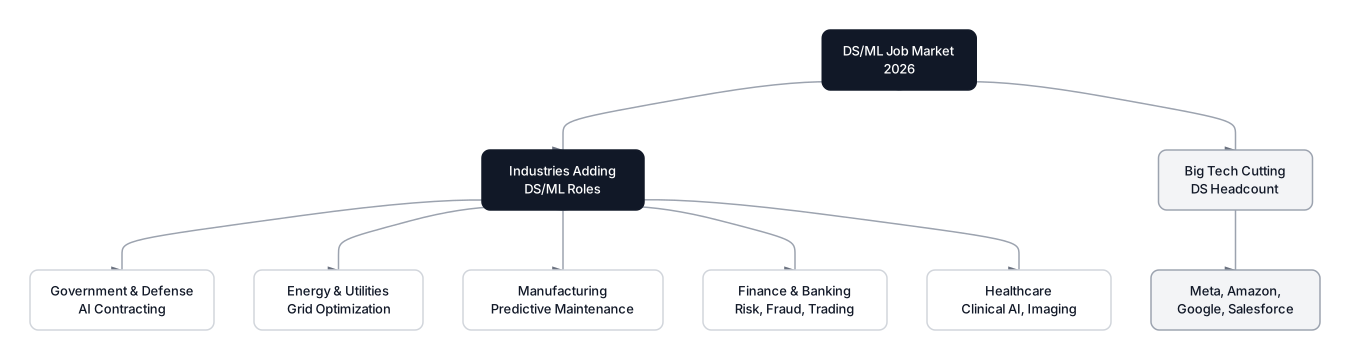 Click to expandWhere DS and ML Hiring Is Growing in 2026
What Happened to the 2022-2023 Layoff Cohort
The current wave has historical precedent. Between 2022 and 2023, roughly 427,000 tech workers were laid off globally — approximately 165,000 in 2022 and 262,000 in 2023 across 1,193 companies in 2023 alone (Layoffs.fyi, TechCrunch archive). The question that matters for practitioners in 2026 is: how long did reemployment take, and what happened to the cohort?
The early 2022 data was relatively encouraging. ZipRecruiter research from that period found 79% of laid-off tech workers found a new position within three months. That figure deteriorated significantly as the wave deepened. By March 2023, only 39% of laid-off data scientists had started new jobs, compared to 47% of UX designers and 52% of HR professionals (365 Data Science analysis of 1,157 LinkedIn profiles of laid-off tech workers).
The data scientists who reemployed fastest had two things in common: they had demonstrable experience with end-to-end ML deployment rather than notebook-centric analysis work, and they had domain expertise in a specific industry vertical. Generalist DS profiles took longer. Deep specialists found the hiring process shorter.
That pattern is likely to repeat. The 2026 wave is absorbing people into non-tech industries faster than the 2022-2023 wave did, because the non-tech demand didn't exist yet at scale. Finance, healthcare, and manufacturing are ready to hire now in ways they were not three years ago.
How to Be in the "Protected" Category
There is no guaranteed protection during a restructuring of this scale. But there is a clear pattern in which roles survive and which don't.
The roles that survived 2022-2023 cuts and are surviving now share a profile: they are working on something the company's AI investment is designed to accelerate, not replace. At Meta, that means working on Llama infrastructure, AI evaluation, or ad ranking models. At Amazon, it means AWS AI services, recommendation systems, or the actual ML platform. At Salesforce, it means building the AI agents in Agentforce, not the operations workflows those agents automate.
Pro Tip: The single most protective move a DS practitioner can make right now is to identify which AI product or infrastructure your company is betting on, and find a way to contribute to it directly. This is not cynical positioning — it's recognizing where the company is investing its next three years.
The skills that are actively de-risking careers in 2026, based on current job posting data:
| Skill Area | Why It Protects You | Where Demand Is Highest |
|---|---|---|
| LLM fine-tuning and evaluation | Core to AI product development | Tech companies, AI labs |
| MLOps and model deployment | AI in production requires infrastructure | All sectors |
| Domain-specific ML (healthcare, finance) | Hard to replicate without domain context | Non-tech verticals |
| Stakeholder translation | AI tools cannot frame business problems | All sectors |
| Data infrastructure (dbt, Spark, Databricks) | AI products need clean data pipelines | All sectors |
The roles at highest risk: pure analytics roles that produce dashboards and reports, QA-adjacent data work, and any role where the primary output is something a well-prompted LLM can produce in minutes.
Common Mistake: Trying to protect your current role by demonstrating you use AI tools. Every DS uses AI tools now. What protects you is working on something that requires judgment, domain knowledge, or system-level thinking that AI cannot yet replicate. "I use ChatGPT to write SQL" is not differentiation.
The Practical Playbook for Right Now
If you're at a company currently doing or likely to do layoffs, the actions that matter are concrete and time-sensitive.
Weeks 1-4: Audit your current work. Write down every project you've touched in the past six months and categorize each by whether it's tied to the company's AI investment roadmap, or whether it's maintaining existing infrastructure that AI tooling may replace. Be honest. If 80% of your work is in the second category, you need to change that before restructuring begins.
Weeks 5-12: Build visible contributions to AI-adjacent work, even if it means taking on stretch projects. The people who survive restructuring rounds are almost always the ones whose names come up when leadership asks "who's working on the AI stuff?" You want your name to come up.
Immediately, regardless of job security: Update your resume and LinkedIn with specific project outcomes tied to business metrics. "Improved ad click-through rate by 14% with a gradient-boosted ranking model deployed to 40M users" is defensible. "Developed ML models" is not. Start the conversation with your manager about where the team sits in the company's AI investment plan. If they don't know, that is itself useful information.
If you're already laid off: The reemployment data from 2022-2023 suggests non-tech verticals are your fastest path. Healthcare, finance, and manufacturing are hiring now and have shorter interview cycles than big tech. The total compensation is often lower but more stable — a trade many practitioners are making willingly after watching equity erode and headcount targets change quarterly.
If you want to understand how AI models are actually being built and deployed — which is increasingly the baseline expectation for DS roles at any company — our deep dive on how large language models work covers the technical foundations that distinguish practitioners who can speak intelligently about model behavior from those who cannot. For roles that involve retrieval-augmented systems specifically, our guide on RAG architecture is directly applicable.
Conclusion
The contradiction resolves when you separate where the money is going from where the headcount is going. The $135 billion Meta is spending on AI does not fund the same 79,000-person workforce that built Instagram in 2019. It funds GPU clusters, data center infrastructure, and the specialized engineers who build, train, and maintain large models. Those are different jobs, requiring different skills, than the ones being eliminated.
The practitioners most at risk in 2026 are the ones doing work that is genuinely replaceable: coordinating tasks that AI orchestrates, generating reports that AI summarizes, and testing software that AI tests. The practitioners most insulated are working directly on the AI products themselves, or bringing ML capability to industries — healthcare, finance, manufacturing — that are still early in their adoption curve and urgently need people who can translate between data and decisions.
The BLS projection of 34% growth in data science employment through 2034 is not naive. It reflects the reality that every industry is now building AI-powered products and that most of them don't have the in-house talent to do it. Big tech is contracting. The rest of the economy is expanding. The practitioners who adapt fastest will benefit most from both sides of that shift.
For a deeper look at which roles are growing, our guide on the AI engineer roadmap for 2026 covers the specific skills and transitions that are opening up as this restructuring plays out.
Career Q&A
My company hasn't announced layoffs but I'm worried. How do I assess my actual risk?
Look at three things: whether your work is tied to any product or cost center that could be replaced by AI tooling in the next 18 months, whether your manager can articulate why your role is strategically important to the company's AI roadmap, and whether the team is growing or shrinking in recent planning cycles. If all three are ambiguous, the honest answer is that you should start interviewing even if nothing has been announced. The best time to look is before you have to.
Should I leave big tech proactively and move to a non-tech industry now?
It depends on your seniority and specialization. If you're at the staff or senior DS level with a specific domain — ranking systems, NLP, experimentation infrastructure — big tech still pays significantly more in total compensation than most non-tech employers. The equity has recovered. It's worth staying and building the AI-adjacent skills that insulate you. If you're mid-level with a generalist analytics profile and no clear tie to the company's AI bets, a move to a healthcare or finance firm where your skills are a relative rarity and you'll be given ownership of a domain may be the better career trajectory.
What if I get laid off and my visa is tied to my employer?
H-1B holders have 60 days to find new sponsorship before accruing unlawful presence. Given that timeline, start outreach the same week, not the same month. Prioritize companies with established immigration infrastructure: large healthcare systems, major banks, and enterprise software companies all sponsor H-1B regularly and some have faster processing than typical FAANG. Contract-to-hire roles can bridge the gap while permanent roles process.
Is data science even worth getting into in 2026 given all these layoffs?
Yes, with one important qualification: the generalist "do a bit of everything with pandas" role is harder to land and less secure than it was in 2021. The entry points that are growing are more specific: ML engineering with deployment experience, DS roles at healthcare or finance firms where you own a domain, and AI engineering roles where you build with LLMs rather than traditional tabular models. The BLS projects 34% growth through 2034 and 23,400 new openings per year on average. The field is expanding — it's just expanding in a different shape than the one that looked like an analyst with Python skills.
What should I say in interviews when asked about being laid off?
Be straightforward: the company restructured to focus resources on AI investment, and your role was part of a broader reduction that affected [X] people across [Y] teams. Do not over-explain, apologize, or criticize the company. Interviewers in 2026 understand structural layoffs completely — you are not uniquely affected. Then pivot immediately to what you've done with the time: the project you built, the skill you deepened, the problem you worked on. The narrative should be "I was laid off; here's what I did next" not "I was laid off and here's why it wasn't my fault."
Which companies are actively hiring DS and ML roles right now?
Healthcare systems (Epic, Optum, major hospital networks), financial institutions (JPMorgan, Goldman Sachs's quantitative research teams, Citadel), defense and government contractors (Palantir, Booz Allen, SAIC), and mid-market software companies building AI features into existing products. These are not the companies with the highest brand recognition or equity upside, but they are consistently hiring and offering stable employment with genuine scope for ownership. Stripe, Jane Street, and other fintech firms are also actively picking up engineering talent from the Block and PayPal cohort.
How long does the job search realistically take in this market?
Based on the 2022-2023 cohort data: 3-4 months for senior practitioners with deep specialization, 5-7 months for mid-level generalists, and 6-12 months for entry-level roles where the applicant pool is largest. Non-tech industries close positions faster than big tech — the interview processes are shorter and hiring managers have more urgency. If you're targeting FAANG during a period when those companies are cutting, expect a longer search. Build the financial runway accordingly.
Sources
- Meta Reports Fourth Quarter and Full Year 2025 Results (Jan 29, 2026)
- Meta Plans Up to $135 Billion AI Capex in 2026 — CNBC (Jan 28, 2026)
- Meta Faces Potential 20% Layoffs as AI Spending Tops $135 Billion — IBTimes (Mar 2026)
- Meta Stock Climbs on Report of Planned Layoffs to Offset AI Spending — CNBC (Mar 16, 2026)
- Amazon Confirms 16,000 More Job Cuts, Bringing Total to 30,000 Since October — GeekWire (Jan 2026)
- Amazon Layoffs: 16,000 Jobs Cut in Anti-Bureaucracy Push — CNBC (Jan 28, 2026)
- Block Lays Off Nearly Half Its Staff Because of AI — CNN Business (Feb 26, 2026)
- Tech Layoffs Surpass 45,000 in Early 2026 — Network World (Mar 2026)
- Tech Layoffs 2026: 55,775 Jobs Cut So Far — Full Tracker — Medhacloud tracker (Mar 2026)
- Data Scientists: Occupational Outlook Handbook — U.S. Bureau of Labor Statistics (2024-2034 projections)
- AI Has Already Added 1.3 Million Jobs, LinkedIn Data Says — World Economic Forum / LinkedIn Economic Graph (Jan 2026)
- Workday Layoffs to Hit About 400 Jobs — The Register (Feb 4, 2026)
- A Workforce Management Giant Will Lay Off 1,750 Employees to Make Way for AI — Fortune (Feb 7, 2025)
- Who Was Affected by the 2022-2023 Tech Layoffs? — 365 Data Science (2023)
- Rise AI Talent Salary Report 2026 — Rise (2026)
- 2026 Technology Job Market: In-Demand Roles and Hiring Trends — Robert Half (2026)
- Growth on ML and AI Engineers Needed in 2026 — Phaidon International (Jan 2026)