
These aren't normal tech jobs. The standard advice — polish your resume, apply online, do well in the interview — explains why most candidates never hear back. OpenAI received over 400,000 job applications in a single year. Anthropic's careers page makes clear that warm introductions and visible contributions carry far more weight than cold applications. Google DeepMind's research scientist track requires a publication record before you apply. The rules are genuinely different here, and most candidates don't learn that until after they've been ignored three times.
This guide covers how these labs actually hire: what they publicly state they want, how each company's process works, what distinguishes the people who get offers, and the 6-to-12 month preparation strategy that puts you in the right position to succeed.
Why These Labs Hire Differently Than FAANG
Google, Meta, and Amazon interview hundreds of thousands of candidates annually. They've built structured systems to process volume — LeetCode pipelines, defined leveling rubrics, interchangeable panels. You can prepare for these interviews from scratch in three months and get an offer.
Frontier AI labs don't work that way. They're smaller, moving faster, and the work they're doing is novel enough that no standard interview rubric captures what they need. Anthropic had roughly 1,000 to 1,100 employees through much of 2025, growing to around 4,585 by February 2026. OpenAI is targeting 8,000 employees by end of 2026, up from approximately 4,500 in early 2026, according to a Financial Times report from March 2026. Google DeepMind has around 6,000 to 7,700 researchers and engineers globally, up from roughly 2,500 at its 2023 formation.
These are small teams doing frontier work. Every bad hire is costly because there's no absorbing layer of middle management to compensate for weak performers. The selection bar isn't just high — it's specifically calibrated to identify people who can operate at the frontier without much guidance.
Key Insight: The hiring bar at these labs isn't harder in the sense that FAANG interviews are harder. It's different. FAANG tests whether you can execute known solutions correctly. These labs test whether you can do useful work on problems nobody has solved yet.
The practical implication: you cannot prepare for these interviews the way you prepare for big tech. And you cannot enter the hiring funnel the way you enter it at big tech — through a job board, cold.
What Anthropic's Careers Page Actually Says
Anthropic states this explicitly on their careers page, and it's worth quoting directly: "If you've done interesting independent research, written a thoughtful blog post, or contributed to open source, put that at the top of your resume."
That sentence changes the entire preparation strategy. At most companies, independent projects are a nice bonus. At Anthropic, they're the primary evidence of capability.
Their public hiring philosophy is equally clear on credentials: "We care about what you can do, not where you learned to do it. About half our technical staff had no prior ML experience; about half have PhDs, but plenty of brilliant colleagues never went to college." That's not marketing copy for diversity. It reflects the actual composition of their team. The ~50% PhD figure has been cited consistently across multiple accounts from people inside the company.
What this means in practice: you don't need a Stanford PhD, but you do need demonstrated work at a high level. Anthropic also rarely hires straight from undergraduate programs unless the candidate has exceptional, documented contributions to AI research or open-source safety projects.
The Anthropic interview process has six stages:
| Stage | Format | Duration |
|---|---|---|
| Recruiter screen | Background and motivation | 30-45 min |
| Technical coding challenge | CodeSignal assessment (most candidates) | 90 min |
| Hiring manager deep dive | Project discussion and technical dive | 60 min |
| Onsite loop | Coding, system design, ML theory, AI safety reasoning | 4 hours (4-6 rounds) |
| Team matching | Finding open role fit across teams | 2-4 weeks |
| Reference checks and offer | Background verification | 1-2 weeks |
The team matching phase is genuinely unusual. Anthropic hires you into a pool, then matches you to a team after you've passed all the technical rounds. This adds 2-4 weeks of silence to the process and catches many candidates off-guard. The full timeline from application to offer averages around 19 to 20 days across all roles, according to Glassdoor data from over 100 candidates in 2025 — but that average is heavily skewed by fast-moving sales and non-technical hires. Engineering candidates typically wait 3 to 8 weeks, and some report 3 months or more when team matching takes time.
A significant portion of the onsite focuses on AI safety, ethical reasoning, and alignment with Anthropic's mission. This isn't perfunctory. Candidates who treat it as box-checking fail it. You need to have actually thought about why safety matters in the work you'd be doing.
From the Hiring Side: Anthropic's public hiring materials emphasize both technical capability and genuine engagement with the organization's mission. A brilliant engineer who treats alignment as someone else's problem is not a good fit for the team.
What OpenAI Actually Looks For
OpenAI's public hiring philosophy is mission-first. They want people who "truly believe in the mission" and specifically call out that they are "not credential-driven." Their interview guide explicitly states they welcome "people who are already experts in their fields as well as people who are not yet specialized but show high potential."
The OpenAI Residency program, their entry path for people transitioning from adjacent fields (mathematics, physics, neuroscience), puts this in concrete terms: they're looking for "unusual self-direction," candidates who "move quickly from idea to prototype," and people who demonstrate "strong research instincts" rather than just technical execution. The Residency is a six-month paid program, and it's one of the more accessible paths into the company for people who haven't come up through a traditional ML research pipeline.
OpenAI's standard engineering interview process:
| Stage | Format | Duration |
|---|---|---|
| Resume screen | Portfolio and background review | Async |
| Recruiter phone screen | Motivation and fit | 30 min |
| Coding screen | Algorithm and data structures | 60 min |
| Project review | Deep dive on past work | 60 min |
| System design | ML infrastructure and architecture | 60 min |
| Onsite loop | 4-6 technical and behavioral rounds | 4-6 hours |
The total timeline at OpenAI runs 4 to 6 weeks for most candidates. Unlike FAANG interviews, the system design questions aren't about abstract architecture — they're grounded in ML systems: how would you build a real-time feature store, how would you design a red-teaming pipeline, how would you handle model deployment at scale. The emphasis is on practical engineering judgment, not textbook solutions.
OpenAI's engineering culture is fast and autonomous. Engineers own entire problem areas with minimal direction. The interviews are calibrated to surface whether you can operate that way — which means they'll give you underspecified problems and want to see how you handle the ambiguity, not whether you arrive at the "correct" answer.
Google DeepMind's Two Tracks
Google DeepMind was formed in April 2023 through the merger of Google Brain and DeepMind, and the resulting organization has around 6,000 people across London, San Francisco, New York, and numerous other offices globally. The culture is explicitly research-first, and the two main technical tracks — Research Scientist and Research Engineer — have meaningfully different hiring criteria.
Research Scientists at DeepMind are expected to drive novel research. The job listing requirements are direct: PhD in a technical field (or equivalent), a track record of publications in top-tier venues, deep theoretical knowledge, and the ability to formulate new hypotheses rather than execute on existing ones. The interviews for this track go deep on ML theory, require candidates to discuss their own publications in detail, and probe the quality of independent scientific thinking.
Research Engineers are a different profile. The role is described as combining engineering, mathematics, and research to advance the mission. Crucially, Research Engineers at DeepMind do NOT require publications as a prerequisite. The 2021 blog post by Aleksa Gordić — who joined DeepMind as a Research Engineer in December 2021 without a machine learning degree, having taught himself ML through his own curriculum and YouTube series, and later left DeepMind in 2023 to found a startup — is the most widely cited example of this track working for people with non-traditional backgrounds. He made contact with a DeepMind employee through LinkedIn, built a genuine relationship over time through paper discussions, and that connection eventually became a referral. The entire arc took months.
The interview process at Google DeepMind runs 4 to 6 weeks and typically includes 7 to 9 rounds: a recruiter screen, one to three LeetCode-style coding rounds, ML theory assessments covering topics like Transformers, fine-tuning methods, and large model training approaches (including recent work like Gemini and DeepSeek architectures), and a research discussion where candidates walk through their technical work in detail.
Key Insight: DeepMind interviews test ML theory more rigorously than most labs. Expect questions on architecture internals, not just API usage. If you can't explain why attention is O(n²) in memory and what alternatives exist, you're not ready for their technical screen.
A role comparison for the two tracks:
| Dimension | Research Scientist | Research Engineer |
|---|---|---|
| Typical background | PhD in ML, CS, neuroscience | Strong SWE + deep ML interest |
| Publications required | Yes (top-tier venues) | No, but helpful |
| Interview depth | Deep ML theory + research presentation | Coding + ML fundamentals + research discussion |
| Day-to-day work | Formulating new research directions | Implementing, scaling, and extending models |
| Path in | Research internship, top PhD program referral | Engineering background + demonstrated ML work |
The Approach That Actually Works
Here's the pattern that gets people hired at these labs, across dozens of practitioner accounts: build substantial public work, get on the radar of people inside the lab, get referred, and then apply.
The funnel reality makes this concrete. OpenAI received over 400,000 applications in a year. Even if we conservatively estimate that 10,000 to 20,000 of those are genuinely qualified candidates, the math does not favor cold applications. Referrals move to the front of the queue. Research on tech hiring consistently shows referred candidates are roughly 7 times more likely to receive an offer than candidates who apply cold, according to Pinpoint's analysis of over 4.5 million applications. For small labs doing high-judgment hiring, that multiplier is likely higher.
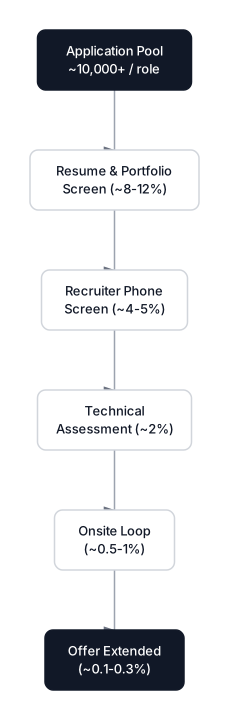 Click to expandAI Lab Hiring Funnel
The funnel isn't just competitive at the top — it's filtered by signal quality. The people making it through the resume screen aren't random qualified applicants. They're candidates whose names or work are already known to someone in the room, or whose portfolio is so clearly exceptional it generates internal excitement without a warm introduction.
From the Hiring Side: Internal referrals at these labs don't just jump the queue — they come with context. When a researcher refers someone, they're implicitly vouching for that person's quality. That context is how a hiring team distinguishes "another solid ML engineer" from "this specific person who built that interesting paper/tool/project."
The 6-to-12 Month Strategy, Made Concrete
This is what building toward a referral actually looks like in practice:
 Click to expand6-12 Month Relationship Building Strategy
Months 1-2: Build something visible. This means publishing technical writing, releasing a well-documented open-source project, reproducing a recent paper with clean code and notes on what you found, or writing a serious blog post analyzing a technique in depth. The goal is creating a public artifact that demonstrates you can think at a high level. Quality matters enormously here — one excellent piece of work is worth ten mediocre ones. If Anthropic's careers page is telling people to put their blog posts at the top of their resume, the blog post has to be good enough that you'd be comfortable putting it in front of a senior researcher at one of these labs.
Months 3-4: Engage with actual research. Start reading and engaging with papers from the labs you're targeting. Post substantive comments on Twitter/X when researchers publish new work — not "great paper!" but something that demonstrates you've read it, understood it, and have a specific observation or follow-up question. When researchers post publicly about problems they're thinking about, engage thoughtfully. The researchers who notice this are not the ones you cold-email asking for a job. They're the ones you eventually want to know you.
Months 5-6: Go where they are. NeurIPS, ICLR, ICML, and the various safety and alignment conferences (AIES, the Alignment Forum workshops) are where you will be in the same room as people from these labs. Attend. Have specific conversations about specific research. If you've been engaging online for a couple of months, some of these conversations will continue naturally. Don't pitch yourself as a job seeker at these events — pitch yourself as a researcher who's interested in the problems they're working on.
Months 7-9: Work toward a referral. By now, you should have at least a handful of genuine relationships with people inside these labs — people you've had substantive conversations with, contributed to discussions with, or collaborated with in some minor way (GitHub issues, paper discussions, community projects). When a role opens that fits your background, this is the time to reach out directly and ask if they'd be comfortable passing your name along. This is different from asking for a referral to a job you found on a job board. You're asking someone who already knows your work if they think you'd be a good fit.
Months 10-12: Apply. When you apply now, you're not a cold applicant. Your work is known, your name is known, and there's likely someone internally who has agreed to vouch for you. Your application goes into a different pile.
Pro Tip: GitHub is not enough on its own. Repositories without READMEs, without context, without clear problem statements, are invisible to researchers. The work needs to be packaged so that someone who has three minutes can understand what you built, why it was hard, and what you learned.
What Independent Research Actually Means Without a PhD
"Independent research" in Anthropic's framing doesn't mean writing a thesis. It means producing technical work that demonstrates original thought. Here are concrete examples of what this looks like in practice:
Replication studies with genuine analysis. Reproducing a paper's results is table stakes. What's valuable is documenting what was unclear in the paper, what hyperparameter decisions actually mattered, and what happened when you tried variants the original paper didn't explore. A replication blog post at that depth takes several weeks and is substantially more impressive than a GitHub repo with the original code cleaned up.
Ablation work on existing models. Taking a published model and systematically removing or modifying components to understand what's actually doing the work is valuable research. It doesn't require original architecture ideas — it requires rigor and a clear write-up of what you found.
Open-source tools with real users. A library that solves a genuine problem in the ML ecosystem, has clean documentation, and has been adopted by researchers or practitioners is strong evidence of both technical capability and communication ability.
Technical writing that clarifies hard concepts. Writing that genuinely makes something clearer — not a tutorial that summarizes the documentation, but something that explains the part of the paper most people get wrong, or benchmarks competing approaches with a clear methodology — is valued by the research community and gets circulated.
Safety-adjacent research for Anthropic specifically. Given Anthropic's mission, work on interpretability, robustness, alignment, or red-teaming has specific relevance. If you're targeting Anthropic and your independent work is on these topics, it signals both technical ability and genuine alignment with the mission.
Common Mistake: Work created to answer a substantive question is more credible than portfolio material optimized only to impress a reviewer. The work that generates genuine attention is work that actually tries to answer a question or solve a problem, not work designed to impress. Write the post you'd want to read, built on a question you actually found interesting.
Technical Interview Breakdown by Lab
All three labs test broadly similar things, but the emphasis differs.
Anthropic onsite (4-6 rounds):
- Coding (2 rounds): Multi-part CodeSignal-style problems that build on each other, testing algorithmic reasoning and modular design.
- System design (1 round): ML system architecture, production considerations, failure modes.
- ML theory (1 round): Fundamentals, model internals, training dynamics.
- AI safety/values (1-2 rounds): Scenario questions about alignment, how you'd approach specific safety problems. These are not multiple-choice — they're open-ended discussions.
OpenAI onsite (4-6 rounds):
- Coding (1-2 rounds): Algorithm and data structures, less LeetCode-heavy than FAANG, more emphasis on clean code and production-quality thinking.
- ML systems (1-2 rounds): How you'd build real infrastructure. Real-time feature stores, training pipelines, deployment at scale.
- Project review (1 round): Deep dive on something you've actually built or researched.
- Behavioral/culture (1 round): Mission alignment, how you handle ambiguity, past experiences with autonomous work.
Google DeepMind onsite (7-9 rounds):
- Coding (1-3 rounds): LeetCode-style, more rigorous than OpenAI.
- ML theory (2-3 rounds): Transformers, attention mechanisms, fine-tuning, training large models. Expect questions on recent work, not just 2020-era architectures.
- Research discussion (1-2 rounds): Walk through your best technical work. Be ready to defend every design decision.
- Recruiter/team fit (1 round): Culture and logistics.
For all three labs, preparation should include: reading their recent papers (not just the famous ones — the recent ones), being able to discuss the work intelligently, and having a clear narrative about your own technical background that connects to what they're doing.
Red Flags That Kill Candidacies
These patterns come up repeatedly in practitioner accounts from people who've been on the hiring side at these labs:
Applying cold with a generic cover letter. If your application materials could have been sent to any of ten companies with a find-and-replace, they signal you haven't actually thought hard about this specific opportunity. Worse, they signal you haven't actually read what the company has publicly said about what they want.
Claiming alignment with the mission without demonstrating it. Saying "I care deeply about AI safety" in an application letter while having no public work related to it is not credible. Researchers have read thousands of application letters. Show, don't say.
Treating AI safety rounds as box-checking. Candidates who clearly view the values/alignment interview as an obstacle to get past — rather than a genuine part of the job — get flagged. These are small teams. Mission fit is a real requirement, not a formality.
Weak independent work. A GitHub with 5-star clones of tutorial projects, or a Medium blog with two posts from 2023, is not the "independent research" Anthropic is asking for. If you're putting work in front of people who publish in NeurIPS, the work has to be serious.
Over-credentialing with under-execution. A PhD from a top program is not, by itself, sufficient. Many people with prestigious credentials have been rejected because the work in their portfolio didn't demonstrate the level of capability the credential implied. Credentials get your resume read. Work gets you an offer.
Key Insight: The biggest self-inflicted mistake is applying before you're ready because a role opened that seemed like a fit. There will be more openings. The reputation you build with a strong application is worth more than being first in the queue for a role you weren't positioned well to get.
Conclusion
The path to one of these labs runs through demonstrated work, not application volume. Anthropic tells you this directly on their careers page. Applicants can strengthen their case by building visible technical work, seeking informed feedback, and developing relationships through substantive professional or research contributions before applying.
The implication for your preparation timeline is significant. If you're targeting one of these labs and haven't started building public work, start now. The work you publish in the next six months is the credential that actually matters when you apply in month ten or twelve.
For the technical preparation side, focus on ML fundamentals at the architecture and training-dynamics level — not just API usage. Read their recent papers. Be able to discuss them. And for Anthropic specifically, engage genuinely with the AI safety literature, because the mission fit interview is real.
If you're building the technical depth needed for these roles, our guides on machine learning fundamentals and how large language models actually work are good starting points for the conceptual grounding these interviews require. Understanding retrieval-augmented generation and the broader LLM stack is increasingly relevant to research engineering roles at all three labs.
The timeline is longer than most candidates expect. That's the actual insight here.
Career Q&A
Am I qualified if I don't have a PhD?
Yes, but the bar shifts. Without a PhD, your independent work becomes the primary evidence of your capability at the research level. Anthropic says explicitly that about half their technical staff have PhDs and plenty don't — but the non-PhD hires universally have strong public portfolios. Research Engineers at DeepMind and engineers at OpenAI regularly come from SWE backgrounds. The more relevant question is whether your work demonstrates you can operate at the level these labs need.
How long should I realistically prepare before applying?
For most candidates targeting research or engineering roles, 6 to 12 months of deliberate preparation is realistic. That timeline isn't about interview prep in the traditional sense — it's about building the public work, developing the relationships, and deepening the technical understanding that makes a strong application. Candidates who try to shortcut this with intensive interview prep alone tend to stall at the values and research discussion stages.
What if I've never attended a major ML conference?
NeurIPS, ICLR, and ICML are worth attending in person if you're serious about these labs, but they're not gatekeepers. The online presence of these conferences (workshops, recorded talks, community discussion) is substantial. Engaging substantively online — through the Alignment Forum, Twitter/X discussions around paper releases, GitHub contributions to research repositories — builds visibility without requiring conference attendance. Conferences accelerate the relationship-building timeline; they don't replace it.
What does "mission alignment" mean in practice for Anthropic?
It means you've actually thought about the risks of powerful AI systems and have a genuine view on why safety research matters — not a talking point, but a considered position you can defend and discuss. Anthropic's interviewers are not looking for perfect agreement with every position in the company. They're looking for evidence that you've engaged with the hard questions and that you'd raise safety concerns when you see them, rather than deprioritizing them under schedule pressure.
Is the OpenAI Residency a viable path if I'm switching fields?
The Residency is one of the best-documented non-traditional entry paths. It's explicitly designed for people from adjacent quantitative fields (mathematics, physics, computational biology) who have strong potential but lack formal ML credentials. Applications are competitive, but the selection criteria are explicitly trajectory-focused: they want to see rapid growth and self-direction, not a specific credential set. If you're a physicist or mathematician with strong programming skills and a serious interest in AI research, this is worth applying for directly.
What do interviewers actually look for in the research discussion rounds?
They want to understand how you think, not just what you built. Expect to walk through your most significant technical project in detail: what the problem was, what you tried that didn't work, what design decisions you made and why, and what you'd do differently with hindsight. Candidates who can describe failures and what they learned from them consistently perform better than candidates who present their work as a series of successes. Intellectual honesty under scrutiny is what distinguishes strong research candidates.
What's the biggest mistake senior engineers make when targeting these labs?
Underestimating the mission-fit component. Senior engineers from FAANG are often excellent at the technical rounds and then underperform in the values and alignment discussions because they've spent years in environments where those conversations don't happen. Walking into an Anthropic or OpenAI interview treating the safety/values rounds as a soft formality is a common and costly mistake. These rounds are not pass/fail checkbox items — they're evidence-based assessments of how you actually think about the work.
Sources
- Anthropic Careers Page — Hiring Philosophy (Accessed March 2026)
- Anthropic Interview Process & Timeline: 6 Steps to an Offer (2025)
- My 2025 Anthropic Software Engineer Interview Experience (2025)
- OpenAI Interview Guide (Accessed March 2026)
- OpenAI Residency 2026 — Program Overview (Accessed March 2026)
- How I Got a Job at DeepMind as a Research Engineer (without a Machine Learning Degree) (2021, Aleksa Gordić)
- Breaking Into AI in 2026: What Anthropic, OpenAI, and Meta Actually Hire For (2026)
- How to Get Hired at OpenAI, Anthropic, and Google DeepMind in 2026 (2026)
- OpenAI to Nearly Double Workforce to 8,000 by End-2026, FT Reports (CNBC / Financial Times, March 2026)
- Anthropic Statistics — Employees, Revenue & Valuation 2026 (Accessed March 2026)
- Anthropic Interview Questions & Process (2025)
- Google DeepMind ML Interview Prep: What to Expect and How to Prepare (2025)
- AI Research Engineer Interview Guide: OpenAI, Anthropic, DeepMind (2025)