
The BLS projects data scientist employment will grow 34% by 2034, making it the fourth-fastest-growing occupation in the US economy. At the same time, AI tools are automating chunks of the actual work data scientists do every day. Both of these things are true simultaneously, and that tension is exactly what this article unpacks.
This isn't a debate about whether AI will "replace" data scientists as a category. That framing is too broad to be useful. The more useful question: which specific tasks are being automated, which skills are becoming more valuable because of that automation, and what does a data scientist who wants to be irreplaceable in 2026 actually need to invest in?
The Automation That Is Already Happening
Let's be specific. Not "AI is changing everything" — but rather, which tools are doing which things today.
GitHub Copilot and Claude Code handle the boilerplate end of the workflow well. Standard pandas operations, sklearn pipelines, SQL query construction, unit test scaffolding — a competent AI assistant writes this faster than most practitioners. According to the 2025 Stack Overflow Developer Survey, 84% of developers now use or plan to use AI tools in their development process. Among those already using AI tools, ChatGPT leads at 82% adoption, followed by GitHub Copilot at 68%. The tasks that autocomplete well tend to be the tasks with known patterns and clear inputs.
AutoML platforms — H2O Driverless AI, Google Vertex AutoML, DataRobot — have matured significantly. They run feature engineering, hyperparameter search, and model selection on structured tabular data without human intervention. DataRobot can produce a baseline model from a labeled CSV in under an hour. H2O's Driverless AI handles feature interactions that used to require manual engineering. For supervised learning on structured data with a clear target variable, these tools produce competitive baselines.
Gemini and ChatGPT's Advanced Data Analysis mode run exploratory data analysis interactively. Upload a CSV, ask for distributions and correlations — you get a full EDA report with visualizations. This used to be three hours of a junior data scientist's time. Now it's a prompt.
Key Insight: The tasks being automated are not random. They share a common trait: they involve applying known patterns to clearly-defined inputs. EDA on a clean dataset. A random forest baseline. A weekly churn report. If the task has a template, the template can be automated.
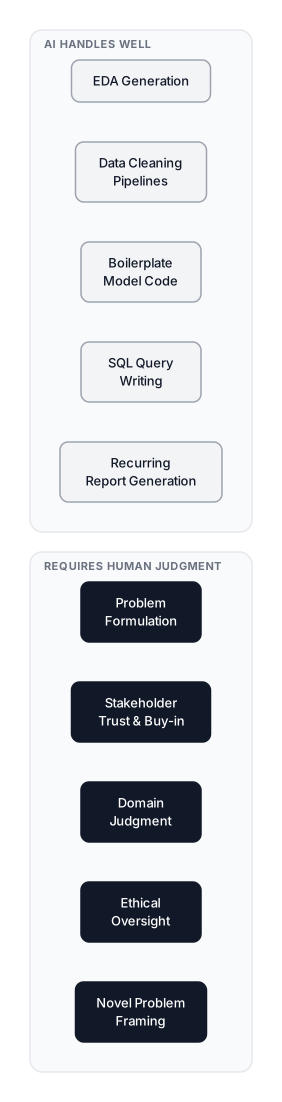 Click to expandAI-automated tasks vs. tasks requiring human judgment in data science
The Automated Tier: What's Genuinely Commoditized
Here is a direct list of tasks that are either already automated or rapidly being commoditized:
Exploratory Data Analysis generation. Pandas profiling, ydata-profiling, and LLM-based EDA tools produce summary statistics, missing value reports, correlation matrices, and distribution plots on demand. The analyst who spent a day generating these reports is being displaced. Not the function — the manual execution of it.
Data cleaning pipelines for standard issues. Duplicate removal, type casting, missing value imputation with mean/median/mode, outlier flagging using IQR — all of this is template work. AI tools handle it reliably. According to Anaconda's 2024 State of Data Science report, 87% of practitioners are spending as much or more time on AI techniques compared to the previous year — with data cleaning, task automation, and predictive modeling cited as the top applications.
Boilerplate model code. The sklearn pipeline for a logistic regression classifier, including preprocessing, cross-validation, and metric reporting, is something Claude Code or Copilot writes correctly on the first try. Writing this by hand offers no advantage in 2026.
SQL query writing from natural language. Given a schema and a question, modern LLMs produce accurate SQL at a level that handles joins, window functions, and CTEs. This doesn't replace the person who understands whether the query answers the right question — it replaces the person whose job was purely to translate questions into SQL.
Automated reporting and dashboard generation. Weekly business metrics reports, A/B test summaries, campaign performance dashboards — anything with a fixed structure and recurring data is now a scripted workflow. Tools like Hex and Mode AI have built this into their core product.
Basic feature engineering on structured data. AutoML tools now handle lag features, rolling windows, and polynomial interactions for structured tabular data. This was a meaningful skill in 2019. It's still useful, but it's no longer a differentiator.
| Task | Automation Status | Primary Tool |
|---|---|---|
| EDA generation | Largely automated | ChatGPT ADA, ydata-profiling |
| Data cleaning (standard) | Largely automated | Claude Code, DataRobot |
| Boilerplate model code | Largely automated | GitHub Copilot, Cursor |
| SQL query writing | Largely automated | Gemini, Text-to-SQL tools |
| Report generation (fixed format) | Largely automated | Hex AI, Mode AI |
| Baseline model selection | Largely automated | H2O, Vertex AutoML |
| Feature engineering (tabular) | Partially automated | DataRobot, H2O |
The Human Tier: What Requires Judgment, Not Pattern Matching
The work that remains genuinely hard to automate shares a different trait: it requires judgment in the absence of a clear template.
Problem formulation. "What should we even measure?" is the question most companies get wrong, and it's entirely human territory. A fraud detection model trained on the wrong target variable is worse than no model. An A/B test measuring click-through rate when the real goal is long-term retention misses the point. These aren't data problems — they're reasoning problems about what matters. AI assists with the analysis after the frame is set. It doesn't set the frame.
Stakeholder trust and communication. A model recommendation that the business actually acts on requires trust. That trust is built through relationships, through demonstrated judgment, through being the person who told them the hard truth two years ago and was right. No tool replicates this. The data scientist who can walk a VP of marketing through why their intuition about seasonality is wrong — and get them to change the campaign — is not being automated. This is the skill that separates senior individual contributors from junior ones, and it compounds over time.
Domain judgment in novel contexts. AutoML tools do not incorporate domain knowledge — they optimize against whatever target you give them. Knowing that a healthcare dataset's missingness is not random — it signals patient non-compliance, not data collection failure — changes the entire modeling approach. No pre-trained model has this context. The data scientist who spent three years in insurance claims knows things about adverse selection that don't exist in any training set.
Deciding what NOT to build. This is underrated. The question "do we actually need a model here, or would a simple rule work just as well?" requires understanding the cost of false positives versus false negatives, the operational complexity of deploying a model vs. a rule, and the tolerance for explainability. These are judgment calls that require organizational context, not pattern matching.
Ethical oversight and fairness analysis. Who is harmed by a model error? Who is systematically excluded from a training set? These questions require moral reasoning, legal knowledge, and institutional accountability. They can't be delegated to an algorithm.
Hypothesis generation in unexplored domains. When a company enters a new market or launches a new product type, there is no historical data to train on and no established framework to apply. The data scientist who can construct a measurement strategy from scratch — deciding what to instrument, what proxy metrics to use, what sample sizes to plan for — is doing genuinely creative work.
From the Hiring Side: Senior hiring managers consistently report that the candidates who get offers in 2026 are those who can articulate not just what they built, but why they chose that approach over alternatives and what tradeoffs they made. That's judgment, not execution.
The Talent Paradox Explained
Here's the counterintuitive part: automation of DS tasks and a growing talent shortage are happening at the same time, and they're connected.
According to the WEF Future of Jobs Report 2025, 94% of leaders face AI-critical skill shortages, with one-third reporting gaps of 40% or more. McKinsey's State of AI 2025 found that 46% of leaders cite skill gaps as their primary barrier to AI adoption. A separate McKinsey Global Institute report published in November 2025 found that demand for AI fluency in job postings grew nearly sevenfold between 2023 and mid-2025.
The resolution to the paradox: more organizations are deploying AI, which requires more data scientists to design the systems, validate the outputs, oversee the models in production, and translate results into decisions. The BLS projects approximately 23,400 new data scientist openings per year through 2034 — not despite AI, but partly because of it.
When a retail chain deploys an AI-driven demand forecasting system, they don't just need a data scientist to build it once. They need someone to monitor model drift, retrain on new seasonal patterns, investigate when the model fails during a supply chain disruption, and communicate confidence intervals to the planning team. That ongoing oversight role didn't exist before the model existed.
Worth Knowing: Nearly 40% of skills required on the job are expected to change by 2030, according to the WEF. The shortage isn't entry-level headcount — it's people who can design, validate, and govern AI systems. That's a senior-level capability problem, and it's exactly why the job market is expanding at the top while contracting at the bottom.
Skill Profiles: Most at Risk vs. Most Durable
The question of risk depends on what you actually spend your time on, not your job title.
Highest automation risk: The junior data scientist profile that consists primarily of EDA, basic feature engineering, writing standard model code, and producing recurring reports. Entry-level job postings have declined approximately 35% since January 2023, according to labor research firm Revelio Labs — a figure independently corroborated by Rezi's 2026 report on entry-level labor. The "learning curve work" that used to develop junior practitioners — the grunt work that built skills — is being automated before those skills are fully formed.
Moderate risk: The mid-level analyst focused on SQL-heavy reporting, dashboard maintenance, and A/B test summary generation without deeper involvement in experiment design or decision-making. These roles are being squeezed from both directions: automation handles the execution, and leadership increasingly expects more strategic input.
Low risk — and growing: Data scientists who own the full problem cycle, from framing the question through stakeholder communication of results. ML engineers who build and maintain production ML systems. Practitioners who specialize in high-stakes or regulated domains (healthcare, finance, legal) where human accountability is non-negotiable. AI safety and alignment researchers. MLOps and model governance specialists.
Highly durable: Any profile that includes genuine domain expertise plus quantitative skills. A data scientist with five years of credit risk experience who also knows causal inference is not being automated. A healthcare DS who understands clinical trial design is not being automated. The moat is the combination, not either component alone.
 Click to expandData science skill durability across automation risk spectrum
Skills to Invest in for 2026
Based on what's actually showing up in job postings, in interviews, and in practitioner conversations, these are the skill bets worth making:
Causal inference and experimental design. AB testing is table stakes. The practitioners who can design observational studies, understand when randomization isn't possible, and apply difference-in-differences or synthetic control methods are genuinely scarce. This is hard to automate because it requires reasoning about what a counterfactual looks like.
MLOps and production systems. Deploying a model is different from training a model. Monitoring for data drift, managing model versions, building retraining pipelines, setting up alerting — this is engineering work with a modeling layer. The practitioners who can do both are in high demand and relatively few.
LLM application development. Retrieval-augmented generation, fine-tuning, prompt engineering for production systems, and evaluating LLM outputs are now core DS skills at many organizations. Understanding how to build reliable RAG systems and when they fail is a significant differentiator.
Stakeholder communication. Not "soft skills" in the vague sense — specifically, the ability to translate a model output into a business decision with appropriate uncertainty quantification. This involves knowing how to communicate confidence intervals without losing the room, when to say "we don't know," and how to frame tradeoffs in terms executives can act on.
Domain depth, not tool breadth. Learning the seventh AutoML tool is not a skill investment. Developing genuine expertise in one industry vertical — healthcare, finance, supply chain, media — is. The combination of domain knowledge and quantitative skills is what AutoML cannot replicate.
AI systems evaluation and oversight. As organizations deploy AI at scale, someone needs to know when a model is wrong in a systematic way, how to audit training data for bias, and how to structure human review processes. This is a new set of skills that didn't exist as a job category five years ago.
When to Be Concerned vs. When Not to Be
This framework is specific. Apply it to your actual role, not to "data science" as an abstraction.
Be genuinely concerned if:
- More than 60% of your weekly work is EDA, standard model code, or recurring reports
- You have not been involved in a single decision about what question to investigate or how to measure success in the past six months
- Your contributions are primarily execution rather than judgment or framing
- Your work could be reproduced by a competent analyst with Claude Code and no domain knowledge
Don't panic if:
- You're regularly involved in experiment design or problem framing
- You have genuine domain expertise that took years to accumulate
- Your role includes stakeholder communication and trust relationships
- You're working in production ML systems, MLOps, or model governance
- You're doing research in genuinely novel domains where training data is sparse
The honest middle: Many data scientists are in a partially automated role right now. Some of what they do is already being commoditized; some isn't. The practitioners who recognize this clearly and invest deliberately in the durable parts are in a strong position. The ones who assume the whole job is equally safe are the ones who will be surprised.
Conclusion
Automation is not eliminating the data science profession — it is sorting it. The work that required pattern matching on known inputs is being absorbed by AI tools. The work that requires judgment, domain knowledge, stakeholder relationships, and novel reasoning is expanding in value.
The BLS projects 34% growth for data science roles through 2034. WEF projects 11 million new AI and data processing jobs by 2030. Both forecasts coexist with the reality that a significant portion of what junior data scientists currently do is being automated. The resolution is not contradiction — it's redistribution. More organizations need data science capability; the specific tasks that constitute that capability are shifting upward.
The practitioners who will thrive are not the ones who fight this or ignore it. They're the ones who honestly assess where their current work sits on the automation spectrum and invest accordingly. If your competitive advantage is writing sklearn pipelines faster than average, that advantage is eroding. If it's the ability to walk into an ambiguous business problem, decide what to measure, build the right thing, and get the organization to act on it — that's becoming more valuable, not less.
For a deeper look at the skills that underpin durable DS careers, the AI Engineer Roadmap covers where the adjacent discipline is heading. Understanding how LLMs work at a technical level is also increasingly expected of senior practitioners, not just AI engineers.
Use the task-by-task framework above to identify one routine responsibility to automate and one judgment-heavy responsibility to deepen.
Career Q&A
Is AI actually replacing junior data scientists right now?
Partly, and the honest answer matters here. Entry-level job postings have declined roughly 35% since January 2023, according to Revelio Labs — a trend independently documented in Rezi's 2026 report on entry-level labor. The routine tasks that used to justify junior hires — basic EDA, standard model code, recurring SQL reports — are being automated. That doesn't mean junior roles are gone, but it means the bar to be valuable in a junior role has risen. Candidates who can operate AI tools, not just produce template work, are getting the offers.
What's the single most durable skill investment for a data scientist in 2026?
Domain expertise combined with causal reasoning. AutoML can optimize a gradient boosted tree. It cannot tell you whether the effect you're measuring is causal or confounded. It cannot apply healthcare regulations to a model design decision. The practitioners with deep domain knowledge plus quantitative rigor are the ones who will not be replaced, because their moat requires years to build and cannot be downloaded.
Should I learn prompt engineering or is it too shallow a skill?
Prompt engineering as a standalone job title is probably not a durable career. But understanding how LLMs behave, where they fail, and how to build reliable systems on top of them is essential for any data scientist working with AI products — which is increasingly most data scientists. The deeper investment is in LLM application development: RAG, evaluation frameworks, fine-tuning. Prompt engineering is a tool within that, not the whole skill.
My current role is 80% EDA and reporting. How worried should I be?
Worried enough to act, not panicked. That profile has meaningful automation risk over the next two to three years. The question is whether you're accumulating adjacent skills — experiment design, stakeholder communication, domain expertise — or whether the role itself is a ceiling. If it's the former, you're in a fine position. If you've been in the same analytical role for three years without developing judgment-intensive capabilities, that's worth addressing now rather than in a year when the options narrow further.
Do I need a graduate degree to stay competitive as AI automates more tasks?
No, but you need something equivalent in depth. The reason graduate degrees helped historically was the signal they provided about technical rigor and domain depth, not the credential itself. In 2026, a well-curated portfolio of production ML work, demonstrated causal reasoning capability, and evidence of stakeholder impact can substitute for the degree signal. What doesn't substitute: shallow project work, generic tutorials repackaged as a portfolio, or tool familiarity without underlying judgment.
Are there specific industries where data scientists are most protected from automation?
Healthcare, financial services, and regulated sectors generally. These areas require human accountability that automation cannot provide. A model recommending a treatment protocol needs a clinician who can explain and defend that recommendation. A credit risk model needs a human who can justify decisions to regulators. Beyond regulation, industries with sparse historical data and novel problem types — early-stage biotech, climate tech, novel financial instruments — require human problem formulation that AutoML cannot provide.
What should I say in interviews when asked about AI automating my job?
Be direct and informed. "AI is automating the execution layer of data science, but the judgment layer is growing in value. My focus has been on building skills that compound as AI handles more routine work" — and then give a specific example of a judgment call you made that an AI tool couldn't have made. Interviewers in 2026 respect candidates who read the situation honestly. The candidates who say "AI won't replace data scientists" sound uninformed; the ones who say "AI is automating everything" sound defeatist. The credible answer is specific.
Sources
- BLS Occupational Outlook Handbook: Data Scientists (2024-2034 projections, updated 2025)
- WEF Future of Jobs Report 2025 (January 2025)
- McKinsey: The State of AI in 2025 — How Organizations Are Rewiring to Capture Value (March 2025)
- McKinsey: Tech Faces a Talent Bottleneck (2025)
- McKinsey Global Institute: Agents, Robots, and Us — Skill Partnerships in the Age of AI (November 2025)
- Anaconda State of Data Science 2024 Report (2024)
- Stack Overflow 2025 Developer Survey — AI Section (2025)
- Revelio Labs: Is AI Responsible for the Rise in Entry-Level Unemployment? (2025)
- Rezi: The Crisis of Entry-Level Labor in the Age of AI (2024-2026) (2026)
- WEF: How AI Overcapacity and Talent Shortages Are Both Real (October 2025)
- BLS Employment Projections 2024-2034 (2025)
- Data & Society: The Craft of Science with AI — Evidence, Judgment, and Practice (November 2025)
- AltexSoft: AutoML Capabilities and Limitations (2025)
- Medium: AI and Data Scientist Job Market in 2026 — Early Year Report (2026)