
X-62 VISTA Demonstrates AI-Guided Air Intercepts
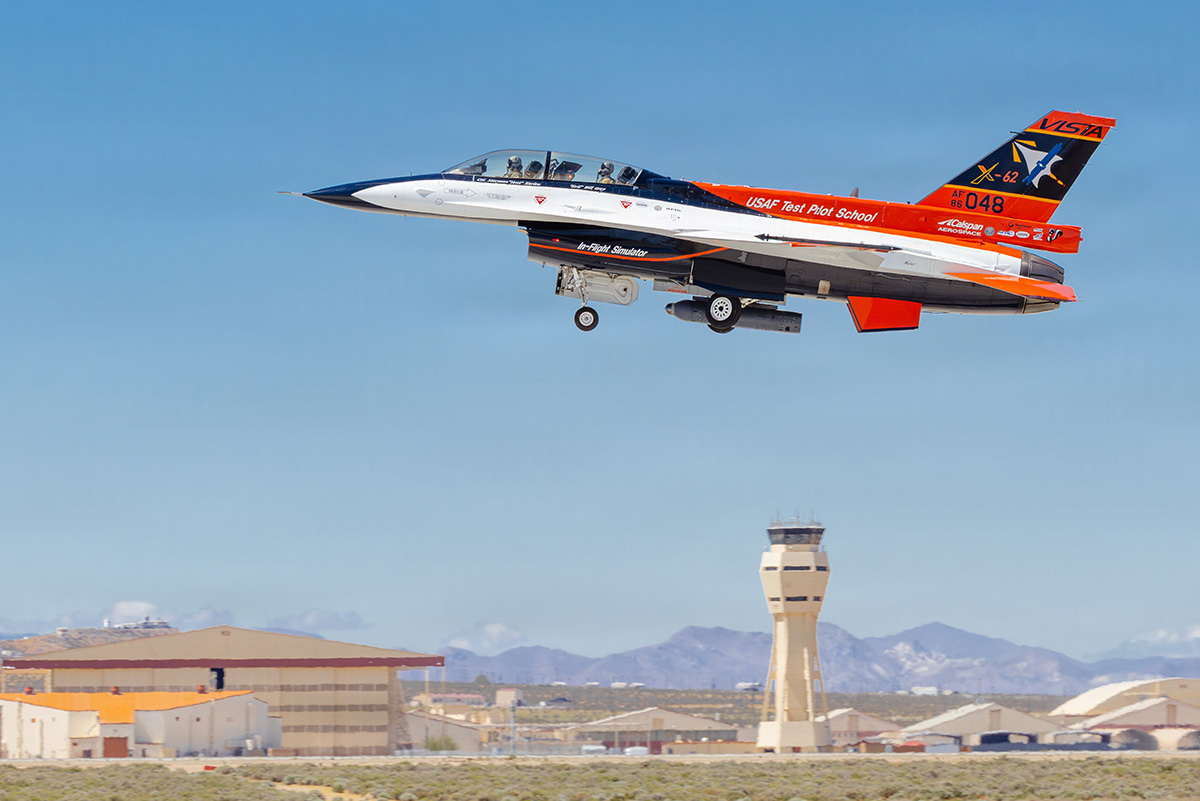
The U.S. Air Force announced on Aug. 4 that its X-62 VISTA test aircraft used an AI agent and live infrared sensor data to autonomously intercept an airborne target during April tests at Edwards Air Force Base. Lockheed Martin reported that the aircraft completed 27 AI-controlled intercepts over eight flights using its Legion Pod infrared search-and-track sensor. The tests also evaluated modular mission-system components and autonomy safety constraints.
The U.S. Air Force announced on Aug. 4 that the X-62 VISTA experimental aircraft used an AI agent to process live infrared sensor data and autonomously direct the aircraft into an intercept of an airborne target. The demonstration occurred during the HAVE HEAT test program at Edwards Air Force Base, California, in April 2026, according to the Air Force's 412th Test Wing.
Lockheed Martin said its Skunk Works unit, the Air Force Test Pilot School, and other industry partners conducted eight flights in which the X-62 completed 27 AI-controlled intercepts against a live T-38 target aircraft. The X-62, a heavily modified two-seat F-16D also known as the Variable In-flight Simulation Test Aircraft, used Lockheed Martin's Legion Pod infrared search-and-track system for the trials.
From sensor stream to aircraft control
According to the Air Force, the HAVE HEAT program tested whether AI agents could ingest live infrared data and direct the aircraft toward an airborne target in real time. Lockheed Martin characterized the exercise as a closed-loop test, linking onboard target sensing, AI behavior, and aircraft control rather than supplying the agent with simulated target data.
Lt. Col. Joshua Strafaccia, dean of faculty for research at the U.S. Air Force Test Pilot School, said in the Air Force release: "HAVE HEAT represents a meaningful expansion of avionics capability towards integrated, AI-driven control of multiple sensors and air vehicles for mission autonomy. This bridges a capability gap and positions us to test advanced autonomy faster."
Air & Space Forces Magazine reported that the latest trials extended the X-62's 2024 AI flight tests. Chase Kohler, spokesman for the 412th Test Wing, told the publication that human operators had locked onto targets in the earlier demonstrations, while the AI system locked onto targets itself in the April tests.
The distinction is technically consequential. In comparable autonomy programs, moving from scripted or simulated inputs to live onboard sensing introduces problems involving sensor noise, target tracking, timing, communications, and the reliability of the control pipeline. A successful intercept demonstration does not by itself establish performance across adverse weather, electronic warfare, dense traffic, or operationally representative threat scenarios, but it provides a flight-test datapoint for the complete sensor-to-action loop.
Parallel work on modularity and guardrails
The Air Force ran a second accelerated program, HAVE HOLIDAYS, alongside HAVE HEAT. According to its release, the program integrated and evaluated modular technologies through the X-62's Enterprise Open Mission Systems Architecture computer.
The work included a third-party autonomous agent, additional chips for advanced sensor exploitation, and enhanced safety rules intended to prevent autonomous vehicles from exceeding operational limits set by users. The Air Force described the activity as system-of-systems testing intended to reduce technical risk for logistics and integration frameworks associated with the aircraft's mission-system upgrades.
The Air Force said military personnel, government specialists, and contractor engineers completed ground testing for the parallel programs within three months. Lockheed Martin separately said its agent integration and ground testing with the X-62 were completed during the same three-month period.
For ML and autonomy engineering teams, the combination of a live-sensor intercept trial and a modular integration test reflects a recurring constraint in safety-critical AI: model behavior is only one component of deployment. Comparable systems require versioned sensor interfaces, deterministic safety enforcement, hardware and software integration procedures, and test infrastructure that can validate changes before flight or field use.
Relevance to collaborative combat aircraft
Air & Space Forces Magazine and The War Zone place the experiment in the broader context of the Air Force's Collaborative Combat Aircraft effort, which involves uncrewed aircraft designed to operate alongside crewed fighters. The X-62 remains a test aircraft, not an operational autonomous fighter.
The reported test therefore offers evidence of an AI agent performing target sensing and intercept guidance in flight, while leaving open major operational questions about generalization, safety assurance, human supervision, and performance under contested conditions. Those questions are central to the transition from controlled demonstrations to deployable autonomous aviation systems.
Key Points
- 1The X-62 processed live infrared feeds and executed 27 AI-controlled intercepts, demonstrating a flight-tested sensor-to-action autonomy loop.
- 2HAVE HOLIDAYS tested modular agents, sensor-processing chips, and operational-limit rules, underscoring that autonomy deployment depends on integration and guardrails.
- 3Comparable safety-critical AI programs face validation challenges beyond model accuracy, including noisy sensing, control latency, software interfaces, and constrained operations.
Scoring Rationale
The tests provide a notable flight demonstration of AI connecting live infrared sensing to aircraft intercept control, a meaningful advance for defense autonomy engineering. The X-62 is an experimental platform rather than an operational system, but the work is relevant to sensor fusion, safety constraints, and validation of autonomous control loops.
Sources
Primary source and supporting public references used for this report.
Practice interview problems based on real data
1,625 SQL & Python problems across 15 industry datasets — the exact type of data you work with.
Try 250 free problems
