VDURA and Wasabi Link AI Storage Tiers
VDURA and Wasabi Technologies announced a technology alliance on August 4 that links VDURA's GPU-adjacent AI storage with Wasabi's S3-compatible cloud archive tier. The arrangement targets AI factories, neoclouds, and enterprise HPC environments, keeping active datasets near GPUs while moving inactive checkpoints, model versions, and artifacts to capacity storage with no per-GB egress or API request fees under Wasabi's standard plan.
VDURA and Wasabi Technologies announced a technology alliance on August 4 that pairs VDURA's GPU-adjacent storage platform with Wasabi's S3-compatible cloud storage for AI data archiving. Reporting from StorageReview, Blocks & Files, and IT Brief describes a two-tier design for AI factories, neoclouds, and enterprise high-performance computing environments.
Separating active and retained AI data
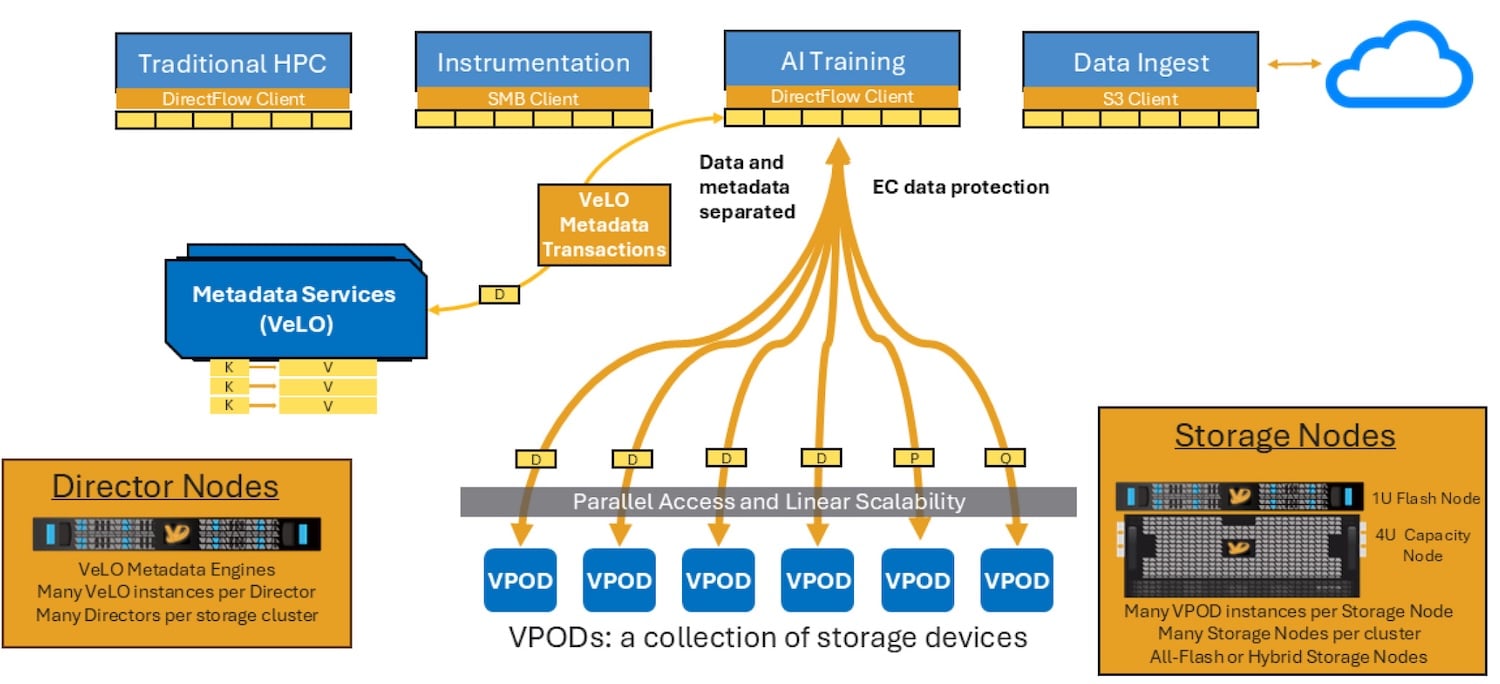
VDURA would handle data that remains in active use for dataset staging, model loading, training, checkpointing, and inference. Its platform combines a parallel file system, RDMA data paths, POSIX workflows, NVMe flash and hard drives, and a native S3 interface under one namespace, according to the reports.
Wasabi would provide the capacity tier for datasets, checkpoints, model versions, and derived artifacts that no longer need to occupy GPU-adjacent performance storage. The reported use cases include long-term retention, disaster recovery, distribution to other sites, retraining, model comparison, and governance review.
Ken Claffey, VDURA's CEO, described the operating principle to Blocks & Files: data belongs close to GPUs while it is doing active work, but it should not stay on performance infrastructure permanently. Laurie Mitchell, Wasabi's senior vice president of global marketing, similarly argued that AI data can retain value after a training run. Those are company statements about the alliance, not independent performance measurements.
Pricing and operational limits
Wasabi's standard plan does not charge per-gigabyte egress fees or API request fees, according to all three reports. The companies present that structure as a way to make the cost of retaining and later retrieving AI artifacts more predictable. The announcement does not provide combined-offering pricing, benchmark results, transfer-time measurements, or details of automated placement policies.
For infrastructure teams, the architecture resembles a familiar hot-and-capacity storage pattern: reserve low-latency parallel storage for active I/O and place less frequently accessed artifacts in object storage. Whether that produces useful savings depends on transfer policy, metadata management, retrieval latency, network capacity, and whether training pipelines can reliably locate archived artifacts.
The companies planned to show the alliance at Ai4 2026 in Las Vegas. Until customer deployments or benchmarks are published, the announcement is best read as a product-integration strategy rather than evidence of measured performance or cost improvements.
Key Points
- 1VDURA and Wasabi connect active GPU-adjacent storage to S3-compatible archival capacity, separating low-latency workload data from inactive AI artifacts.
- 2Wasabi's stated no-egress and no-API-request-fee terms target a variable-cost obstacle in checkpoint retention, recovery, and cross-site reuse.
- 3The announcement provides no combined pricing, benchmark results, transfer measurements, or automated-placement details.
Scoring Rationale
The alliance addresses a practical storage-lifecycle problem for large AI environments, but the announcement includes no customer evidence, benchmarks, or combined product pricing.
Sources
Public references used for this report.
Practice interview problems based on real data
1,625 SQL & Python problems across 15 industry datasets — the exact type of data you work with.
Try 250 free problems