US Controls Allied Access to Frontier AI
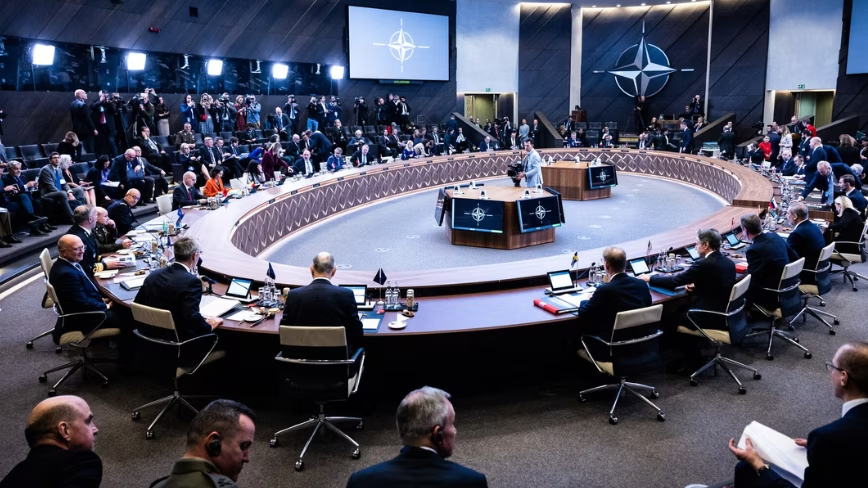
The United States is controlling allied access to cyber-capable frontier AI models before NATO's July 7-8, 2026 Ankara summit, with reporting centered on Claude Mythos and limited OpenAI rollouts. The Next Web reports that Washington has moved between export controls and managed allied access through Anthropic's Project Glasswing, while Politico reports that European allies want broader access to the most capable defensive models. The Guardian separately reported that U.S. export controls on Anthropic's Fable 5 and Mythos 5 were lifted after Anthropic agreed to stronger safeguards and government collaboration. For security teams, the operational issue is fragmented access: joint exercises, red-team baselines, and defensive evaluations may not be reproducible across allies.
The practical issue for security and AI teams is not just diplomacy; it is reproducibility. If only some allies can evaluate the strongest cyber-capable models, joint threat models, red-team exercises, and defensive tooling baselines become harder to compare across borders.
What happened
The Next Web reports that U.S. control over cyber-capable frontier models, especially Anthropic's Claude Mythos, is looming over the NATO summit scheduled for July 7-8, 2026 in Ankara. Politico's article is blocked to this audit environment but is search-confirmed as covering AI security questions at the NATO summit. The Guardian separately reported that the U.S. government lifted export controls on Anthropic's Fable 5 and Mythos 5 after security concerns, while the Financial Times previously reported Anthropic's Project Glasswing expansion to more than 15 countries.
Timeline
Financial Times reported Anthropic's Project Glasswing expansion to 150 organizations across more than 15 countries.
The U.S. government ordered Anthropic to restrict Fable 5 and Mythos 5 access for foreign nationals, according to The Guardian.
Anthropic said U.S. export controls on Fable 5 and Mythos 5 had been lifted, according to The Guardian.
The NATO summit in Ankara is scheduled to begin, with The Next Web reporting that AI access is expected to receive little formal agenda time.
Policy context
The reported tension is between preventing misuse of models that can assist vulnerability discovery and giving allies enough access to prepare defensive systems. That makes the access regime itself part of the security architecture: who can test, who can reproduce a result, and who can validate a defensive playbook all become policy decisions rather than purely technical ones.
For practitioners
Security teams should assume that frontier-model availability may vary by jurisdiction, partner status, and government review. That argues for portable evaluation suites, model-agnostic detection workflows, careful documentation of which model version was used in an exercise, and fallback plans when a partner cannot access the same model.
What to watch
Watch NATO communiques for any language on AI sharing, Anthropic and OpenAI disclosures about trusted-access cohorts, and Commerce or White House guidance clarifying export-control scope. Also watch European and UK procurement signals for signs that restricted U.S. access accelerates domestic defense-AI programs.
Editorial analysis
This is a notable policy and security story because it connects model access, export controls, and alliance readiness. The impact is below industry-shaking because many operational details remain reported through blocked or paywalled outlets, and the public record is still evolving.
Key Points
- 1U.S. access controls for cyber-capable models could fragment NATO threat modeling and defensive evaluation workflows.
- 2Accessible reporting confirms recent export-control whiplash around Anthropic models and managed Project Glasswing access for allies.
- 3Practitioners should document model availability, versions, and partner access when comparing red-team or defensive results.
Scoring Rationale
This remains a notable policy and security story because access to cyber-capable frontier models affects cross-border defensive evaluation, procurement, and alliance coordination. The score is held below major because public details are still split across blocked or paywalled reporting and no formal NATO policy shift has been verified.
Sources
Public references used for this report.
Practice interview problems based on real data
1,625 SQL & Python problems across 15 industry datasets — the exact type of data you work with.
Try 250 free problems