Google releases TabFM, zero-shot tabular prediction model
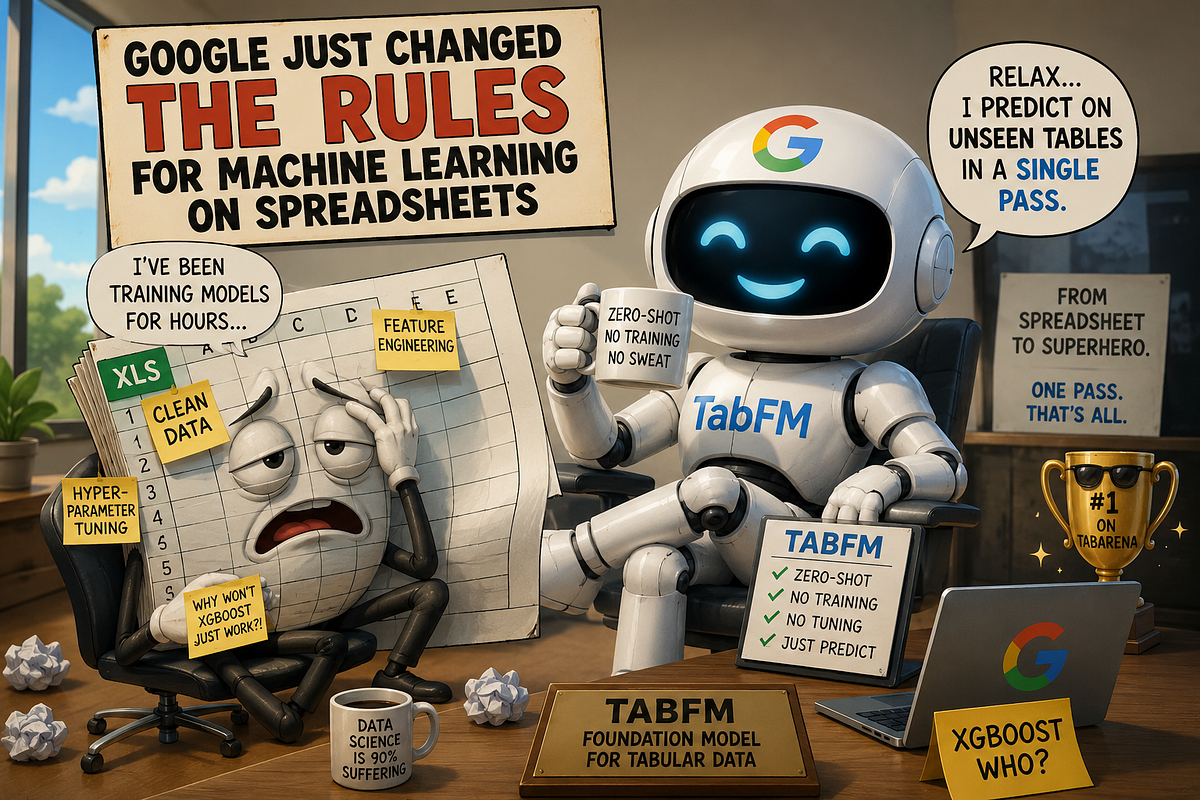
Google Research released TabFM 1.0.0 on June 30, 2026 as a zero-shot foundation model for tabular classification and regression, with public code on GitHub and pretrained weights on Hugging Face. The Google post says TabFM uses in-context learning so teams can pass training examples and target rows as one prompt, avoiding per-dataset fine-tuning and hyperparameter search. The Hugging Face card says the PyTorch checkpoint supports regression and classification up to 10 classes, while the model weights carry a non-commercial license. For practitioners, the release is important because tabular ML still underpins fraud, churn, risk, and operations workloads, but production value depends on latency, calibration, explainability, licensing, and performance against tuned tree ensembles.
TabFM matters because tabular prediction is one of the least glamorous but most operationally important ML workloads. The release gives data teams a credible Google Research baseline for asking whether foundation-model-style inference can reduce onboarding work for structured datasets, while also exposing new constraints around context size, cost, and licensing.
What happened
Google Research introduced TabFM on June 30, 2026 as a zero-shot foundation model for tabular data. The accompanying GitHub repository provides scikit-learn-compatible code, and Hugging Face hosts pretrained PyTorch weights for TabFM 1.0.0. Google's post frames the model as a way to perform classification and regression on unseen tables in a single forward pass rather than through dataset-specific training and tuning.
Technical context
The public materials describe TabFM as using in-context learning for tabular inputs: training examples and target rows are provided together so the model can infer relationships at prediction time. The Hugging Face card lists separate classification and regression checkpoints, says classification is capped at 10 classes, and states that the source code is Apache 2.0 while the model weights use the TabFM Non-Commercial License v1.0.
For practitioners
The practical test is not whether TabFM replaces XGBoost by default. It is whether the model can shorten early experimentation, cold-start prediction, and low-data onboarding enough to justify its inference cost and governance limits. Teams should benchmark TabFM against tuned tree ensembles on their own tables, with calibration, latency, memory, feature leakage, and explanation needs measured alongside accuracy.
What to watch
Watch for independent benchmarks on enterprise-style datasets, guidance on memory and context limits, and any official Google Cloud documentation if the reported BigQuery AI.PREDICT integration appears. Also watch whether the non-commercial weight license changes, because that constraint sharply limits direct production adoption.
Editorial analysis
This is a notable ML release because tabular workloads remain central to business data science, and Google made code and weights public. It falls short of industry-shaking for now because it is not an officially supported Google product and the weights are not licensed for commercial use.
Key Points
- 1TabFM applies in-context learning to tabular classification and regression, reducing the need for per-dataset training loops.
- 2Google released public code and Hugging Face weights, but the model weights carry a non-commercial license.
- 3Adoption depends on real-world benchmarks against tuned tree ensembles, plus latency, calibration, explainability, and integration evidence.
Scoring Rationale
TabFM is a notable release for applied ML because tabular prediction is central to many production data-science workflows and Google published code plus weights. The score is below major because the model is not an officially supported Google product, the weights are non-commercial, and production value still depends on independent benchmarks and integration evidence.
Sources
Public references used for this report.
Practice with real Ad Tech data
90 SQL & Python problems · 15 industry datasets
250 free problems · No credit card
See all Ad Tech problems