Tucker Bryant Turns ChatTJB Into Human-Powered Chatbot
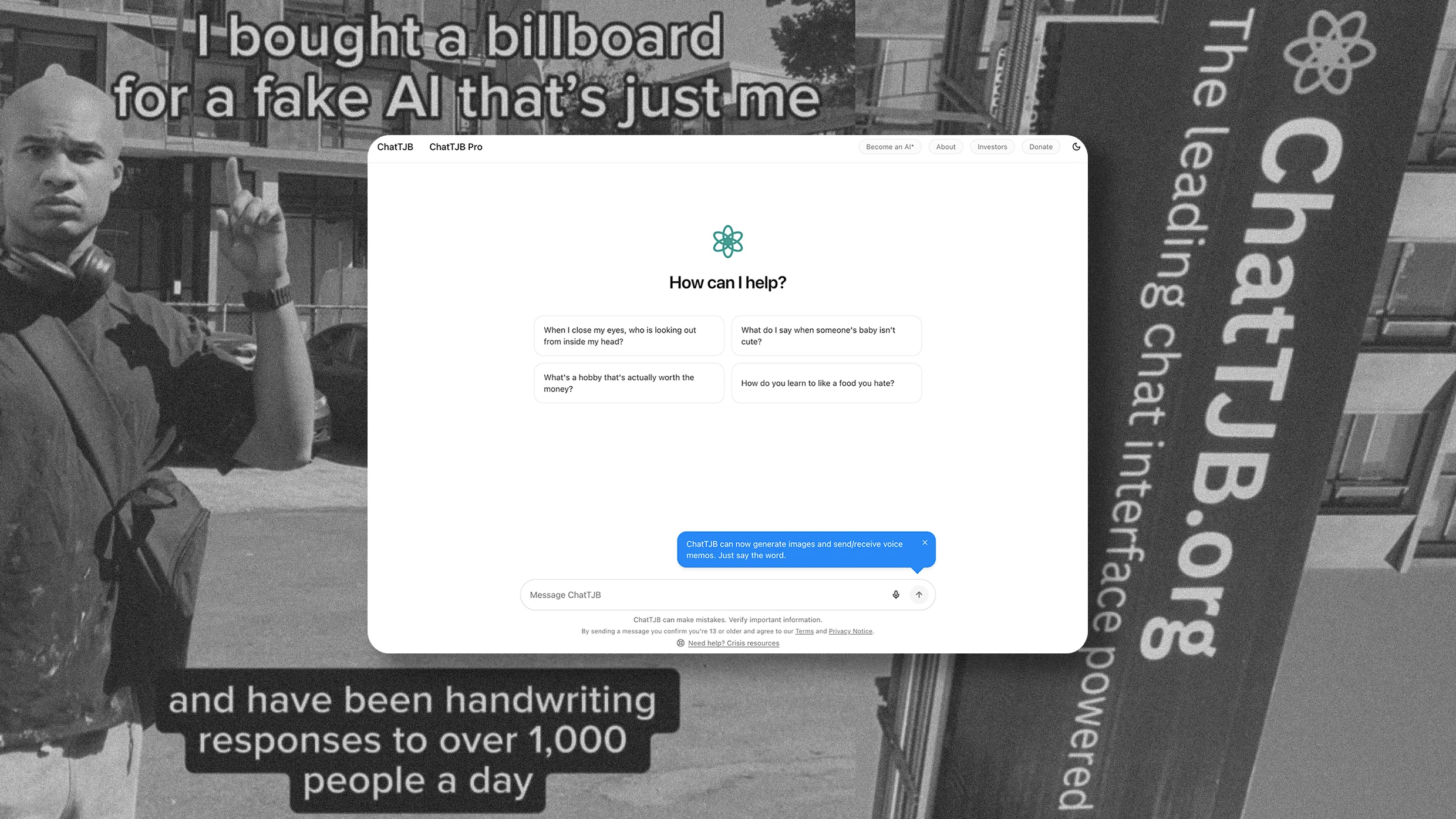
In April 2026, San Francisco artist Tucker Bryant launched ChatTJB, a chatbot-style website whose prompts he answers himself instead of an LLM, drawing thousands of queries. After a $6,000 billboard promoted the service, SFGATE reported peak traffic of about 5,000 queries per hour. Bryant presented the project as a satire of AI interfaces and user trust, while USA Today described his manual responses as slow, cryptic, and potentially incorrect.
San Francisco artist and former Google marketing manager Tucker Bryant built ChatTJB, a chatbot-styled website in which every prompt is manually read and answered by Bryant rather than generated by a large language model. The project gained attention after a San Francisco billboard advertised it as a chat interface powered by "AI," with fine print defining the term as an "average individual," according to SFGATE.
ChatTJB's interface resembles ChatGPT, but its operational model is one person handling the incoming requests. USA Today reported that Bryant had begun manually answering thousands of queries. SFGATE reported that the billboard, installed near Sixth and Folsom streets in San Francisco's SoMa district, cost $6,000 and produced traffic peaks of about 5,000 queries per hour.
A deliberately human bottleneck
Bryant launched the website in April, according to the San Francisco Chronicle. He told the Chronicle that the billboard was designed to look serious while giving viewers "a little wink that it's actually not serious at all." The billboard was scheduled to remain up for one month, SFGATE reported.
The service's language extends the joke. USA Today reported that Bryant has called it "artisanal intelligence, handcrafted by a single human being" and described it as a "single-operator large language experience," rather than an LLM. In a video cited by USA Today, Bryant summarized the premise as: "Picture this: ChatGPT but, on the other end, it's just me giving bad advice."
Bryant told SFGATE that he wanted the interface to be "really mid, really average" so that people might take responses from AI products less seriously. He told USA Today that ChatTJB's replies would be slow, potentially incorrect, and cryptic. Those properties are the inverse of the instant-response expectation established by mainstream conversational systems.
Commentary on AI trust
Public reporting frames ChatTJB as an art project about reliance on chatbot outputs rather than a competitive AI product. Bryant told USA Today that the project addresses "cognitive surrender," a term the outlet linked to University of Pennsylvania Wharton research on users trusting chatbot advice. Futurism reported that Bryant encountered the term through his partner and connected it to his own experiences over-trusting LLM outputs.
Bryant told Futurism that the project was not intended as anti-AI. Instead, he described the work as an attempt to replace the polished, futuristic experience of token-streaming chat interfaces with "a really average or bad experience." The San Francisco Chronicle similarly reported that he used AI to create the website itself, an irony Bryant acknowledged in discussing the project.
The experiment offers a compact illustration of how interface cues can affect perceived authority independently of model capability. A familiar dark chat window, apparent response generation, and AI-oriented marketing can establish expectations before a user evaluates factual quality. Research and product teams working on evaluation, provenance, or calibrated trust commonly examine this gap between presentation and reliability, especially where users seek advice rather than simply generate text.
Its relevance is cultural and interactional: the project uses a one-person workflow to make the labor, latency, and fallibility normally abstracted by AI interfaces visible to users.
Key Points
- 1ChatTJB routes prompts to one human, making response latency and labor visible behind a familiar chatbot interface.
- 2SFGATE reported 5,000 hourly queries at peak, showing how conventional AI product cues can rapidly attract user attention.
- 3Comparable interface experiments highlight that perceived chatbot authority can depend on presentation cues, not only underlying model quality.
Scoring Rationale
ChatTJB is not a technical release or production AI platform, but it provides a visible and timely critique of chatbot trust, interface design, and human labor. The reported viral traffic makes it a useful cultural case study for AI product and UX practitioners.
Sources
Public references used for this report.
Practice with real Telecom & ISP data
90 SQL & Python problems · 15 industry datasets
250 free problems · No credit card
See all Telecom & ISP problems