
RoboCup 2026 Humanoid League Declares Division Winners
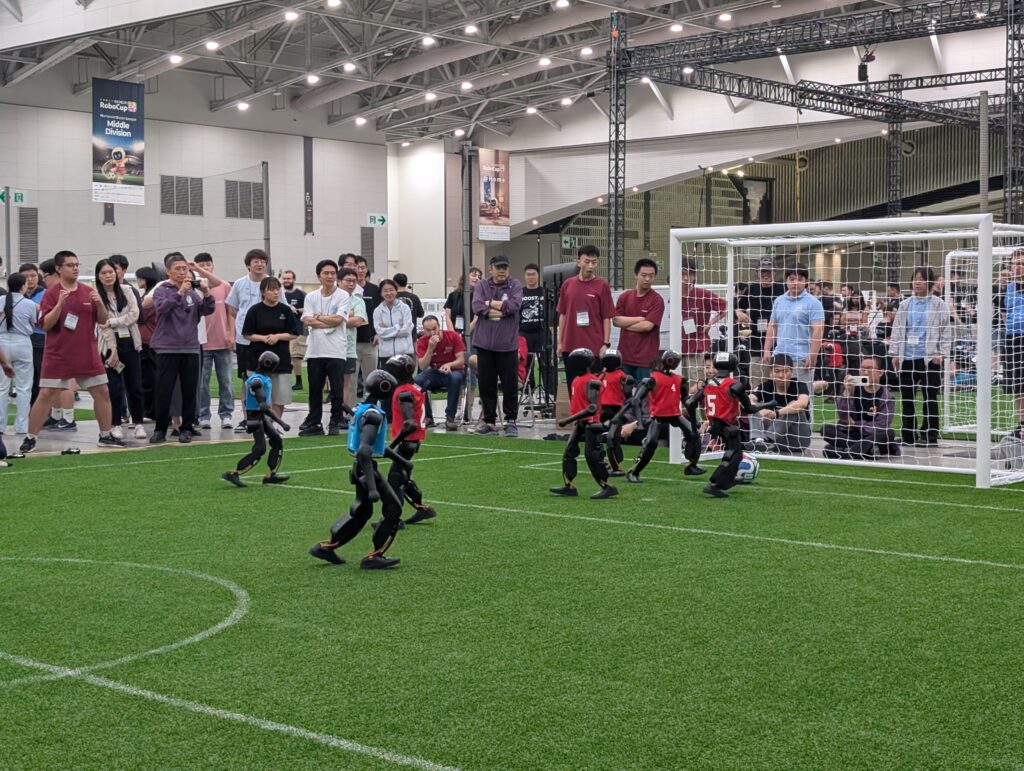
The official RoboCup 2026 Humanoid Soccer League results list Invic, B-Human, and Tsinghua Hephaestus as the Small, Middle, and Large Division winners in Incheon. For robotics and embodied-AI practitioners, the result is useful less as a scoreboard than as a signal of which teams' locomotion, perception, control, and game-stack choices survived a public multi-agent evaluation. The newly merged HSL also matters because it combines the prior Standard Platform and Humanoid leagues, making the 2026 results a baseline for future comparisons across hardware sizes and software stacks.
RoboCup results are a practical benchmark signal for embodied-AI teams because they expose full-stack systems to messy perception, locomotion, coordination, and recovery problems in public competition rather than isolated lab demos. The main takeaway is not that one model or robot won, but that the teams at the top of each division now become reference points for reusable robot-soccer tooling, simulation practices, gait control, and multi-agent decision loops.
What happened
The official RoboCup Humanoid Soccer League results page lists Invic from Wuhan University as the Small Division winner, B-Human from Universitaet Bremen and DFKI as the Middle Division winner, and Tsinghua Hephaestus from Tsinghua University as the Large Division winner. The final rankings also name Hamburg Bit-Bots, HTWK Robots, CAU Mountain&Sea, GeoHBots, Rhoban, and Water among the podium teams.
Technical context
The 2026 Humanoid Soccer League is the first season after the Standard Platform League and Humanoid League were merged. The league used Swiss-style seeding before knockout rounds, which makes the event a useful but imperfect comparison point: teams faced a compressed schedule and a broad mix of opponents before the bracket decided final placements.
For practitioners
The most useful follow-up is to watch which winners publish technical reports, code, hardware notes, or simulation assets. RoboCup performance often reflects integration quality across vision, controls, localization, communication, and recovery behavior, so the public artifacts can matter more than the final scoreline for teams building field robots or embodied-ML experiments.
What to watch
The HSL merger should make year-over-year comparison cleaner after 2026, but this first season should be treated as a baseline. Teams and researchers should compare future results against both division placement and open research challenge outputs rather than reading a single final ranking as a complete measure of robot capability.
Key Points
- 1RoboCup podiums expose integrated robotics stacks under public, multi-agent competition pressure rather than isolated benchmark conditions.
- 2The merged HSL format makes 2026 a baseline year for comparing future humanoid-soccer systems across hardware sizes.
- 3Practitioners should track post-event code, reports, and simulation assets from winning teams for reusable engineering patterns.
Scoring Rationale
This is a solid robotics and embodied-AI benchmark signal, but it is not a broad industry-shifting event. The value is mainly practitioner-facing: the winning teams and open challenge outputs can guide future robot-soccer systems, controls work, and multi-agent robotics research.
Sources
Public references used for this report.
Practice interview problems based on real data
1,625 SQL & Python problems across 15 industry datasets — the exact type of data you work with.
Try 250 free problems