MGI and Shanghai AI Lab Launch ProtoPilot and BioLab Bench
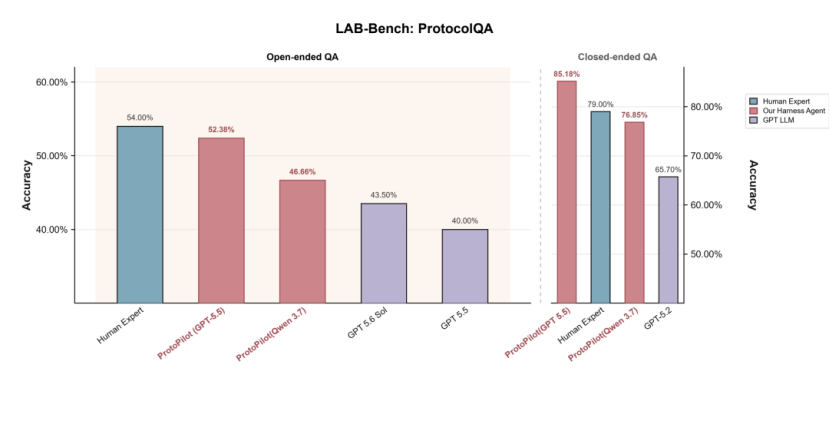
MGI Tech subsidiary Genoria AI and Shanghai AI Laboratory announced ProtoPilot and BioLab Bench on July 3, 2026, and their release says ProtoPilot reached 52.38% on ProtocolQA. The practitioner significance is the hardware loop: this is framed as a life-sciences agent stack that moves from experimental intent to protocol, SOP, device code, execution, and wet-lab feedback. The arXiv preprint describes BioLab Bench as an expert-grounded evaluation framework built from 294 synthetic-biology and molecular-biology tasks, so the useful question is not whether the agent writes plausible protocols, but whether its outputs remain safe, executable, and reproducible on automated lab platforms.
The important shift in this announcement is that life-sciences agents are being evaluated against physical execution, not only text-answer quality. For AI and data-science teams working near lab automation, that moves the benchmark target from 'can the model reason about biology?' to 'can the system preserve intent, parameters, device constraints, and recovery behavior across a real workflow?'
What happened
MGI Tech says its subsidiary Genoria AI and Shanghai Artificial Intelligence Laboratory announced ProtoPilot, a self-evolving multi-agent system for biological protocol generation and execution, alongside BioLab Bench, an evaluation framework for life-science agents. The company release says ProtoPilot spans Design2Protocol, Protocol2Code, Device Execution, and Wet-Lab Feedback, and reports a 52.38% ProtocolQA result against a 54% human-expert reference point.
Technical context
The linked arXiv preprint describes BioLab Bench as an expert-grounded framework using 294 synthetic-biology and molecular-biology tasks derived from 98 gold-standard protocols, with protocol design, SOP generation, device-code translation, validity gates, and wet-lab tests. That matters because protocol text can look convincing while still failing on volumes, labware, incubation conditions, device mappings, or safety constraints.
For practitioners
The useful reading is cautious but concrete: ProtoPilot is evidence that agent workflows for biology are moving toward closed-loop execution, but adoption will depend on independent replication, hardware coverage, audit trails, and failure handling. Teams evaluating similar systems should ask whether benchmark scores include real device constraints and wet-lab feedback, not just LLM-written protocols.
What to watch
Look for third-party reproductions of the BioLab Bench setup, additional device integrations, public protocol-to-code failure cases, and whether labs outside MGI or Shanghai AI Lab can reproduce the claimed execution gains. Those signals will matter more than the headline ProtocolQA number alone.
Key Points
- 1ProtoPilot shifts evaluation toward executable lab workflows, tying biological intent to SOPs, device code, and wet-lab feedback.
- 2BioLab Bench is useful because it tests procedure validity and hardware constraints, not only plausible protocol text.
- 3Practitioners should wait for independent replication and broader device coverage before treating the benchmark as operational proof.
Scoring Rationale
The story is notable because it connects agentic AI evaluation to automated wet-lab execution and includes an arXiv preprint plus specific benchmark claims. It stays below major-industry impact because the claims are mainly from the announcing organizations and still need independent replication across labs and devices.
Sources
Public references used for this report.
Practice with real Health & Insurance data
90 SQL & Python problems · 15 industry datasets
250 free problems · No credit card
See all Health & Insurance problems