The Tech Humanist Show Explores AI Augmentation vs Automation
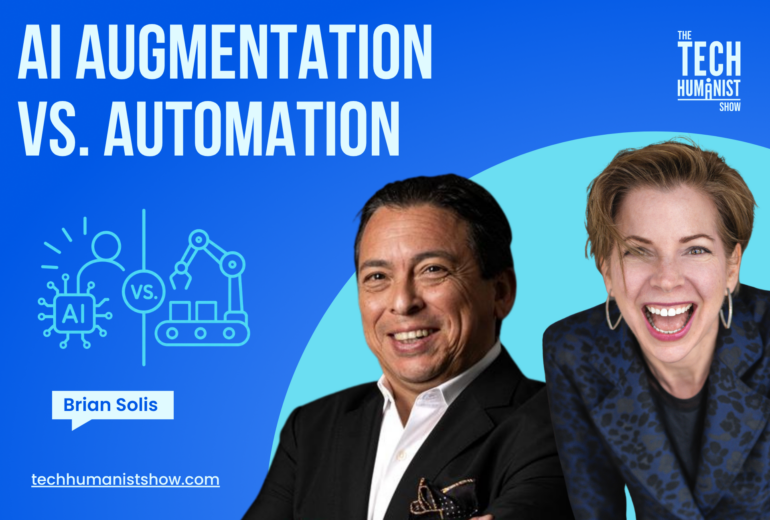
The Tech Humanist Show episode "AI Augmentation vs. Automation" pairs host Kate O'Neill with guest Brian Solis, Head of Global Innovation at ServiceNow, to discuss leadership and human-centered choices in the AI era, including the concept of "cognitive Darwinism," AI augmentation versus automation, and reskilling case studies from IKEA and Walmart. The episode runs about 45 minutes, according to Apple Podcasts, and is posted on BrianSolis.com and distributed via Apple Podcasts, Deezer, and Spotify.
What happened
The Tech Humanist Show published an episode titled "AI Augmentation vs. Automation" featuring host Kate O'Neill and guest Brian Solis, who is listed as Head of Global Innovation at ServiceNow, per BrianSolis.com. The episode covers a set of leadership and transformation topics including cognitive Darwinism, an explicit contrast between AI augmentation and automation, evaluation of efficiency versus net-new value, and workforce reskilling case studies involving IKEA and Walmart, as documented on the episode pages on BrianSolis.com, Apple Podcasts, and Deezer. The episode's length is listed at about 44-45 minutes on Apple Podcasts and Deezer.
Editorial analysis - technical context
Industry-pattern observations: the episode frames AI adoption as less about replacing workers and more about redesigning work and leadership mindsets. That framing aligns with a broader practitioner conversation where augmentation-focused projects prioritize human-in-the-loop design, change management, and measurable business outcomes over pure automation. Observers tracking enterprise AI adoption will recognize familiar tensions: capacity and capability overhang, the need for psychological safety during change, and the tradeoff between incremental efficiency and creating net-new value.
Context and significance
Key thematic details reported in the episode
- •Cognitive Darwinism and the psychological impacts of rapid technology change are called out as central challenges, per the episode chapter listing on BrianSolis.com.
- •The episode explicitly contrasts AI augmentation with automation and examines when organizations should seek net-new value versus pure efficiency, as shown in the episode chapters on Apple Podcasts and Deezer.
- •Reskilling and workforce transformation are discussed with IKEA and Walmart presented as case studies in the episode metadata on BrianSolis.com.
What to watch
Practical takeaway for practitioners
Editorial analysis
this episode joins a growing set of practitioner-facing conversations that foreground leadership, ethics, and workforce development alongside technical capability. For AI/ML teams embedded in enterprises, the emphasis on reskilling case studies from large retailers highlights operational realities: cross-functional coordination, programmatic learning, and metrics that extend beyond throughput to employee capability. The language used in the episode, such as "AIQ" and "return on intelligence," reflects a shift in business vocabulary that practitioners see when organizations move from experimental pilots to scaled programs.
practitioners and leaders should monitor how organizations translate augmentation rhetoric into measurable programs. Useful indicators include the presence of human-centered metrics (psychological safety, role evolution), investment in distributed learning pathways, and pilot designs that pair automation with role redesign. Podcast conversations like this can presage where enterprise attention and vocabulary are shifting, but they do not substitute for documented program outcomes or vendor roadmaps.
episodes framed around leadership and human-centric adoption provide a helpful checklist for teams designing AI initiatives: clarify whether a use case aims for augmentation or replacement; define success metrics that include human outcomes; and plan reskilling as a program rather than a one-off course. The episode surfaces cultural and strategic questions that engineering and product teams will need to translate into governance, measurement, and operational design.
Availability
The episode is available on BrianSolis.com, Apple Podcasts, Deezer, and streaming platforms such as Spotify, per the published episode pages.
Key Points
- 1Podcast episode contrasts AI augmentation with automation, urging evaluation of efficiency versus net-new value for enterprise use cases.
- 2Reskilling case studies from IKEA and Walmart underscore the operational complexity of workforce transformation, not just training rollouts.
- 3Industry conversations increasingly prioritize human-centered metrics and psychological safety alongside technical performance in scaled AI programs.
Scoring Rationale
A practitioner-oriented podcast episode on AI augmentation vs automation, useful for enterprise AI program leaders, but it is a discussion format without new research or deployments. The IKEA and Walmart workforce reskilling framing adds practical depth, but the format limits its reach to practitioners seeking strategic framing rather than technical or operational specifics.
Sources
Public references used for this report.
Practice with real Ad Tech data
90 SQL & Python problems · 15 industry datasets
250 free problems · No credit card
See all Ad Tech problems