Tencent Tests AI Agent for WeChat Super App
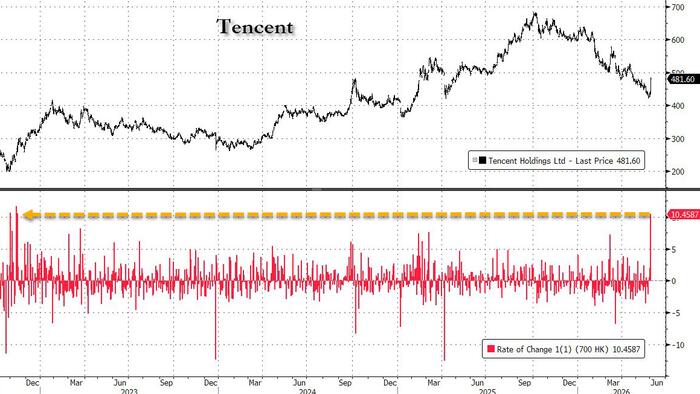
Shares of Tencent jumped about 10.5%, the largest one-day gain since November 2022, after the Financial Times reported the company was testing a prototype AI agent for WeChat and preparing a compliance process that could begin this month, according to the FT and follow-up coverage by Bloomberg and Dow Jones/Morningstar. The FT report, citing unnamed people, said Tencent would test the agent with a small group of external users before a phased rollout and that users could access the agent by swiping right on WeChat to invoke a chat box that taps into mini-programs, per the FT. Market commentary from Citi and Union Bancaire Privée framed the timing as earlier-than-expected and cited the WeChat ecosystem as a natural fit for agent-driven tasks. Tencent declined to comment on the FT report, according to SCMP and Dow Jones.
What happened
Shares of Tencent surged about 10.5% on June 2, 2026, marking the largest one-day gain since November 2022, according to Dow Jones/Morningstar and SCMP reporting. The move followed a Financial Times article that reported Tencent was testing a prototype AI agent for WeChat and had begun preparatory compliance steps that could start as soon as this month, the FT reported, citing unnamed people with knowledge of the matter. The FT story said Tencent plans to test the agent with a small group of external users before a phased rollout and described a demo in which users access a chat box by swiping right on the main WeChat screen and instruct the agent to complete tasks across WeChat mini-programs, per the FT. Multiple outlets, including Bloomberg and SCMP, noted the stock move also lifted the Hang Seng Tech Index, which rose 4.7% on the day, per market reports.
Technical details
Editorial analysis - technical context
Large consumer super apps like WeChat are a natural integration surface for conversational AI because they combine messaging, payments, content and a broad mini-program ecosystem. Industry observers have pointed out that mini-programs provide a programmatic interface an agent could call to complete end-to-end tasks such as ordering or scheduling, a pattern already discussed in academic and industry work on agentification and tool use by LLMs.
Context and significance
Reporting frames the FT account as notable primarily because Tencent has been perceived by some analysts as trailing domestic peers on visible AI productization, and an earlier-than-expected agent test changed market sentiment, according to Citi and Union Bancaire Privée commentary cited by Dow Jones and ZeroHedge. For practitioners, a widely deployed agent inside a super app would raise practical engineering questions around secure API integration, latency for multi-step workflows, access control for third-party mini-programs, and compliance with China-specific content and data rules.
What to watch
Industry context
Observers will monitor:
- •whether Tencent files public compliance disclosures or regulatory filings referenced by the FT
- •any public beta or external user tests that confirm the FT timeline
- •technical signals such as published SDKs, developer documentation for mini-program agent access, or partnerships with model providers. Media outlets report Tencent declined to comment on the FT story, per SCMP and Dow Jones
Editorial analysis
If Tencent or other Chinese super apps enable programmatic agent access to internal ecosystems at scale, practitioners should expect increased demand for robust authentication, transaction-safe prompts, and tooling for multi-step orchestration and observability. Industry players building agent tooling will also watch how regulators and platform owners balance automation with content-control and payment-security requirements.
Key Points
- 1Reported testing of a WeChat AI agent drove a 10.5% stock rally, showing investor sensitivity to AI product timelines.
- 2WeChat's mini-program ecosystem provides practical primitives for agent task automation, lowering integration friction.
- 3Practitioners should watch for regulatory/compliance disclosures and developer hooks that will determine real-world adoption.
Scoring Rationale
The report concerns a major platform potentially enabling large-scale agent deployment inside WeChat, which matters for practitioners building agent integrations and monetization paths. Coverage is based on FT reporting and unnamed sources, so the signal is important but still early.
Sources
Public references used for this report.
Practice interview problems based on real data
1,625 SQL & Python problems across 15 industry datasets — the exact type of data you work with.
Try 250 free problems