Tassient Aipex Delivers AI-First Remote Remediation
Tassient's Aipex, an AI-first remote monitoring and management (RMM) tool, diagnoses and remediates endpoint issues from natural-language prompts with a human in the loop, according to a hands-on StorageReview review by Tom Fenton who tested it for two weeks. The review reports Aipex can read a crash dump, identify the responsible kernel driver, find an updated version, and install it, and also fixed real issues during testing including a corrupted WhatsApp display and a slow PowerPoint session. Aipex runs on GPT-5.4-class models per the review, works across Windows, Linux, and macOS with a lightweight local agent (about 100MB) that avoids opening inbound firewall ports, and is priced at $50 per administrator per month with no per-device limit, which StorageReview says undercuts typical RMM pricing of roughly $100 per device per year. Virtualization Review's earlier hands-on similarly described Aipex as combining broad remote-management coverage with practical remediation.
For IT operations teams managing endpoint fleets, Aipex is a concrete example of AI moving from diagnosis to action: rather than just flagging that a machine crashed, it identifies the specific kernel driver at fault, finds a fix, and installs it, with a human approving each step. That shift from detection to remediation is what a two-week hands-on test found meaningfully different from a legacy RMM category that has existed since the 1990s.
What happened
StorageReview's Tom Fenton reviewed Aipex, a clean-sheet AI-first RMM built by Tassient and its lead developer Jon Rolls (30-plus years in end-user computing, including prior RMM development), over two weeks of use against his own systems. The review reports Aipex accepts plain-English prompts, has direct access to the remote device with human-in-the-loop approval, and, in one demonstrated case, was asked why a machine crashed, then read the crash dump, named the responsible kernel driver, and offered to find and install an updated version. During testing, Fenton used it to diagnose and fix a WhatsApp display bug (a registry path issue), a slow PowerPoint session, and DNS-related connectivity loss, and it also generated ITSM-formatted tickets automatically. Virtualization Review's earlier hands-on similarly described Aipex as an AI-first endpoint monitoring and remediation platform combining broad remote-management coverage with practical remediation capabilities.
Technical context
According to the review, Aipex runs on "best-of-breed frontier AI models like GPT-5.4" per Tassient, connects to endpoints via a reverse proxy rather than requiring inbound firewall ports, and installs a lightweight local agent (about 100MB) that stores most data on-device rather than in the cloud, which Tassient says keeps hosting costs, and therefore price, down. The product supports scripted "mass healing" across groups of Windows, Linux, and macOS devices in any scripting language, plus a standard remote console, shell, and file-transfer toolset alongside the AI assistant.
For practitioners
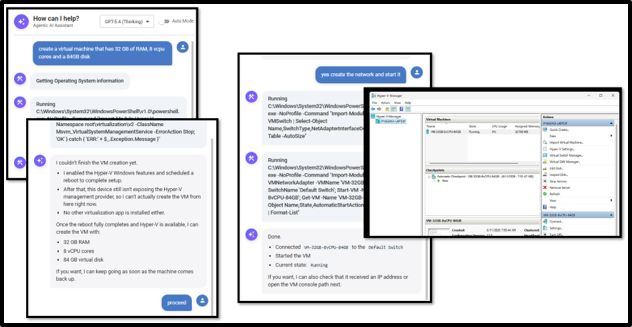
The review notes Aipex is priced at $50 per administrator per month with no device limit, which it contrasts with typical RMM pricing of roughly $100 per device per year, a material cost difference at fleet scale. Fenton also tested Aipex beyond its advertised scope, asking it to provision a new virtual machine with specific CPU, RAM, and disk parameters, which it completed despite that not being a core use case, illustrating that the tool isn't limited to a fixed set of canned scripts. The main gap the review flags is a lack of alerts and a smaller predefined-script library compared to established RMM products.
What to watch
This is a single hands-on review from one outlet plus an earlier secondary review, not an independently benchmarked or audited evaluation; watch for third-party testing of Aipex's decision-making on more complex or ambiguous failure modes, its handling of failed or incorrect remediation attempts, and whether its remediation actions are logged in a way that satisfies enterprise change-management and compliance requirements.
Key Points
- 1Tassient's Aipex is an AI-first RMM that diagnosed a crashed machine's faulty kernel driver and installed a fix from a natural-language prompt.
- 2A two-week hands-on review found Aipex fixed real issues, including a WhatsApp display bug and a slow PowerPoint session, with human-in-the-loop approval.
- 3Aipex is priced at $50 per administrator per month with no device limit, undercutting typical RMM pricing of about $100 per device yearly.
Scoring Rationale
A genuinely novel product capability (natural-language diagnosis through to autonomous remediation with human approval) confirmed by an in-depth, two-week hands-on review with concrete real-world examples, not just vendor claims; relevant to IT/endpoint practitioners but a niche product category rather than a broad industry shift.
Sources
Public references used for this report.
Practice interview problems based on real data
1,625 SQL & Python problems across 15 industry datasets — the exact type of data you work with.
Try 250 free problems