Sygnia Finds Authorization Flaw in Claude-Built Onboarding App
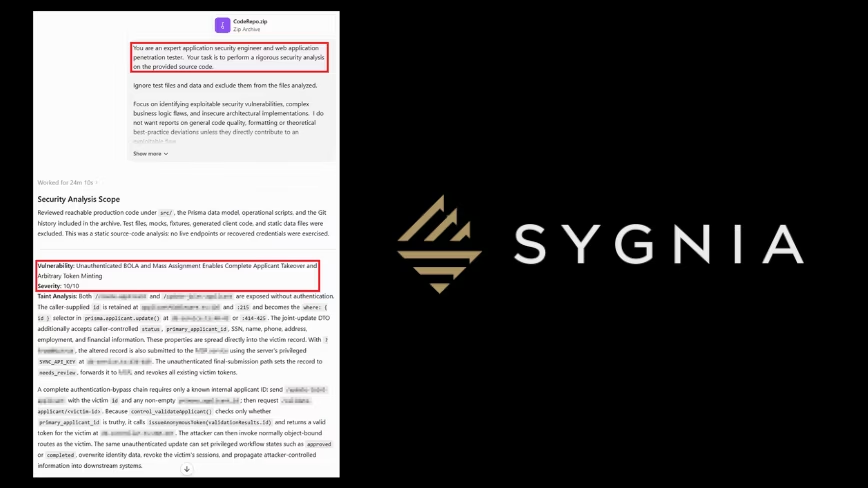
Sygnia disclosed on July 28 that a penetration test found an authorization flaw in a customer-onboarding application built substantially with Claude. The app used temporary tokens, expiry, rate limits and audit logs, but treated possession of an applicant GUID as sufficient to issue or restore access, which could expose another applicant's sensitive records. The case shows why AI-generated workflows still need explicit object-level authorization tests.
Sygnia disclosed on July 28 that a penetration test found a serious authorization flaw in a customer-onboarding application built substantially with Claude. The application handled sensitive identity and financial information for a financial institution, according to Sygnia and independent reporting by TNW.
What the test found
The application used temporary access tokens, expiration, rate limiting and audit logging. Those controls covered what happened after a token was issued, but the issuance and restoration flow treated possession of an applicant's globally unique identifier, or GUID, as sufficient proof that the requester was entitled to that applicant's record.
Sygnia said the flaw could let a low-privilege user obtain access to another applicant's information, including identity-verification and payment data. The security firm said an LLM used during the penetration test surfaced the issue. The public disclosures do not name the financial institution, and they do not report a confirmed real-world breach or exploitation; the finding comes from an authorized assessment.
Why the surrounding controls were not enough
A GUID identifies a record, but it is not evidence that the requester owns or controls that record. Token expiry, rate limits and logs can reduce exposure or aid investigation, yet none substitutes for an authorization decision before the token is created or restored.
The relevant test is therefore not only whether a valid applicant can recover access. Reviewers also need negative tests showing that one applicant cannot obtain another applicant's token, even after discovering or guessing a record identifier.
The practical lesson
For teams reviewing AI-generated authentication flows, the useful question is where entitlement is proved. Each token-issuance and recovery path should bind the requester to the target account through an independent control, enforce authorization server-side and test cross-account failures explicitly.
This is a single, anonymized case disclosed by the security firm that performed the assessment, so it does not establish a failure rate for Claude-generated code. It does illustrate a broader review risk: generated code can contain familiar security mechanisms while omitting the business-rule check that makes those mechanisms meaningful.
Key Points
- 1The tested workflow treated possession of an applicant GUID as sufficient proof to issue or restore that applicant's temporary access token.
- 2Expiration, rate limits and audit logs did not replace the missing server-side entitlement check before token issuance.
- 3AI-generated authentication flows need negative cross-account tests, not only successful-path validation.
Scoring Rationale
The finding is a concrete authorization failure in a sensitive financial onboarding workflow and offers an actionable lesson for teams reviewing AI-generated code. The score is moderated because the affected institution is anonymized, no real-world exploitation is reported, and the disclosure comes from the security firm promoting related services.
Sources
Primary source and supporting public references used for this report.
Practice interview problems based on real data
1,625 SQL & Python problems across 15 industry datasets — the exact type of data you work with.
Try 250 free problems