Survey Maps the Long-Horizon AI Agent Stack
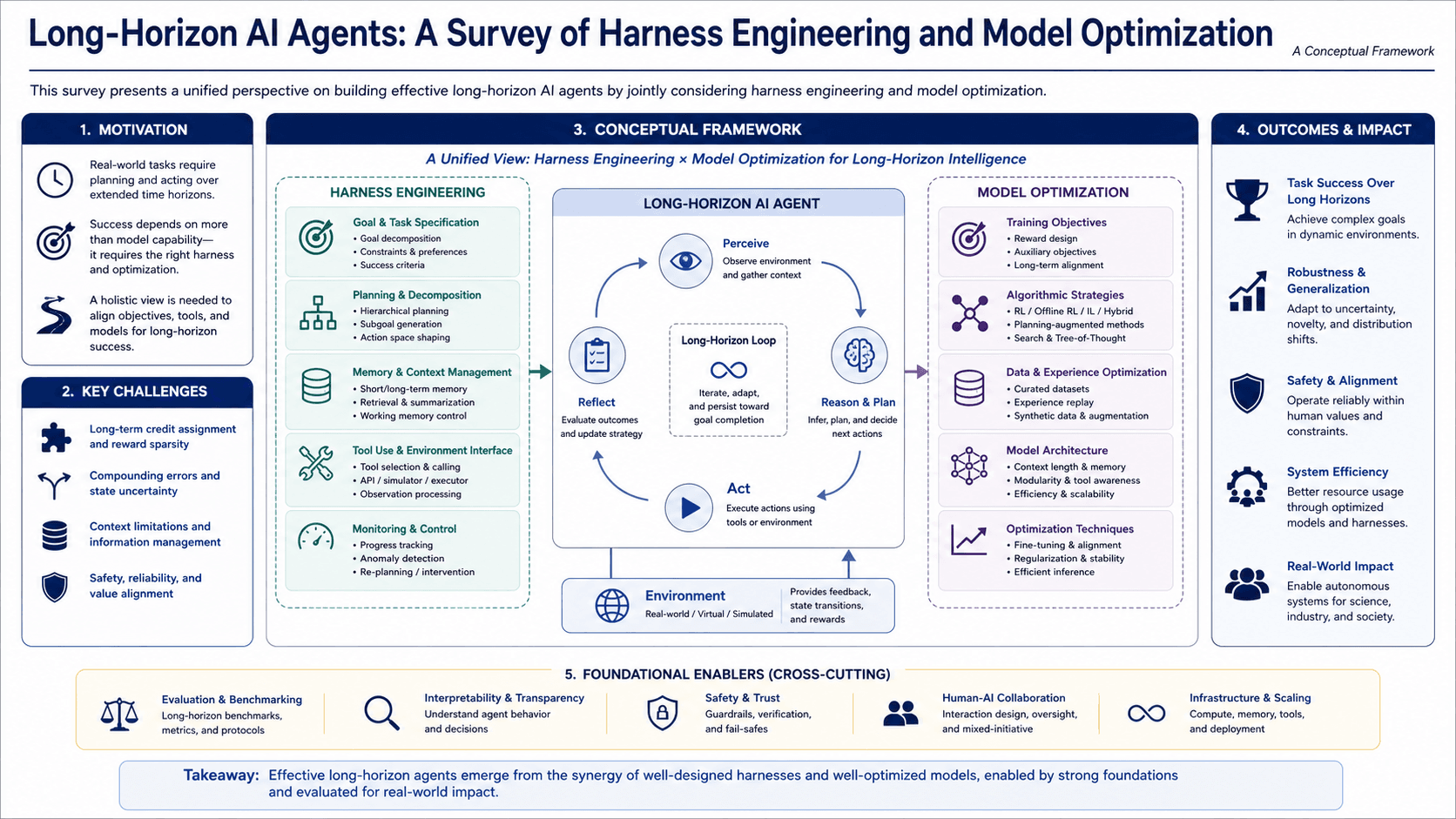
A 20-author survey posted July 17 proposes a unified framework for long-horizon AI agents, separating external harness engineering from model optimization and mapping three task levels to three required capabilities. Its analysis of METR data estimates agent task horizons doubled every 6.5 months across the full series and every 4.3 months for post-2023 models, but the 149-page paper is a preprint and has not been peer reviewed.
A 20-author research team posted *Towards Long-Horizon Agents: A Survey* on July 17, offering a common vocabulary for systems that must sustain many interdependent decisions rather than answer a single prompt. The 149-page preprint treats long-horizon capability as a property of the whole model-and-harness system, not the foundation model alone.
The paper is a survey and conceptual framework, not a new agent benchmark or a peer-reviewed experimental result. Its value lies in organizing a fragmented field and making the engineering boundary explicit.
Three levels of long-horizon work
The authors define three nested task levels and the capabilities needed to handle them:
- •H1 / C1: work completed within one context window still requires interactive reasoning through repeated planning, action, feedback and correction.
- •H2 / C2: work that crosses windows or sessions requires durable state, memory, checkpointing and reliable handoffs.
- •H3 / C3: open-ended task streams require experience accumulation, reusable skills and adaptation across tasks.
This framing distinguishes a task that merely runs for a long time from one whose decisions remain logically coupled across a long trajectory. A system can stay active for hours and still fail the paper's definition if it cannot preserve goals, recover from errors or resume accurately.
Harnesses and models co-evolve
The survey organizes the field around two connected lines. External harness engineering supplies loops, context management, tools, orchestration, hooks and verification. Internal model optimization develops compatible capability through architecture, data and environment synthesis, training, reinforcement learning, distillation and self-improvement.
For practitioners, that division offers a useful diagnostic
a failure may come from the model policy, or from missing runtime controls such as state persistence, tool governance and validation. The paper argues that stronger models and stronger harnesses reinforce one another rather than replace one another.
A fast-moving but uncertain frontier
Using METR's 50%-task-completion time horizon as a proxy, the authors estimate a 196.5-day doubling time across a stitched historical series and 130.8 days for models released from 2023 onward. They also caution that the underlying tasks are automatically scorable software-style work, methodologies differ across the historical series, and estimates near the benchmark's roughly 16-hour reliability boundary carry substantial uncertainty.
The practical takeaway is not that a specific agent can now run indefinitely. It is that teams evaluating long-running agents should measure recovery, cross-context state, task completion, cost and safety alongside single-step model accuracy.
Key Points
- 1The survey defines long-horizon agency as a model-and-harness system and maps H1-H3 task levels to C1-C3 capabilities.
- 2Its METR-based analysis estimates task-horizon doubling times of 6.5 months across the full series and 4.3 months for post-2023 models, with important methodology limits.
- 3For builders, the framework separates failures in model policy from gaps in memory, orchestration, tool governance, verification and recovery.
Scoring Rationale
The preprint provides a broad, timely taxonomy with direct value for agent architecture and evaluation, but it is a survey rather than a validated new system and has not been peer reviewed.
Sources
Primary source and supporting public references used for this report.
Practice interview problems based on real data
1,625 SQL & Python problems across 15 industry datasets — the exact type of data you work with.
Try 250 free problems