Supermicro Expands Edge AI Systems With Intel
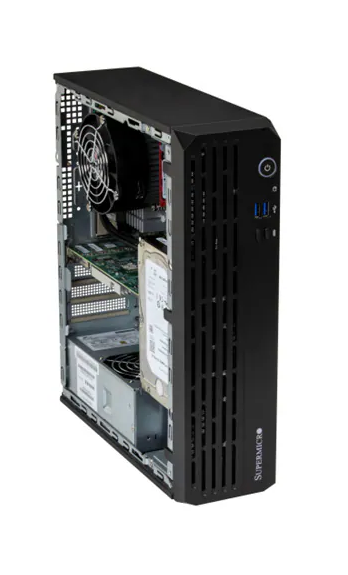
Supermicro announced an expanded edge AI portfolio built around Intel Core Ultra Series 3, Intel Core Series 2, and Intel Arc Pro B-series GPUs, according to a PR Newswire release and Supermicro product materials. The new lineup includes fanless industrial, short-depth 1U, and mini-tower form factors for retail, manufacturing, physical security, transportation, and logistics, per Supermicro's datasheet and PR release. The DIN-rail fanless SYS-E103-14P uses an Intel Core Ultra Series 3 processor and integrates GPU and NPU acceleration for up to 180 TOPS of combined AI performance (Supermicro datasheet; StorageReview). The Intel Arc Pro B70 GPU delivers up to 367 TOPS and up to 32GB VRAM, while the compact B50 targets lower-power edge use with up to 170 TOPS (Supermicro datasheet). A slim mini tower, SYS-521AD-LN2, supports Intel Core Series 2 with up to 12 P-cores and compact GPU options including Intel Arc Pro B50 and NVIDIA RTX PRO 2000 Blackwell (StorageReview; The Elec).
Why this matters for edge AI practitioners
Supermicro's announcement gives teams deploying on-device inference a concrete set of hardware options with published TOPS figures - B50 at 170 TOPS (70W), B60 at 197 TOPS, B70 at 367 TOPS with up to 32GB VRAM - across form factors ranging from a DIN-rail fanless industrial box to a 1U rackmount and a compact mini tower. For practitioners, the key design choice is whether a given workload fits within the 180 TOPS of the on-die NPU+GPU in the Core Ultra Series 3 SYS-E103-14P (no discrete GPU required) or requires the headroom of a discrete Arc Pro B-series card. The B70's 32GB VRAM makes it viable for running mid-size generative models or large vision pipelines without cloud offload.
What happened
Super Micro Computer (NASDAQ: SMCI) announced on June 23, 2026 an expanded Intel-powered edge AI portfolio covering three new system platforms: the fanless DIN-rail SYS-E103-14P with Intel Core Ultra Series 3 and integrated NPU+GPU; the slim mini tower SYS-521AD-LN2 with Intel Core Series 2 and support for discrete Arc Pro B50 or NVIDIA RTX Pro Blackwell 2000; and an updated short-depth 1U SYS-111AD-WN2R also based on Core Series 2. (PR Newswire; Supermicro datasheet)
Product specs
- •SYS-E103-14P: fanless, DIN-rail, Intel Core Ultra Series 3, integrated GPU+NPU delivering up to 180 TOPS combined, up to 128GB DDR5, operating range 0 to 45 degrees C
- •SYS-521AD-LN2: mini tower, Intel Core Series 2 with up to 12 P-cores, up to 64GB DDR5, supports Intel Arc Pro B50 and NVIDIA RTX Pro 2000 Blackwell
- •Intel Arc Pro B50: 70W, up to 170 TOPS; B60: up to 197 TOPS; B70: up to 367 TOPS, up to 32GB VRAM
Technical context
The product mix follows a common edge inference architecture: CPU-integrated NPUs handle lightweight or continuous inference (computer vision, anomaly detection) while discrete GPUs provide headroom for larger or generative workloads. Supermicro's datasheet highlights OpenVINO optimisation and PCIe 5 connectivity, consistent with industry practice of pairing vendor toolkits with standard interconnects to simplify model portability across heterogeneous hardware. Mory Lin, VP of IoT/Embedded and Edge Computing at Supermicro, stated: "As agentic AI adoption accelerates, organizations need edge infrastructure that can deliver real-time inferencing, low-latency performance, and power efficiency close to where data is generated" (PR Newswire). Dan Rodriguez, corporate VP and GM of Intel's Edge Computing Group, added: "By combining Intel Core Ultra processors and Arc Pro GPUs with Supermicro's edge-optimized systems, customers can deploy AI solutions faster and more efficiently across a wide range of real-world environments" (PR Newswire).
What to watch
Watch for independent benchmark results on representative inference workloads (vision, LLM prefill latency) for the SYS-E103-14P and SYS-521AD-LN2; OpenVINO and mainstream framework driver maturity for Arc Pro B-series; and regional availability and confirmed industrial certifications for the fanless platform's rugged-deployment use cases.
Key Points
- 1Supermicro's lineup combines CPU-integrated NPU/GPU (up to 180 TOPS in the SYS-E103-14P) and discrete Arc Pro cards (up to 367 TOPS for B70), giving edge deployments graded acceleration options for varying model sizes.
- 2The Intel Arc Pro B70's 367 TOPS and up to 32GB VRAM create discrete-GPU headroom for larger on-premises generative or multi-modal inference workloads at the edge.
- 3Fanless DIN-rail and short-depth 1U designs (0-45 degrees C operating range) prioritise thermal and space constraints, reflecting growing demand for ruggedised, deployable edge inference platforms.
Scoring Rationale
Notable product announcement: practitioners gain new Intel-based edge SKUs with published TOPS figures and concrete form-factor specs (fanless DIN-rail to short-depth 1U), verified against Supermicro's own datasheet and PR Newswire release. Story is vendor-driven product launch rather than a frontier-model or paradigm shift, warranting mid-range scoring.
Sources
Public references used for this report.
Practice interview problems based on real data
1,625 SQL & Python problems across 15 industry datasets — the exact type of data you work with.
Try 250 free problems