Sopra Steria Maps European Trust in Agentic Commerce
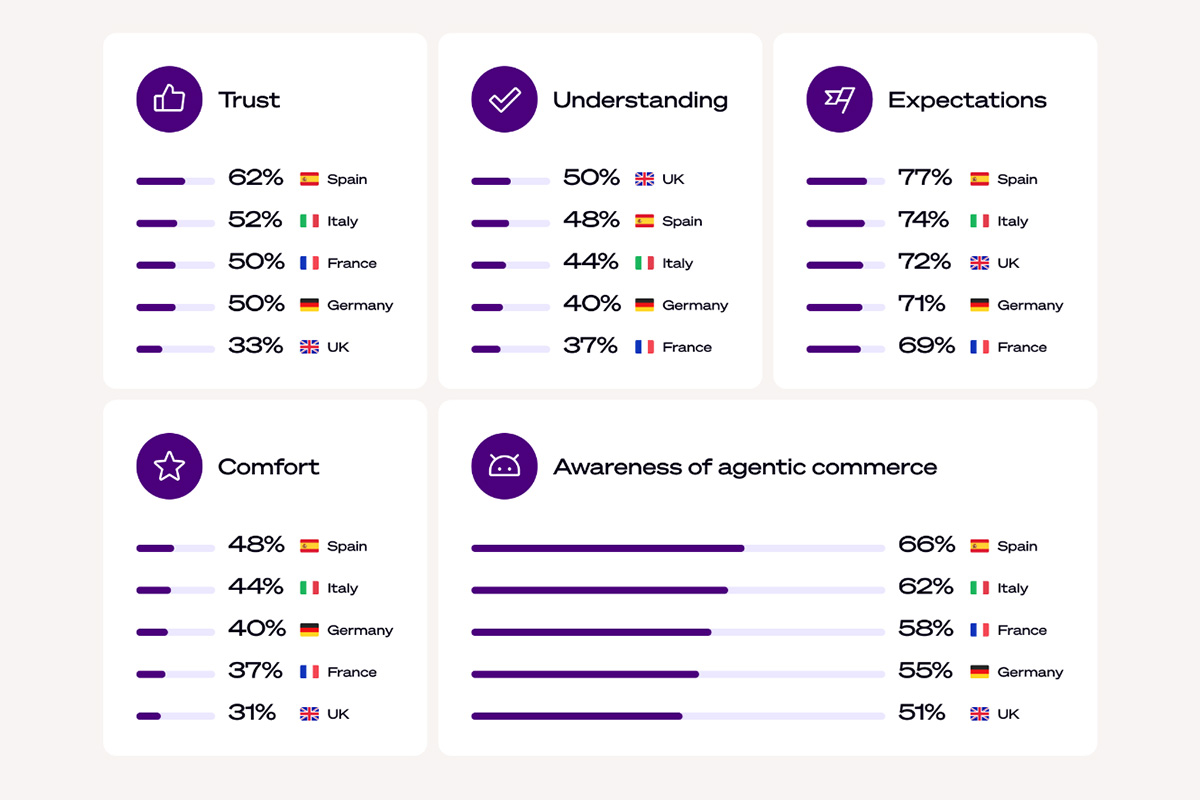
According to a Sopra Steria survey of 8,400 consumers across eight European countries, AI agents could assist 310 billion euros of European e-commerce transactions within ten years, but trust, not technology, is the main barrier: 41% of Europeans say they do not yet trust any single provider to offer them a shopping agent. The May 2026 study found 55% have heard of agentic commerce, 74% still hit friction shopping online, and willingness to delegate varies sharply by category, from 45% for electronics down to 16% for healthcare and groceries. Banks emerged as the most trusted potential providers at 27%, ahead of European tech startups (14%) and US tech giants (10%), which Sopra Steria executives attribute to banks' existing hold on payment infrastructure rather than AI capability. For product and trust-engineering teams, the findings argue for category-aware delegation limits and partnerships with already-trusted institutions.
For product, trust, and payments teams building agentic-commerce features, the headline number here is not the market-size estimate but the trust gap beneath it: four in ten Europeans do not yet trust any single company to run a shopping agent on their behalf, and delegation appetite drops sharply outside a few low-risk categories. That gap, more than any technology constraint, is what will determine which companies actually capture agentic-commerce volume over the next decade.
What happened
Sopra Steria surveyed 8,400 consumers across France, Belgium, Germany, the UK, Italy, Spain, the Netherlands, and Norway (fielded by Cluster17 in February 2026) and estimates AI agents could assist 310 billion euros worth of European e-commerce transactions within ten years. Key findings: 55% of Europeans have heard of agentic commerce, 74% still encounter friction shopping online today, and delegation willingness is sharply category-dependent - 45% for electronics and tech, 39% for energy bills, 36% for insurance, versus 22% for financial services and just 16% for healthcare or groceries. Awareness and comfort also vary widely by country, from 76% in Norway to 38% in France.
Industry context
Banks were named the most legitimate potential shopping-agent provider by 27% of respondents, ahead of European tech startups (14%) and US tech giants (10%); European retailers ranked last at 6%. Sopra Steria's Ayman Awada, Executive Director of its Financial Services Division, said the finding reflects an institutional trust advantage rather than an AI-model advantage: "In agentic commerce, the decisive advantage is not the power of your AI model - it is the legitimacy consumers grant you." Mung Ki Woo, the division's Chief Digital and Innovation Officer, pointed to two concrete moves banks can make now: making payment instruments compatible with agent-initiated transactions, and offering merchants agent-authentication services.
For practitioners
The category split is the most actionable data point here: consumers are nearly three times more willing to delegate electronics and tech purchases than healthcare or groceries, which argues against a one-size-fits-all agent design. Teams should expect friction and drop-off if they push autonomous checkout into low-trust categories before establishing a track record in higher-tolerance categories like electronics or utilities, and should treat explainability and a trusted-partner credential (bank-backed identity or payment verification) as adoption levers rather than optional polish.
What to watch
Sopra Steria's press materials did not include a full country-by-country breakdown, though UK-specific figures reported separately by Retail Technology Innovation Hub show the UK is both the most digitally ready market (50% shop online weekly) and one of the most trust-sensitive, with 57% fearing loss of control over bank details. Watch for whether banks translate their trust advantage into shipped agent-authentication products before tech platforms close the gap with their own trust signals.
Key Points
- 1Sopra Steria's 8,400-consumer survey estimates AI agents could assist 310 billion euros of European e-commerce transactions within the next decade.
- 2Forty-one percent of Europeans do not yet trust any single provider with a shopping agent, and delegation appetite drops sharply for sensitive categories.
- 3Banks lead as the most trusted potential agent provider at 27 percent, suggesting payment-infrastructure incumbents may have an edge over pure AI vendors.
Scoring Rationale
A well-sourced, survey-backed study quantifying both market opportunity and a specific, actionable trust barrier for agentic commerce; useful for product and trust-engineering teams but not a technical breakthrough, so it sits in the solid-notable band rather than higher.
Sources
Public references used for this report.
Practice with real Retail & eCommerce data
90 SQL & Python problems · 15 industry datasets
250 free problems · No credit card
See all Retail & eCommerce problems