Sirish Subash Wins 2024 Young Scientist Challenge
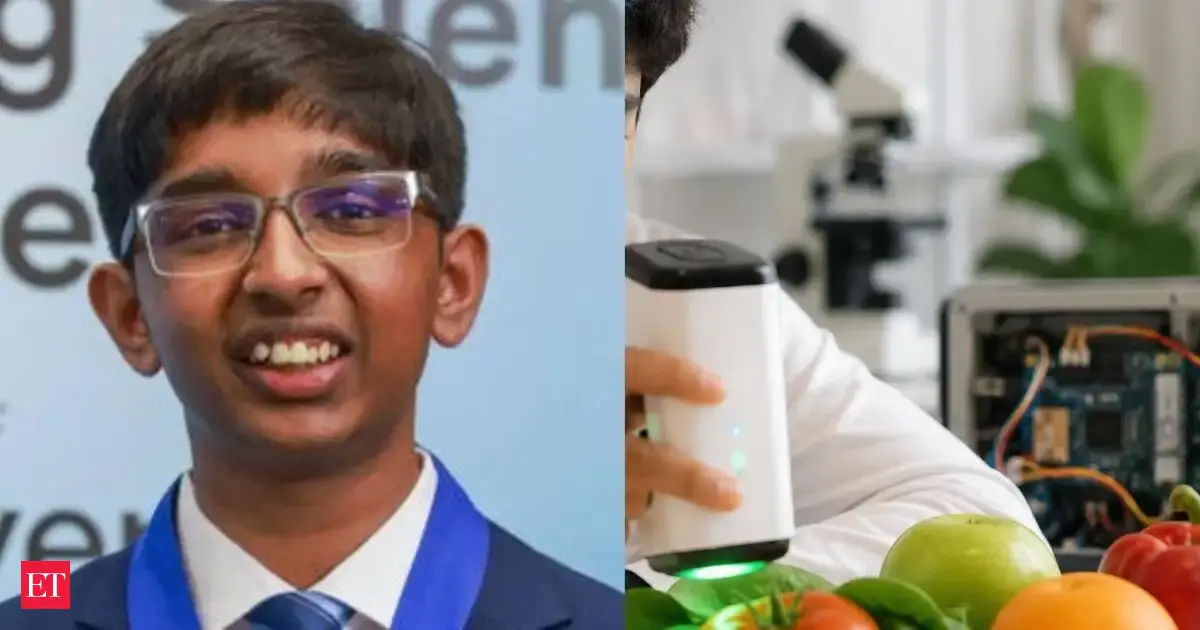
Sirish Subash won the 2024 3M Young Scientist Challenge and a $25,000 prize for Pestiscand, a handheld system that uses spectrophotometry and machine learning to detect pesticide residues on produce. According to 3M and Discovery Education's October 2024 announcement, tests on spinach and tomatoes recorded accuracy above 85%. Recent coverage republishes the 2024 award rather than reporting a new competition result.
Sirish Subash won the 2024 3M Young Scientist Challenge and its $25,000 grand prize for Pestiscand, a handheld pesticide-residue detector that combines reflected-light measurements with machine learning. The award was announced by 3M and Discovery Education on October 16, 2024, following final challenge events held October 14-15 at 3M's headquarters in St. Paul, Minnesota.
Recent articles dated August 2026 recirculate the award. The Economic Times describes Subash as a 14-year-old ninth grader, while India Today describes him as a 13-year-old eighth grader. The underlying competition result dates to 2024, when 3M and Discovery Education named him "America's Top Young Scientist."
How the prototype works
According to the 3M and Discovery Education announcement, Pestiscand uses spectrophotometry to measure light at different wavelengths reflected from the surface of fruits and vegetables. A machine learning model analyzes the resulting spectral data to determine whether pesticide residue is present. The handheld prototype includes a sensor, power supply, display, and processor.
3M reported that testing on spinach and tomatoes achieved pesticide-residue identification accuracy greater than 85%. Spectroscopy Online similarly described the system as a non-destructive spectrophotometric approach paired with ML analysis of spectral data.
The reported result is limited to the tested produce types and conditions described in the challenge materials. In applied ML and analytical sensing, performance across two produce categories does not by itself establish robustness across pesticide compounds, residue concentrations, cultivars, surface textures, lighting conditions, or field samples. Independent validation, including sensitivity, specificity, calibration procedures, and comparison with laboratory reference methods, would be required to assess broader practical performance.
A consumer-facing sensing problem
Pesticide-residue testing is commonly associated with laboratory analytical workflows. Pestiscand's project framing centers on a portable, non-destructive alternative for produce screening. The 3M announcement described the device as designed to detect residues without damaging the item being tested.
For ML practitioners, the project is an accessible example of a familiar edge-AI pattern: acquire a physical signal, transform it into model inputs, and return a classification result on a compact device. The central technical challenge in comparable systems is not only model accuracy, but also whether the training and evaluation data represent the variability encountered outside controlled tests.
Key Points
- 1Subash's 2024 award recognized a handheld spectrophotometry system whose ML model classified pesticide residues on tested spinach and tomatoes.
- 23M reported accuracy above 85%, but the disclosed result covers only two produce types and does not establish broad analytical performance.
- 3Comparable edge-sensing projects depend on representative spectral data, calibration, reference testing, and robustness beyond controlled prototype conditions.
Scoring Rationale
The story offers a useful example of ML-assisted optical sensing for food safety, but it concerns a student prototype with limited disclosed validation. The award occurred in October 2024, and August 2026 coverage revisits that result.
Sources
Primary source and supporting public references used for this report.
View 4 more sources
- 14-year-old named America's Top Young Scientist for inventing an ...prnewswire.com
- This 13-year-old built an AI device that can detect pesticides on fruits in secondsindiatoday.in
- How a ninth-grader from Georgia created a device to detect ...m.economictimes.com
- Young Scientist Awardee Uses Spectrophotometry and AI for ...spectroscopyonline.com
Practice interview problems based on real data
1,625 SQL & Python problems across 15 industry datasets — the exact type of data you work with.
Try 250 free problems