Sakuranesia Brings UI and UGM Researchers to Japan AI Climate Forum
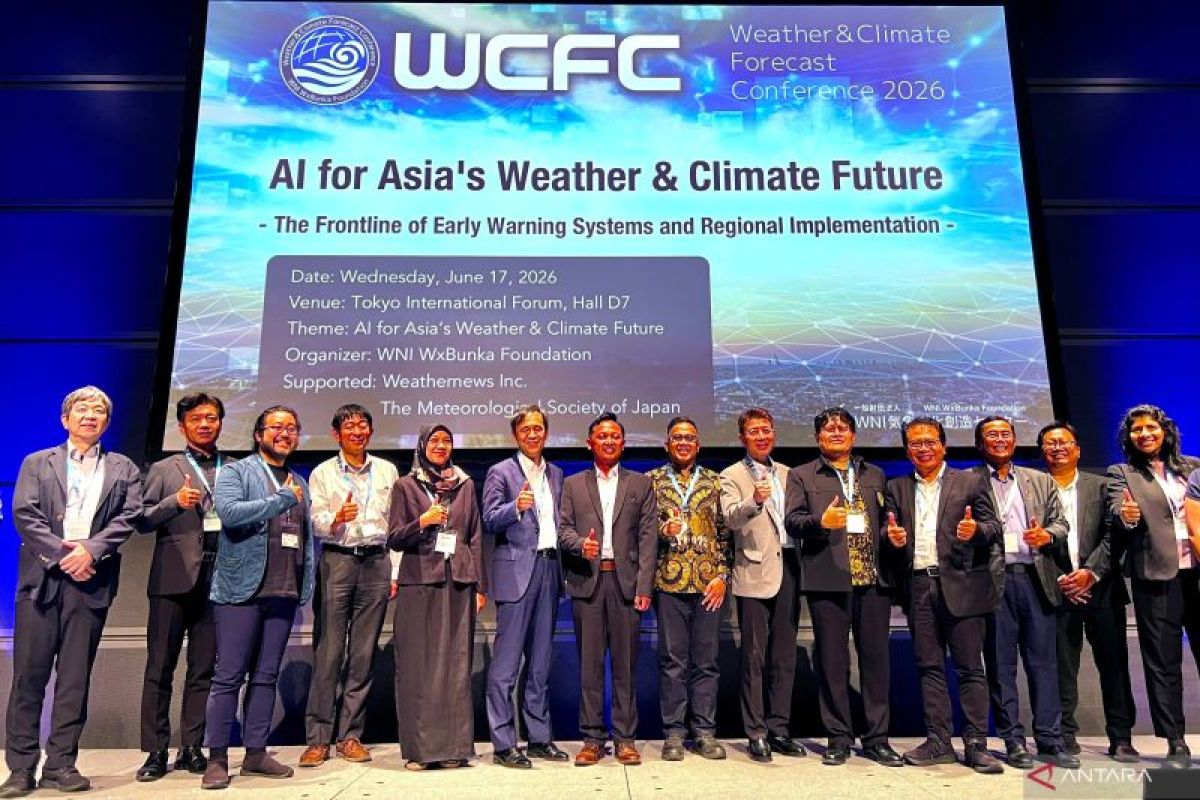
The Sakuranesia Foundation facilitated participation of academics from the University of Indonesia (UI) and Gadjah Mada University (UGM) at the Weathernews Weather & Climate Forecast Conference (WCFC) 2026 in Tokyo on June 17, 2026, according to ANTARA. UI research team leader Prof. Jatna Supriatna and Prof. Alhadi Bustamam presented a study titled "The Impacts of Senyar Cyclones on Sumatra's Landscape, Biodiversity, and Communities," which reported that extreme weather in late 2025 sparked severe flooding and landslides that threatened the habitat of the critically endangered Tapanuli orangutan, per ANTARA. UI's Eko Waludi highlighted AI applications for national energy efficiency and renewable development, while the UGM delegation led by Prof. Agus Maryono and Dr. Ganjar Alfian presented machine learning and Explainable Artificial Intelligence (XAI) methods for hydrometeorological risk forecasting. Indonesia's BMKG presented an international cooperation roadmap on early warning systems, ANTARA reports.
What happened
The Sakuranesia Foundation facilitated the participation of academics from the University of Indonesia (UI) and Gadjah Mada University (UGM) at the Weathernews Weather & Climate Forecast Conference (WCFC) 2026 in Tokyo on June 17, 2026, according to ANTARA. The conference was organized by Weathernews International in collaboration with the WxBunka Foundation, per ANTARA. UI presenters Prof. Jatna Supriatna and Prof. Alhadi Bustamam delivered a study titled "The Impacts of Senyar Cyclones on Sumatra's Landscape, Biodiversity, and Communities," and ANTARA reports the research linked extreme weather events in late 2025 to severe flooding and landslides that threatened the habitat of the critically endangered Tapanuli orangutan. UI's Eko Waludi presented on AI's potential to improve national energy efficiency and accelerate renewable energy development, and UGM presenters Prof. Agus Maryono and Dr. Ganjar Alfian introduced research using machine learning and Explainable Artificial Intelligence (XAI) to forecast hydrometeorological disaster risks. The Badan Meteorologi, Klimatologi, dan Geofisika (BMKG) presented an international cooperation roadmap on strengthening early warning systems, ANTARA reports.
Technical details
Context and significance
What to watch
Editorial analysis
The conference emphasis on AI for early warning systems mirrors a broader trend where machine learning and XAI are paired to increase both predictive skill and interpretability in disaster-risk applications. Public reporting highlights two technical threads presented by the Indonesian delegation: use of AI to optimise energy systems and use of ML/XAI for hazard forecasting. Industry observers commonly note that combining interpretable models with probabilistic forecasts helps integrate outputs into operational early warning chains, though this is a general observation about the field and not a claim about the delegations' internal deployments.
Regional scientific diplomacy efforts that put academic research before global technology forums typically aim to surface locally sourced data and models for internationally coordinated response. For practitioners, increased participation from Southeast Asian research teams matters because locally trained models and event-specific case studies, such as the Senyar cyclone analysis, can reveal dataset biases, sensor gaps, and transferability limits that global models do not expose.
Observers should follow:
- •publications or technical reports from the UI and UGM teams for model details and evaluation metrics
- •any public datasets or code releases tied to the Senyar cyclone study
- •BMKG announcements regarding international cooperation mechanisms that could enable data sharing or joint model validation across the Asia-Pacific. ANTARA coverage does not provide implementation code or quantitative model scores, and the institutions have not been quoted with operational rollout timelines in the cited reporting
Key Points
- 1Sakuranesia enabled UI and UGM to present AI-focused climate research at WCFC 2026, increasing Indonesia's visibility in regional climate-technology forums.
- 2UI presented a cyclone impact study linking late-2025 extreme weather to habitat threats, highlighting the value of local case studies for model training and risk assessment.
- 3UGM and UI showcased ML and XAI approaches for forecasting and energy efficiency, underscoring practitioner demand for interpretable, operationally useful AI in early warning systems.
Scoring Rationale
Indonesian academic teams presented ML and XAI methods for climate early-warning at a Japan conference, covered by ANTARA. The story is regionally significant and relevant to climate-AI practitioners but introduces no new open models, benchmarks, or deployable artifacts - placing it firmly in the Solid tier for practitioner awareness.
Sources
Public references used for this report.
Practice with real Ad Tech data
90 SQL & Python problems · 15 industry datasets
250 free problems · No credit card
See all Ad Tech problems