RLWRLD's RLDX-1 Enables Humanoid Robot Dexterity
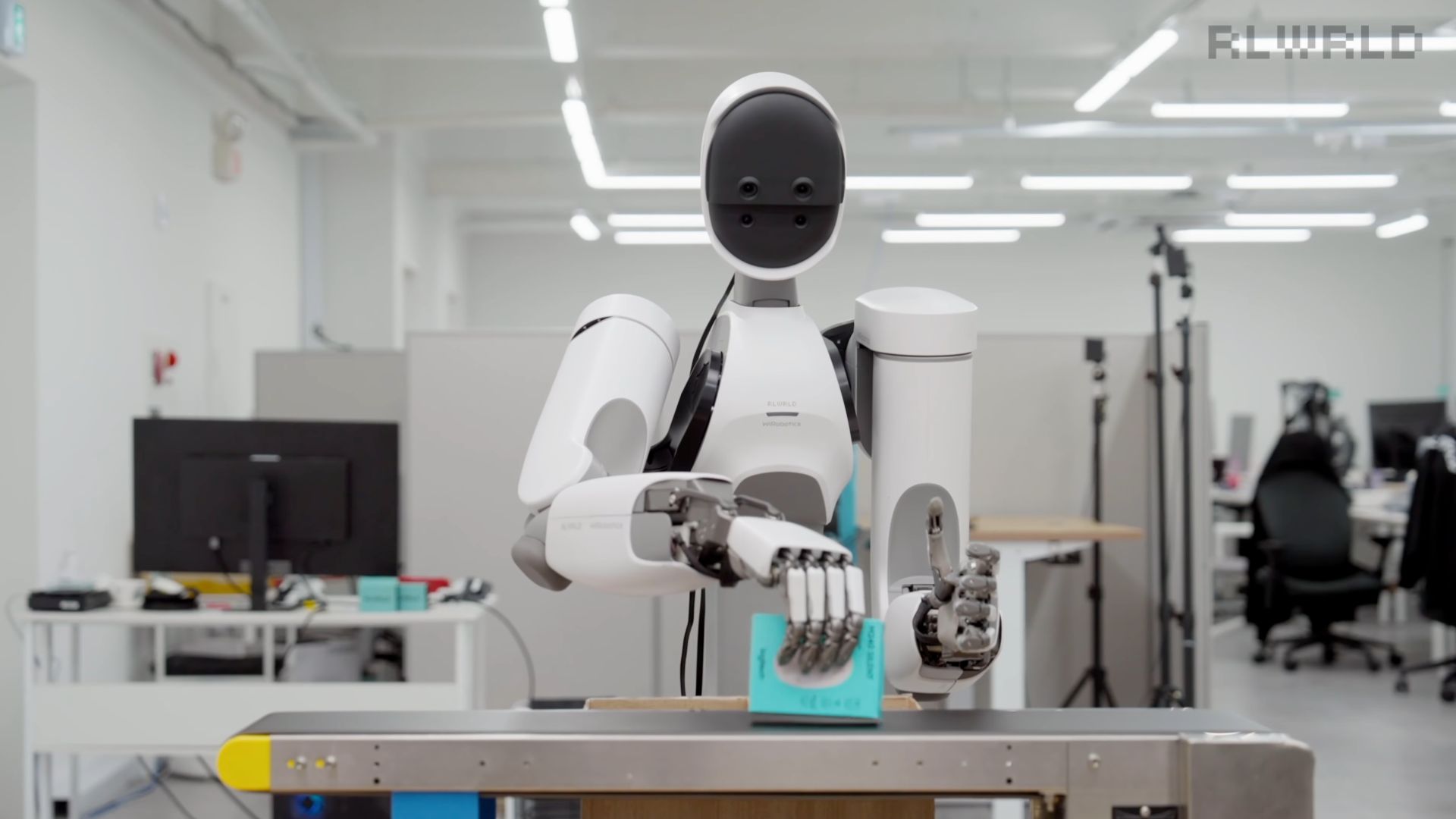
A humanoid robot demonstrated sorting black and white socks at RLWRLD's "Dexterity Night" event in San Francisco, according to Interesting Engineering. The demo used onboard cameras and five-fingered hands to detect colors, grasp items on a moving conveyor belt, and place black socks into a separate container, per reporting from The Chosun Daily and Interesting Engineering. RLWRLD unveiled a dexterity-first foundation model called RLDX-1 that integrates vision, motion, memory, and torque streams, per coverage in The Robot Report and a technical report posted on arXiv. RLWRLD has also captured human hand motion and workplace footage with body cameras for training data, the company describes on its website and in media coverage. This combination of multi-stream models, long-horizon memory tokens, and real-world human data represents a notable step toward practical robotic manipulation for industrial and service tasks.
What happened
A humanoid robot demonstrated object-sorting dexterity at RLWRLD's "Dexterity Night" event in San Francisco, where a Japanese robot from Enactic picked black socks from a moving conveyor belt and deposited them into a separate container, according to Interesting Engineering and The Chosun Daily. The demo used onboard cameras and five-finger hands to identify colors and execute grasps while retaining previously observed color information, per Interesting Engineering.
Technical details
Per a technical report posted on arXiv and reporting by The Robot Report, RLWRLD unveiled a dexterity-first foundation model named RLDX-1. The model is described as a Vision-Language-Action (VLA) system that processes multiple sensor streams, including vision, motion, memory, and torque, using a Multi-Stream Action Transformer, abbreviated MSAT, for action generation. RLWRLD's materials and media coverage describe a cognition interface that compresses perception into memory tokens for long-horizon task tracking, plus motion and physics modules and a robotics-specialized vision-language model to ground perception into manipulation actions (arXiv; The Robot Report).
Deployment and data pipeline
Reporting by Interesting Engineering and The AI Insider notes that RLWRLD is collecting real-world training data via body-worn cameras in partner sites such as hotels and logistics centers. The company uses human hand motion capture, synthetic data engines, and multi-site recordings to expand training coverage for dexterous tasks, according to company disclosures and media coverage (RLWRLD website; Interesting Engineering).
Industry context
Performance claims and benchmarking
Per RLWRLD's public materials and press coverage, RLDX-1 reportedly achieves state-of-the-art results across simulated and real-world manipulation benchmarks and is being integrated into systems from multiple robotics firms, including Enactic, WIRobotics, and Origami Robotics (Interesting Engineering; The AI Insider). ArXiv documentation provides architecture details but does not substitute for independent third-party benchmark replication.
Implications for practitioners
Editorial analysis
Foundation models for perception and action are now being extended into physical robotics, and RLDX-1 fits a broader industry pattern where multi-modal transformer architectures and large-scale human data are applied to manipulation. Observers following robotics R&D have seen similar approaches-combining simulation, synthetic data, and captured human demonstrations-to improve sample efficiency and transfer to real hardware.
For roboticists and ML engineers building manipulation systems, the two practical takeaways are the increasing importance of multi-stream sensor fusion architectures for contact-aware control and the operational challenge of assembling large, high-quality human demonstration datasets. Teams aiming to replicate similar capabilities will need expertise in high-DoF hand kinematics, tactile or torque sensing, and long-horizon memory representations, as well as infrastructure for safe real-world data collection.
What to watch
- •Whether independent benchmarking reproduces RLWRLD's reported gains on open dexterity suites.
- •Availability of RLDX-1 model weights, APIs, or robotics SDKs for research and integration, as that will determine accessibility for practitioners.
- •Evidence of robust transfer from captured human demonstrations to diverse hardware platforms, including metrics on success rates, sample efficiency, and failure modes.
Key Points
- 1Demo-level success: A humanoid from Enactic sorted socks using vision and memory tokens, showing practical use of long-horizon perception.
- 2Model architecture shift: Multi-stream transformer designs plus memory tokens are emerging as a standard approach for contact-aware manipulation.
- 3Data strategy matters: Real-world bodycam capture and synthetic augmentation are being used to scale dexterity training for industrial deployment.
Scoring Rationale
This story reports a foundation-model-style advance specifically targeted at dexterous manipulation, which matters to practitioners working on robot control and data pipelines. The contribution is notable but requires independent benchmarking and broader hardware adoption before qualifying as industry-shaking.
Sources
Public references used for this report.
Practice interview problems based on real data
1,625 SQL & Python problems across 15 industry datasets — the exact type of data you work with.
Try 250 free problems