Researchers Develop Ultrasound Navigation For Tiny Drones
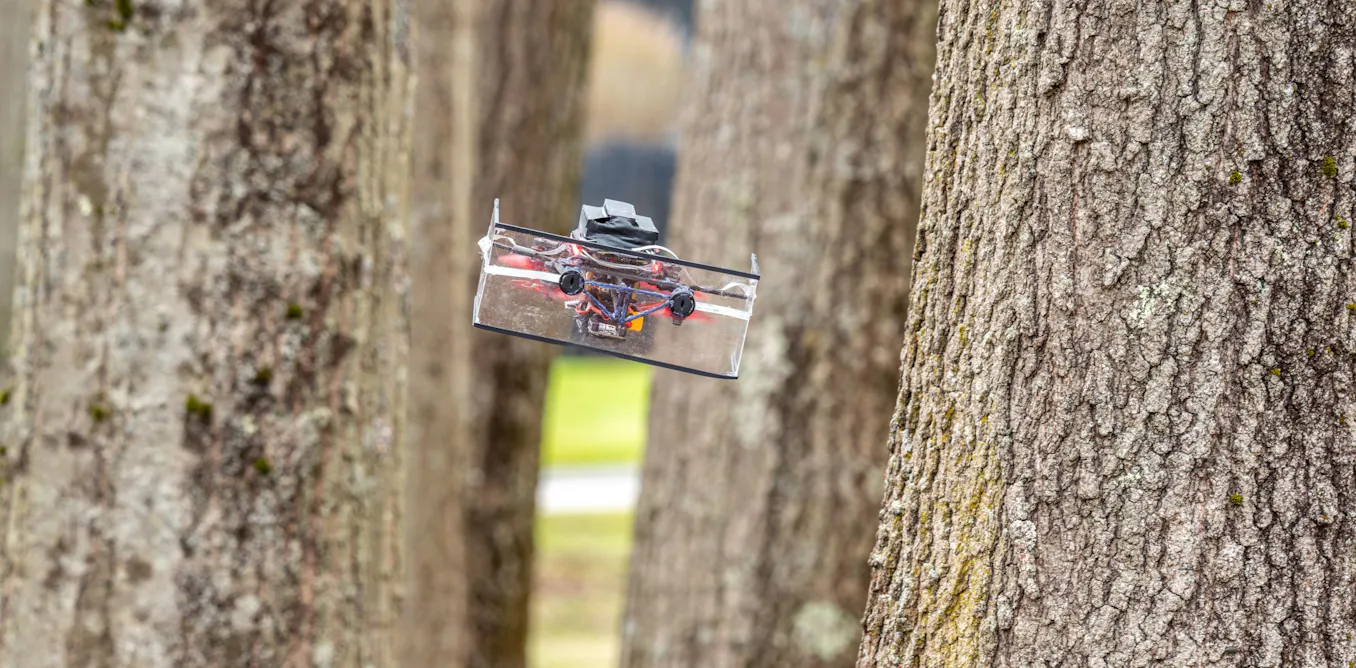
A research team develops an ultrasound-based perception system inspired by bat echolocation to help small aerial robots navigate in low-visibility environments. The approach pairs a bat-inspired physical acoustic shield with a neural network called Saranga to recover weak echoes and estimate 3D obstacle locations despite propeller noise. The team reports milliwatt-level sensing and claims up to 1,000× power, 10× weight, and 100× cost reductions, enabling search-and-rescue applications.
Key Points
- 1Demonstrate ultrasound sensing using an acoustic shield and Saranga neural network on small drones
- 2Reduce propeller noise and recover weak echoes, enabling accurate 3D obstacle estimation in darkness
- 3Enable low-power, lightweight, low-cost drones suitable for search-and-rescue and environmental monitoring
Scoring Rationale
Strong novelty and practical relevance across small-drone applications, somewhat limited by prototype-stage evaluations.
Practice interview problems based on real data
1,625 SQL & Python problems across 15 industry datasets — the exact type of data you work with.
Try 250 free problems