PLA Daily Says AI Cannot Replace Battlefield Commanders
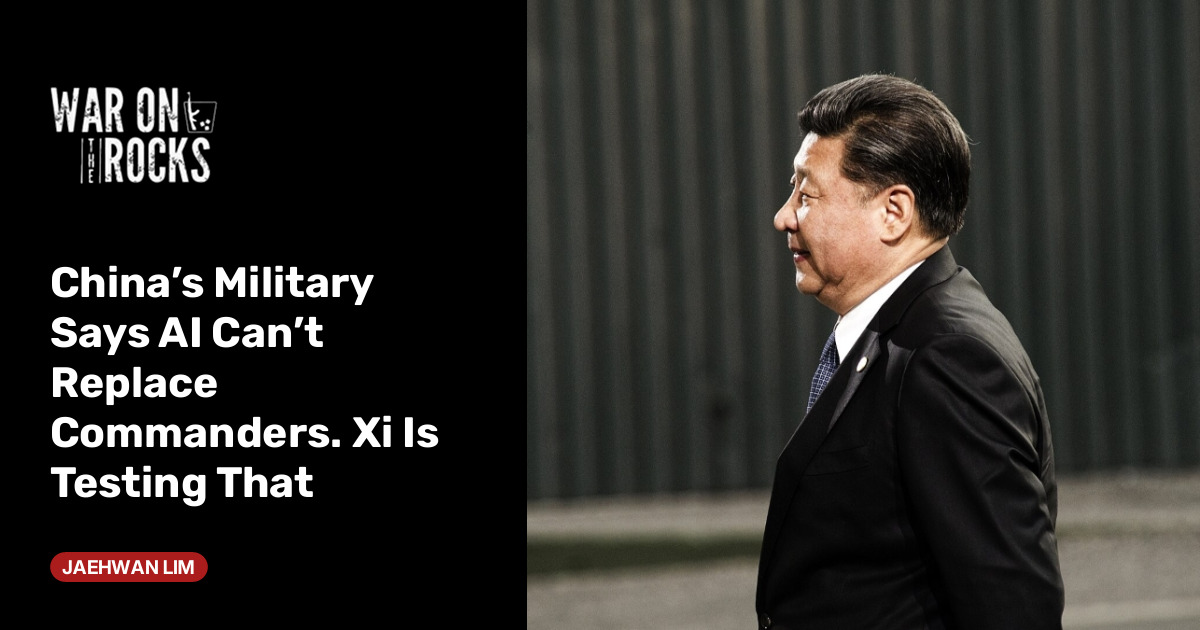
China's PLA Daily argued on New Year's Eve that AI cannot replace human battlefield decision-making and should remain guided by commanders. The article, reported by the South China Morning Post, described AI as useful for data analysis, simulation and planning while reserving final decisions for human commanders because of accountability, adaptability and black-box risks.
China's People's Liberation Army Daily has stated that artificial intelligence should augment, rather than replace, human commanders in battlefield decision-making. A New Year's Eve article cited by the South China Morning Post said AI lacks self-awareness and should operate as "a tool guided by human judgment."
The PLA Daily article described military uses for AI in data analysis, simulations and planning. It advocated a "humans plan and AI executes" model, in which machines analyze information, offer insights and suggest possible actions, while commanders retain final decision authority. According to SCMP's report, the article linked that human-control requirement to accountability, creativity, strategic adaptability and the risk of errors from AI's black-box nature.
A documented tension in PLA AI thinking
The stance sits alongside China's broader military modernization program around "intelligentization," a term used for the integration of AI-enabled systems into military capabilities. In a January 2025 Joint Force Quarterly study, Japan Ground Self-Defense Force Colonel Koichiro Takagi wrote that intelligentization has been a focus of PLA reform and that Xi Jinping referred to it three times at the Chinese Communist Party's 20th National Congress in 2022.
Takagi's study examined PLA Daily military-theory articles to assess how Chinese military writers describe AI's potential and limitations. It notes an external debate over whether PLA theorists overestimate AI and autonomous systems, particularly given their vulnerabilities. The study also examines whether the PLA is aware of those vulnerabilities while continuing to pursue AI-focused military reforms.
What human control means technically
The available reporting does not specify particular models, weapons platforms or command-and-control deployments. It does, however, identify a functional division: AI supports information processing and options generation, while humans retain authority over strategy and final action.
For practitioners working on high-consequence decision systems, comparable human-in-the-loop designs raise concrete engineering questions: whether model recommendations can be audited, how operators detect degraded inputs or adversarial manipulation, and whether an escalation path exists when model confidence and human judgment diverge. These are general deployment challenges, not evidence of the PLA's internal implementation.
What is publicly documented is the PLA Daily's January 2025 position that AI can support command effectiveness but should not displace commanders' final decision authority.
Key Points
- 1PLA Daily endorsed AI-assisted analysis and planning, but assigned final battlefield decisions to human commanders because of accountability and black-box concerns.
- 2China's intelligentization agenda places AI within military modernization, while published PLA commentary also acknowledges limits on autonomous command authority.
- 3Comparable high-consequence AI systems require auditable recommendations, robust input validation, and clear human escalation paths when automated outputs conflict with judgment.
Scoring Rationale
The story concerns AI governance in military command, a high-consequence deployment domain with direct relevance to autonomy, oversight, and model-risk engineering. The retrieved evidence primarily documents policy and theory rather than a newly disclosed system or operational deployment.
Sources
Public references used for this report.
Practice with real Retail & eCommerce data
90 SQL & Python problems · 15 industry datasets
250 free problems · No credit card
See all Retail & eCommerce problems