
OpenAI Model Disproves Erdos Unit Distance Conjecture
OpenAI announced on May 20, 2026 that one of its internal, general-purpose reasoning models disproved the Erdos unit distance conjecture, an open problem in discrete geometry posed by Paul Erdos in 1946. The conjecture held that the maximum number of unit-distance pairs among n points in the plane grows as n^(1+o(1)); the model constructed an infinite family of point sets that exceed this bound by a polynomial factor. A refinement by Princeton's Will Sawin makes the improvement explicit at n^1.014. The proof, which draws on tools from algebraic number theory (infinite class field towers and Golod-Shafarevich theory), was checked by external mathematicians, who wrote a companion paper. Fields Medalist Tim Gowers called it "a milestone in AI mathematics," and OpenAI says it is the first time AI has autonomously resolved a central open problem in a subfield of mathematics. OpenAI released the proof, companion remarks, and an abridged chain-of-thought.
What happened
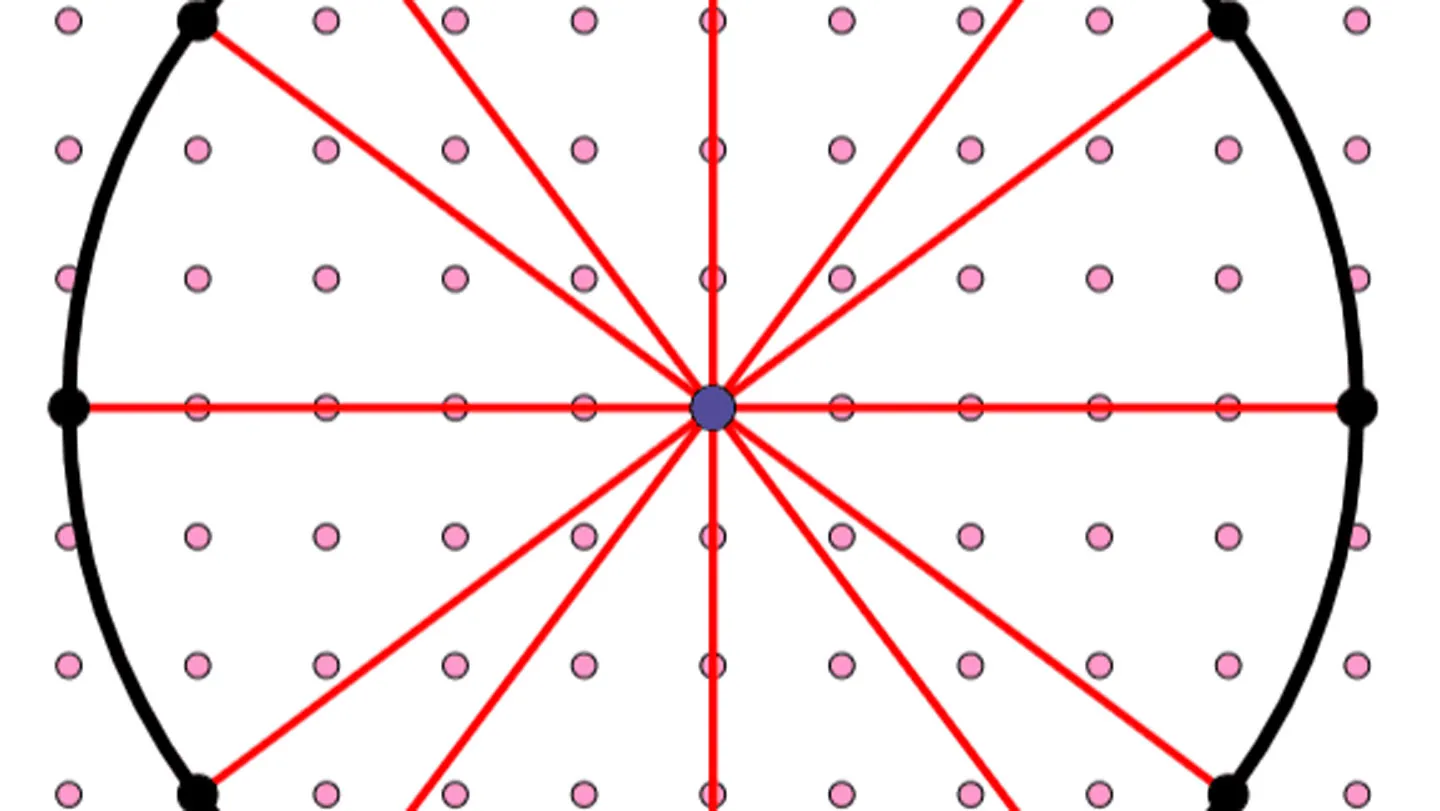
OpenAI announced on May 20, 2026 that an internal, general-purpose reasoning model disproved the Erdos unit distance conjecture, a longstanding open problem in discrete geometry. The planar unit distance problem, posed by Paul Erdos in 1946, asks for the maximum number of pairs of points that can be exactly distance 1 apart among n points in the plane. The prevailing belief was that rescaled "square grid" constructions were essentially optimal, and Erdos conjectured an upper bound of n^(1+o(1)). The model produced an infinite family of configurations that exceed this bound by a polynomial factor.
The result
For infinitely many n, the construction yields at least n^(1+delta) unit-distance pairs for a fixed delta greater than 0. The original AI proof does not give an explicit delta, but a forthcoming refinement by Princeton mathematics professor Will Sawin shows one can take delta = 0.014. For context, the best known upper bound, O(n^(4/3)), dates to Spencer, Szemeredi, and Trotter in 1984, and the best lower bound had been essentially unchanged since Erdos's 1946 construction.
The method
The proof's key ingredients come from algebraic number theory. It generalizes the Gaussian integers to more complex algebraic number fields with richer symmetries, and uses infinite class field towers and Golod-Shafarevich theory to show the required fields exist. The unexpected bridge between deep number theory and an elementary geometric question is a large part of why mathematicians have called the result surprising.
Verification and reception
The proof was checked by a group of external mathematicians, who also wrote a companion paper explaining the argument. Fields Medalist Tim Gowers called it "a milestone in AI mathematics" and said he would have recommended acceptance to a top journal without hesitation. Number theorist Arul Shankar said the work shows current models can have "original ingenious ideas," and combinatorialist Noga Alon called it "an outstanding achievement." OpenAI notes the proof came from a general-purpose reasoning model rather than a system trained or scaffolded specifically for mathematics.
Why it matters
This is, by OpenAI's account, the first time AI has autonomously resolved a prominent open problem at the center of a mathematical subfield. It is evidence that frontier reasoning models can sustain long, novel arguments and connect distant areas of knowledge - capabilities relevant beyond mathematics to fields such as physics, materials science, and AI research itself. As mathematician Thomas Bloom notes in the companion work, the result also teaches something new about the problem, suggesting number-theoretic methods have more to say about discrete geometry than expected.
What to watch
Track independent formalization of the construction in proof assistants, follow-on work applying these number-theoretic tools to other discrete-geometry problems, and how reliably such results can be reproduced as models and test-time compute scale.
Key Points
- 1An internal OpenAI general-purpose reasoning model - not a math-specific system - disproved the 1946 Erdos unit distance conjecture, building point sets that beat the conjectured n^(1+o(1)) bound; Will Sawin's refinement gives n^1.014.
- 2The proof imports algebraic number theory (class field towers, Golod-Shafarevich theory) into a geometry problem and was checked by external mathematicians, who wrote a companion paper.
- 3Mathematicians including Fields Medalist Tim Gowers and Noga Alon called it a landmark; OpenAI frames it as the first central open problem in a math subfield solved autonomously by AI.
Scoring Rationale
An internal OpenAI general-purpose reasoning model autonomously disproved the 1946 Erdos unit distance conjecture, with the proof checked by external mathematicians and endorsed by figures including Fields Medalist Tim Gowers and Noga Alon. As, by OpenAI's account, the first central open problem in a math subfield solved autonomously by AI - using novel algebraic number theory - it is a landmark milestone for AI-assisted research. The cross-domain method and external verification make it broadly significant beyond mathematics.
Sources
Public references used for this report.
Practice interview problems based on real data
1,625 SQL & Python problems across 15 industry datasets — the exact type of data you work with.
Try 250 free problems