OpenAI Rolls Out Health in ChatGPT Across US Plans
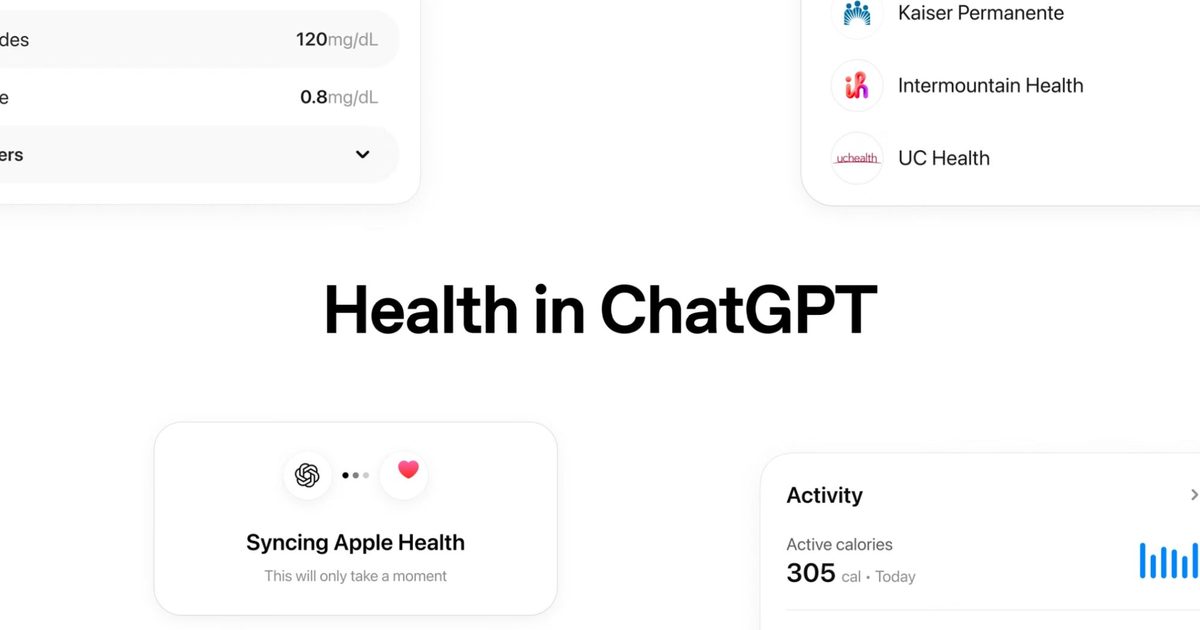
OpenAI began rolling out Health in ChatGPT to logged-in U.S. users aged 18 and older on July 23, enabling connections to Apple Health and supported medical records. The feature is available on web and iOS across Free, Go, Plus, and Pro plans, according to OpenAI. The Verge reports that OpenAI executives made qualified claims about model performance relative to clinicians as the broader release began.
OpenAI began rolling out Health in ChatGPT to logged-in U.S. users aged 18 and older on July 23, extending the feature across web and iOS for Free, Go, Plus, and Pro accounts. According to OpenAI's launch announcement, users can connect Apple Health and supported medical-record sources, then use the information in conversations to compare results, summarize changes, and discuss activity, sleep, and workout data.
OpenAI says users can connect supported U.S. provider portals, One Medical, Function Health, and Apple Health. The company also reports that more than 70% of health-related conversations among early users occurred outside its dedicated Health experience, which informed the decision to let connected health information be used in ordinary ChatGPT conversations when a user permits it.
Data use and clinical boundaries
OpenAI states that connected medical records, Apple Health data, and conversations that use those data are not used to train its foundation models or target advertising. The company describes Health as having layered privacy and security safeguards and says users control what they connect and when ChatGPT can access it.
OpenAI's Help Center frames the feature as support for, rather than a replacement for, professional care and says it is not intended for diagnosis or treatment. That limitation is particularly consequential when a general-purpose chatbot can bring sensitive longitudinal data into an otherwise ordinary chat session.
Performance claims draw qualification
OpenAI wrote that more than 300 million people each week ask ChatGPT health-related questions. The company also said it is improving models used in health conversations so they can reason across complex details, request missing context, explain information clearly, and recognize when professional care may be needed.
The Verge reports that Ashley Alexander, OpenAI's vice president of health product, said during a briefing that the company's models "are now capable of reasoning at levels that are better than clinician level." In the same reporting, OpenAI health lead Karan Singhal said he would "temper" that characterization, while pointing to individual studies that he said indicate performance in that direction.
OpenAI says GPT-5.6 Sol is its strongest model yet for health and that its GPT-5.6 models outperformed GPT-5.5 on HealthBench Professional. Those are company evaluation claims, not evidence that ChatGPT can safely diagnose or treat patients in real-world settings.
For ML practitioners building health-facing systems, the rollout illustrates a familiar distinction between model evaluation and deployment safety. Comparable systems require more than strong benchmark scores: data permissions, provenance across heterogeneous records, uncertainty handling, escalation pathways, and clear product boundaries all shape whether model outputs can be used responsibly. OpenAI's stated restriction against diagnostic or treatment use leaves those clinical-accountability questions unresolved for consumer chat workflows.
Key Points
- 1OpenAI expanded Health in ChatGPT across U.S. plans, bringing connected medical and wearable data into ordinary chatbot conversations.
- 2OpenAI states connected health data and related conversations are excluded from foundation-model training and advertising targeting, a key privacy boundary.
- 3Industry deployment patterns show that health benchmarks alone do not resolve provenance, uncertainty, escalation, and clinical-accountability challenges.
Scoring Rationale
The broad U.S. release brings health-record connectivity to ChatGPT's large consumer user base and raises material privacy and safety questions for health AI practitioners. The feature is not a new foundation model, but its integration of longitudinal personal data into general chat is a notable deployment step.
Sources
Primary source and supporting public references used for this report.
Practice with real Health & Insurance data
90 SQL & Python problems · 15 industry datasets
250 free problems · No credit card
See all Health & Insurance problems