
NVIDIA unveils BioNeMo Agent Toolkit for scientific agents
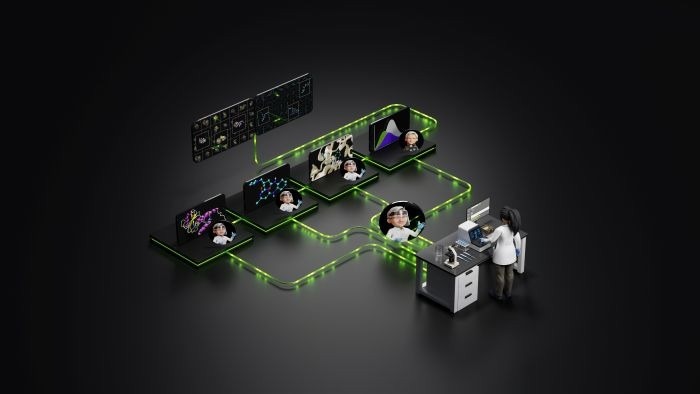
NVIDIA announced the BioNeMo Agent Toolkit, a domain-specific software stack that packages more than a decade of NVIDIA life-sciences libraries, tools and open models into agent-callable skills, per NVIDIA's announcement (NVIDIA newsroom; NVIDIA technical blog). The toolkit bundles BioNeMo, NIM microservices, Parabricks, NeMo and Nemotron technologies to let AI agents gather evidence, run computational experiments, reason across findings and recommend next steps, according to NVIDIA (NVIDIA newsroom). NVIDIA quoted Jensen Huang: "Frontier models are the brains. BioNeMo is the scientific toolbox. Together, they give AI agents the skills of a PhD research assistant and the speed of a supercomputer." Multiple outlets report more than 50 early adopters, including cloud and life-sciences partners, are using the toolkit to accelerate tasks such as protein structure prediction, molecular docking, generative chemistry and genomic analysis (news-medical; Yahoo Finance).
What happened
NVIDIA announced the BioNeMo Agent Toolkit, a domain-specific foundation that packages life-sciences libraries, tools and open models into agent-callable capabilities, per NVIDIA's announcement and technical blog (NVIDIA newsroom; NVIDIA technical blog). The company presents the toolkit as integrating BioNeMo with NIM microservices, Parabricks, NeMo and Nemotron technologies to provide skills for tasks including protein structure prediction, molecular docking, generative chemistry, sequence analysis and genomics, according to NVIDIA (NVIDIA technical blog). The announcement includes a direct quote from Jensen Huang: "Frontier models are the brains. BioNeMo is the scientific toolbox. Together, they give AI agents the skills of a PhD research assistant and the speed of a supercomputer." (news-medical).
Per press coverage, more than 50 organisations have already adopted the toolkit in early experiments and integrations; Yahoo Finance and news-medical list academic and industry collaborators and adopters including research institutes and life-sciences companies (Yahoo Finance; news-medical). NVIDIA and the University of Washington's Institute for Protein Design (IPD) report collaboration results that accelerated runtimes for RosettaFold3, producing roughly 2x faster performance versus the prior-generation model, according to NVIDIA's partner reporting (news-medical).
Technical details
Per NVIDIA's technical blog, the BioNeMo Agent Toolkit exposes discrete BioNeMo Skills as agent-callable services that document model purpose, input requirements, expected artifacts and failure modes, enabling agents to discover, select, invoke and interpret biomolecular models independently of the backend runtime (NVIDIA technical blog). The blog also presents empirical benchmarking using a controlled harness (Codex CLI with GPT-5.5 fast), reporting a doubling of token efficiency and an increase in task completion rate from 57.1% to 100% when agents used BioNeMo Skills versus baseline workflows (NVIDIA technical blog). The toolkit is described as agent-agnostic and compatible with third-party orchestration frameworks and cloud partners, with both hosted and local NIM deployment options noted in NVIDIA's materials (NVIDIA newsroom; NVIDIA technical blog).
Editorial analysis - technical context
Companies building domain-specialized agents typically separate three capabilities: a reasoning backbone (models), action connectors (tools/skills) and a runtime that executes workflows. The BioNeMo approach mirrors that pattern by packaging domain knowledge as composable skills, which helps reduce repeated model prompts and back-and-forth token costs in multi-step scientific workflows. For practitioners, this trend emphasizes modular interfaces and clear failure-mode documentation as valuable properties when integrating models into experimental loops.
Context and significance
What to watch
Editorial analysis
The BioNeMo Agent Toolkit arrives amid growing industry interest in agentic workflows for R&D. Public reporting frames the launch as part of NVIDIA's broader push to commercialize GPU-accelerated software stacks for life sciences and to make model-driven workflows more turnkey (Yahoo Finance; pharmaceutical-technology.com). The IPD collaboration and reported adopters signal early cross-sector engagement between academia, startups and established pharma groups. For data-science and ML teams working in biology, the toolkit's focus on callable skills and microservice deployment addresses common integration pain points: reproducible model IO, documented artifacts, and the ability to stitch multiple biomolecular tools into iterative experiments.
Observers will want to validate third-party benchmarks and reproducibility claims outside vendor-provided tests; independent replication of the RosettaFold3 runtime improvements and the token-efficiency numbers reported by NVIDIA will be important. Watch for detailed interoperability tests with third-party agent harnesses (for example, Codex-based workflows), commercial adopters' case studies that quantify time-to-insight in real projects, and emerging standards around skill metadata and failure-mode declarations. Also monitor cloud and data-platform partnerships-reported integrations with Snowflake and others may determine how easily enterprise R&D teams can run agentic experiments at scale (Snowflake blog; Yahoo Finance).
For practitioners
Expect integration work to focus less on raw model fine-tuning and more on reliable orchestration: connecting model outputs to downstream simulation and lab automation steps, tracking artifacts, and handling model uncertainty. Industry reporting suggests the BioNeMo stack is intended to reduce token costs and accelerate iteration, but independent performance audits and open benchmarks will be essential for teams that must meet regulatory and reproducibility requirements (NVIDIA technical blog; news-medical).
Key Points
- 1BioNeMo packages domain-specific 'skills' and NVIDIA life-science libraries as agent-callable services, lowering integration friction for scientific agents.
- 2Vendor benchmarks show doubled token efficiency and task completion gains, highlighting potential runtime and cost improvements for agentic R&D workflows.
- 3Early adopters and academic collaborations illustrate rapid cross-sector uptake; independent benchmarks and reproducibility will determine real-world impact.
Scoring Rationale
A notable product launch that packages domain capabilities for agentic life-science workflows, with vendor benchmarks and early adopters. Important for practitioners integrating models into R&D but not a paradigm-shifting release.
Sources
Public references used for this report.
View 9 more sources
- Nvidia Unveils Science Reasoning AI Suite with BioNeMo Agent ...genengnews.com
- NVIDIA Announces BioNeMo Agent Toolkit - Tools for Agents to Accelerate Scientific Discoveryhpcwire.com
- How Businesses Are Building Specialized AI They Can Trustblogs.nvidia.com
- Nvidia pushes deeper into biomedical researchfinance.yahoo.com
- Snowflake and NVIDIA Bring Agentic AI to Life Sciencessnowflake.com
- Tecan accelerates Data-Driven Lab journey with Agentic AI developments powered by NVIDIAnews-medical.net
- Building the Agent-Driven Era of Science with NVIDIA BioNeMo Agent Toolkitlila.ai
- NVIDIA BioNeMo Agent Toolkit on Basetenbaseten.co
- Benchmarking NVIDIA BioNeMo Agent Toolkit Skills for NIM ...k-dense.ai
Practice interview problems based on real data
1,625 SQL & Python problems across 15 industry datasets — the exact type of data you work with.
Try 250 free problems

