NVIDIA Publishes COMPASS Cross-Embodiment Navigation Framework
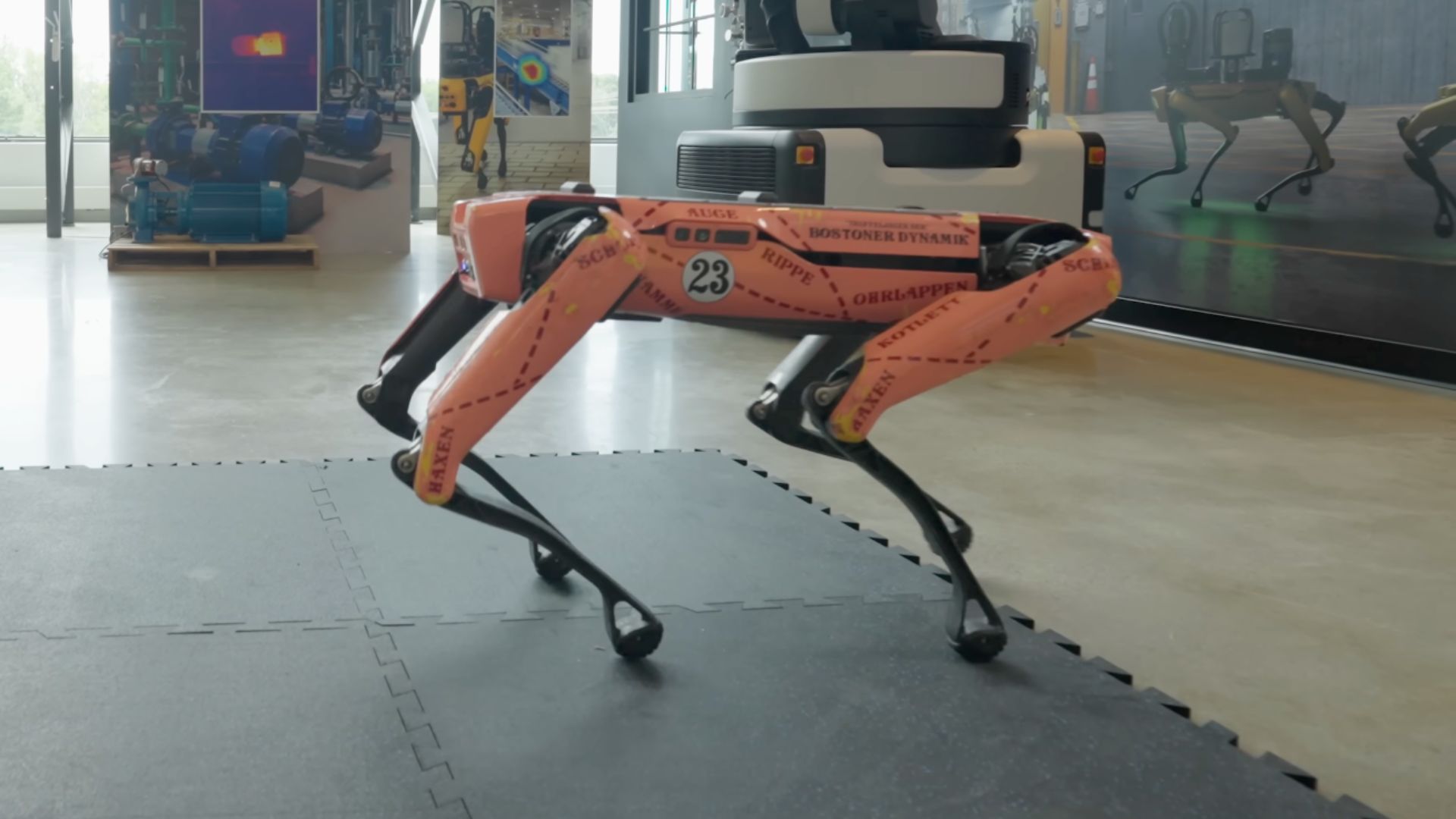
NVIDIA published COMPASS on August 26, 2026, a framework for adapting robot navigation policies across humanoid, quadruped, and wheeled platforms. NVIDIA's documentation describes a workflow that combines a pretrained X-Mobility policy, residual reinforcement learning, policy distillation, and AI-agent automation. The reference implementation uses Boston Dynamics' Spot robot across simulated, generated, and captured scenes.
NVIDIA published COMPASS, a cross-embodiment robot-navigation framework that combines imitation learning, residual reinforcement learning, policy distillation, and AI-agent-driven workflow automation. In an August 26 developer post, NVIDIA described the system as a way to adapt its pretrained X-Mobility navigation policy to particular robots and environments without building a navigation system from scratch.
COMPASS stands for Cross-Embodiment Mobility Policy via Residual RL and Skill Synthesis, according to Interesting Engineering. The reported workflow begins with a base policy and trains a residual specialist that learns corrections for a target embodiment and scene. NVIDIA's COMPASS handbook states that the resulting specialists can be rolled out to collect HDF5 data, which is then used to distill a generalist policy.
Training and deployment pipeline
NVIDIA's documentation lists an end-to-end process covering residual-RL training, specialist rollouts, distillation, export, TensorRT conversion, and ROS 2 deployment. The handbook identifies Isaac Lab 3.0 and Isaac Sim 4.5 as core simulation components, with optional OSMO cloud submission for training and evaluation runs.
According to NVIDIA's developer post, AI agents automate parts of the engineering workflow, including environment validation, scene preparation, smoke tests, training launches, checkpoint evaluation, and runtime packaging. The post also states that human approval gates remain in the process, including after smoke testing.
The published runtime interface consumes RGB camera input, odometry, and a goal point, then publishes velocity commands through /cmd_vel, NVIDIA reported. Its documentation notes that Isaac Perceptor can optionally provide deployment odometry where a robot lacks compatible state estimation.
Reference evaluation setup
NVIDIA's reference implementation uses the Boston Dynamics Spot quadruped across three types of scene paths: a built-in warehouse, generated indoor scenes, and captured environments reconstructed with NVIDIA Omniverse NuRec. The developer post describes matched-condition evaluation of the base X-Mobility policy and residual candidates using identical seeds, goals, and rollout conditions.
The reported metrics include goal-reached rate, fall-down rate, and travel time. Neither the developer post nor the COMPASS handbook excerpt provides a single aggregate performance result that would establish a universal improvement across robot forms or environments.
Why the workflow is notable
Cross-embodiment transfer remains difficult because navigation software must account for differences in sensing, locomotion, geometry, and control interfaces. NVIDIA's earlier May research coverage described the broader problem as one in which a navigation system trained for one robot body can fail when moved to another.
For robotics teams, COMPASS packages a familiar technical pattern: retain a broad pretrained policy, learn task- or embodiment-specific corrections, then consolidate useful behavior through distillation. In comparable sim-to-real workflows, the practical value depends not only on policy reward but also on reproducible scene assets, consistent evaluation conditions, and deployment compatibility with the robot's state-estimation and control stack. NVIDIA's published material provides those pipeline components, while broader performance and real-world transfer claims will require independent testing across additional hardware and operating settings.
Key Points
- 1COMPASS adapts NVIDIA's pretrained X-Mobility policy through residual reinforcement learning rather than requiring a complete navigation-policy retraining cycle.
- 2The framework documents a pipeline from specialist training and distillation to TensorRT and ROS 2 deployment on simulated or physical robots.
- 3Comparable cross-embodiment workflows depend on controlled evaluation, robust state estimation, and sim-to-real validation beyond simulation reward metrics.
Scoring Rationale
COMPASS packages reinforcement learning, simulation, distillation, and deployment tooling into a documented workflow for robot-navigation developers. It is notable for embodied-AI practitioners, although the available material does not provide broad independent performance validation or a reported aggregate benchmark result.
Sources
Primary source and supporting public references used for this report.
Practice interview problems based on real data
1,625 SQL & Python problems across 15 industry datasets — the exact type of data you work with.
Try 250 free problems