NVIDIA, Hyundai, Boston Dynamics Expand Physical AI Partnership
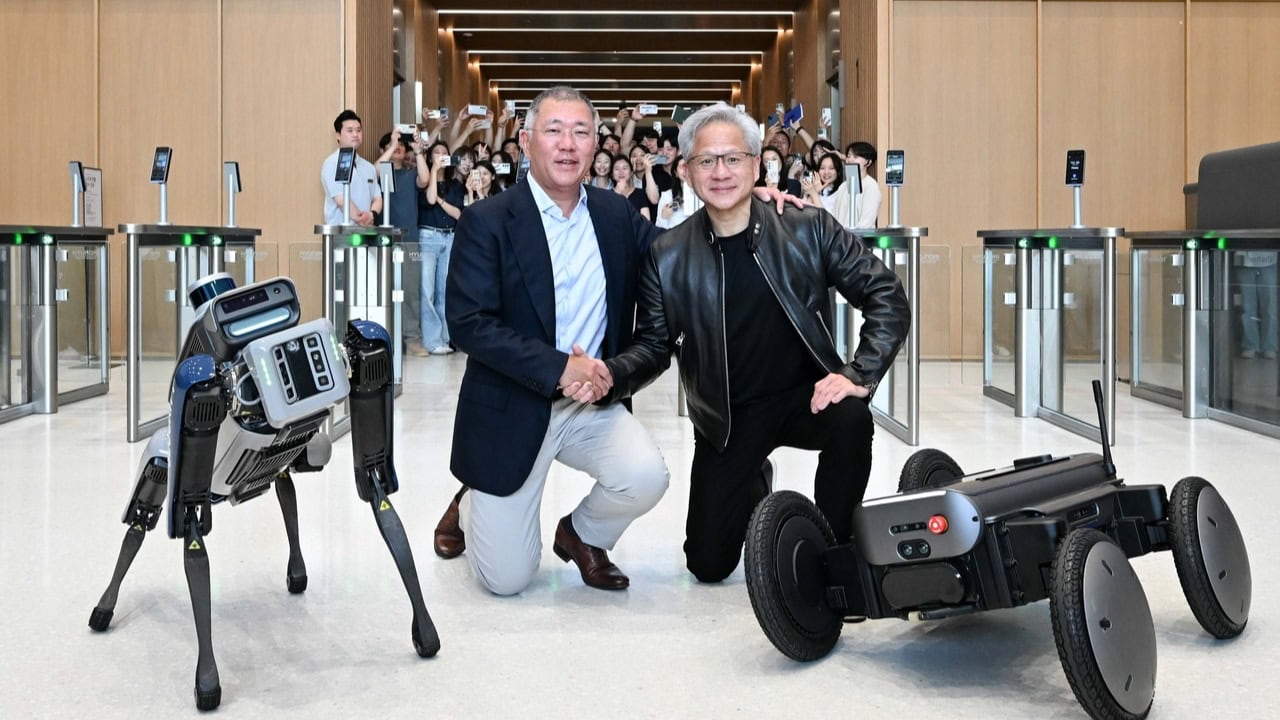
NVIDIA CEO Jensen Huang visited Seoul and met Hyundai Motor Group executive chair Chung Euisun to deepen a robotics and "physical AI" alliance, according to TechJuice and The Korea Herald. Reporting says the expanded roadmap centers on Boston Dynamics' humanoid Atlas, which Hyundai has indicated it wants to mass-produce from 2028 at up to 30,000 units per year (TechJuice). Sources report Hyundai outlined a 9 trillion won (about $5.9 billion) plan for an AI data centre, robot manufacturing cluster and hydrogen plant at Saemangeum, and local coverage says the site would run on tens of thousands of NVIDIA Blackwell GPUs (The Korea Herald; TechJuice). TechJuice also reports market moves: Hyundai shares rose nearly 7% and NVIDIA rose over 6% on the announcement day.
What happened
NVIDIA CEO Jensen Huang visited Seoul this week and held meetings with Hyundai Motor Group executive chair Chung Euisun, reporting participants and local press say (TechJuice; The Korea Herald). The parties described an expanded industrial roadmap focused on "physical AI" and robotics, with public coverage placing Boston Dynamics' humanoid Atlas at the centre of the collaboration (TechJuice; The Korea Herald). TechJuice reports Hyundai has indicated a target to mass-produce Atlas beginning in 2028, potentially at up to 30,000 units per year. The Korea Herald reports Hyundai has pledged 9 trillion won (about $5.9 billion) toward an innovation hub at Saemangeum that would host an AI data centre, a robot manufacturing cluster and a hydrogen plant. TechJuice reports the site is expected to run on tens of thousands of NVIDIA Blackwell GPUs. TechJuice also reports daily market reactions: Hyundai Motor shares rose nearly 7% and NVIDIA shares rose more than 6% on the news.
Technical details
Per reporting in TechJuice, the parties described a development workflow that trains robots in simulation before deploying them into Hyundai manufacturing environments, with NVIDIA platforms supporting both simulation and the inference layer. The coverage emphasizes using large-scale simulation plus on-site inference and integration into existing industrial automation. TechJuice also describes a Seoul lobby converted into a live testbed where robots handled security, deliveries and plant watering during Huang's visit.
Editorial analysis - technical context
Companies integrating humanoid robotics with production-scale manufacturing typically rely on high-fidelity simulation to accelerate policy learning and to reduce physical wear during development. Observed patterns in comparable projects show simulation-to-reality gaps, robust perception stacks, and safety validation frameworks become central engineering efforts. For practitioners, that means large simulation clusters, long-running synthetic-data pipelines, domain-randomization strategies, and tightly instrumented field testing are likely priorities for teams executing similar programs.
Context and significance
The reported collaboration combines NVIDIA's AI compute and simulation tooling with Hyundai's manufacturing scale and Boston Dynamics' robotics IP, a mix public coverage frames as aiming to move humanoid robotics from demonstrations toward industrial deployment (The Korea Herald; TechJuice). If implemented at the scale described in reporting, the effort would be notable for combining industrial-scale production planning with edge inference deployments in factory settings, and for the implied demand for data-centre GPUs and robotics integration expertise.
What to watch
- •Watch for formal announcements or memoranda from the companies or South Korean authorities that confirm site selection, financing, or timelines; The Korea Herald and TechJuice describe discussions but note no final decisions are publicly confirmed.
- •Track engineering disclosures about the simulation stack, safety validation, and how perception/control models are transferred from simulation to physical Atlas units; these will indicate how the project addresses sim-to-real risk.
- •Monitor procurement signals for large-scale Blackwell GPU deployments and partner ecosystems (cloud, middleware, systems integrators), which reporters say would underpin the Saemangeum hub (TechJuice; The Korea Herald).
Editorial analysis
Reporting describes discussions and figures attributed to outlets including TechJuice and The Korea Herald; Hyundai and NVIDIA have not issued a single consolidated public roadmap, and specific operational decisions (site selection, financing, and timelines) remain subject to confirmation in formal announcements.
Key Points
- 1NVIDIA CEO Jensen Huang met Hyundai leadership in Seoul to expand a "physical AI" alliance centered on Boston Dynamics' Atlas (TechJuice; The Korea Herald).
- 2Reported plans include a 9 trillion won Saemangeum hub and the potential mass production of Atlas from 2028, implying large GPU and manufacturing demand (The Korea Herald; TechJuice).
- 3Editorial analysis: Industry patterns show simulation-first development and large-scale validation are prerequisites for deploying humanoid robots at factory scale, raising engineering and safety complexity for practitioners.
Scoring Rationale
A major cross-industry physical-AI and robotics push pairing NVIDIA compute and simulation with Hyundai's manufacturing scale and Boston Dynamics' Atlas, with reported plans for a ~9 trillion won Saemangeum hub and tens of thousands of Blackwell GPUs. It is highly relevant to infrastructure and robotics practitioners, but several commitments are still described as in talks and unconfirmed, so it sits just below the top of the major band.
Sources
Public references used for this report.
View 6 more sources
- Nvidia CEO's upcoming visit to Korea stokes hopes on physical AI collaborationkoreatimes.co.kr
- How Hyundai, LG stole the spotlight from Samsung for Huang's Korea visitkoreajoongangdaily.joins.com
- Hyundai's humanoid moment: It's not sci-fi; Atlas emerges as much ...kedglobal.com
- Boston Dynamics: Hyundai's Plans for Humanoid AI Robotsmanufacturingdigital.com
- News | Boston Dynamicsbostondynamics.com
- English News - The Chosun Dailychosun.com
Practice interview problems based on real data
1,625 SQL & Python problems across 15 industry datasets — the exact type of data you work with.
Try 250 free problems