Nvidia Delivers RTX Spark Arm PC Superchip
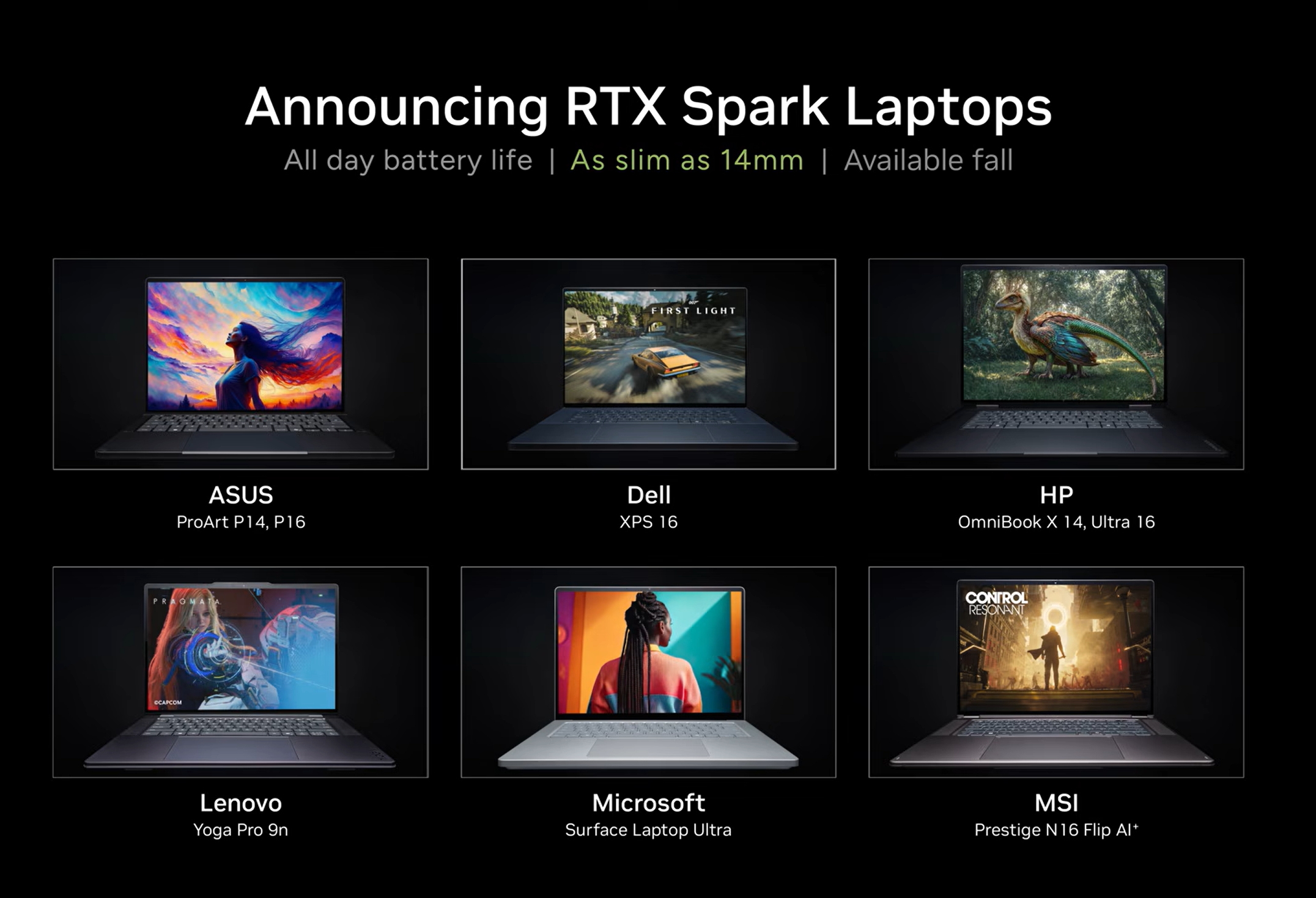
NVIDIA unveiled the RTX Spark superchip at GTC/Computex, a Windows-on-Arm platform co-developed with Microsoft, designed for local AI agents and content creation. According to NVIDIA's May 31 press release, RTX Spark combines up to 6,144 CUDA cores, a 20-core Arm-based NVIDIA Grace CPU, and up to 128GB of unified memory, and delivers about 1 petaflop of AI performance. NVIDIA and Microsoft say the platform will ship in thin-and-light laptops and compact desktops from partners including ASUS, Dell, HP, Lenovo, Microsoft Surface, MSI, with Acer and GIGABYTE to follow, arriving this fall (NVIDIA; Microsoft blog). "The PC is being reinvented," said Jensen Huang in NVIDIA's announcement. Industry coverage notes this positions NVIDIA into the consumer PC chip space while Microsoft optimizes Windows for the architecture (The Verge; Windows Blog).
What happened
NVIDIA announced RTX Spark, a new Arm-based Windows PC platform and superchip, at its May 31 event and companion Microsoft posts (NVIDIA press release; Microsoft Windows blog). Per NVIDIA, the flagship configuration includes 6,144 CUDA cores, a fifth-generation Blackwell GPU architecture, a 20-core Arm-based NVIDIA Grace CPU co-developed with MediaTek, up to 128GB of unified memory, and about 1 petaflop of AI performance. NVIDIA's release states RTX Spark supports running large models locally, citing the ability to run 120B-parameter models with up to 1 million tokens of context and to power "personal agents" on-device. NVIDIA and Microsoft said OEMs including ASUS, Dell, HP, Lenovo, Microsoft Surface, MSI, with Acer and GIGABYTE to follow, will ship RTX Spark laptops and mini-PCs this fall (NVIDIA; Microsoft blog). Jensen Huang is quoted saying, "The PC is being reinvented," in NVIDIA's announcement.
Technical details
Per NVIDIA and Microsoft, RTX Spark integrates NVIDIA CUDA, RTX graphics, FP4 precision, TensorRT, OptiX, and a chip-to-chip interconnect linking the GPU cluster and the Arm CPU (NVIDIA press release; Windows blog). NVIDIA describes unified memory up to 128GB and claims high performance-per-watt suitable for thin-and-light designs. Reporting from The Verge and Tom's Hardware notes the architecture is derived from NVIDIA's previous GB10 / N1 family and that Windows runs on Arm will use compatibility and emulation layers for legacy x86 apps, an ongoing engineering area (The Verge; Tom's Hardware).
Industry context
Industry context: Coverage frames this as NVIDIA moving from a primarily GPU-focused vendor into supplying full-system Arm silicon for consumer Windows PCs, joining Apple, Qualcomm, and Intel in offering platform-level chips (The Verge; Tom's Hardware). Observers highlight that Microsoft has spent years adapting Windows for Arm, and that OEM partner commitments help signal a coordinated Windows-on-Arm push (Windows blog; Windows Central). At the same time, reviewers emphasize that Arm-based Windows machines face software compatibility and emulation tradeoffs compared with x86 systems, which will influence early user experience (The Verge).
What this means for practitioners
Editorial analysis: For ML engineers and system architects, RTX Spark's combination of large unified memory and high on-device AI throughput lowers friction for experimenting with larger context models and agent workflows locally. Industry reporting suggests the platform is optimized for mixed AI and graphics workloads, which may shift some development and benchmarking focus toward power-efficient, unified-memory scenarios. Observed patterns in similar platform transitions: developers should expect a period where toolchains, drivers, and performance tuning for heterogeneous Arm GPU-CPU stacks mature, and where end-to-end profiling (memory, interconnect, FP4 behavior) will be important before production deployment.
What to watch
Industry context: Watch for:
- •independent benchmarks of real-world model throughput and latency on RTX Spark laptops versus x86 plus discrete GPU setups
- •how major ML runtimes and libraries (PyTorch, TensorFlow, ONNX Runtime, TensorRT) perform and expose acceleration on the Blackwell GPU and Arm CPU
- •the OEM pricing and thermal limits in shipping thin-and-light designs. Also monitor Microsoft and OEM tooling for developer workflows and the degree to which legacy x86 application emulation affects AI workloads and peripheral compatibility (The Verge; Windows Central; Tom's Hardware)
Key Points
- 1NVIDIA unveiled RTX Spark, an Arm-based laptop/mini-PC superchip with up to 6,144 CUDA cores and 128GB unified memory, targeting local AI agents.
- 2Microsoft and OEM support aims to accelerate Windows-on-Arm adoption, but observers flag x86 compatibility and emulation as early adoption friction points.
- 3Industry implication: large unified memory and on-device throughput make richer local-agent and long-context LLM experiments more practical for practitioners.
Scoring Rationale
This is a major hardware platform announcement that materially changes the endpoint compute landscape for local AI: high unified memory, integrated GPU-CPU, and explicit Windows vendor support. It matters for practitioners building local-agent workflows, model deployment, and performance tuning on heterogeneous Arm-based systems.
Sources
Public references used for this report.
View 5 more sources
- Microsoft and NVIDIA’s Surface Laptop Ultra pushes Windows on Arm into high‑performance territorywindowscentral.com
- Nvidia unveils RTX Spark Superchip for laptops and desktop PCs at Computex 2026 – new platform promises to turn Windows into an agentic AI OS with Arm CPU, Blackwell GPU, and 128GB unified memorytomshardware.com
- Nvidia and Microsoft Just Dropped a Cryptic Tease. Is an Arm-Powered Windows PC Chip Finally Coming?pcmag.com
- Nvidia's first consumer CPU in over a decade is coming - TechSpottechspot.com
- Not just for AI agents: Nvidia's RTX Spark means Arm-powered ...pcgamer.com
Practice with real Health & Insurance data
90 SQL & Python problems · 15 industry datasets
250 free problems · No credit card
See all Health & Insurance problems