NVIDIA Delivers DLSS 4.5 Ray Reconstruction Update in August
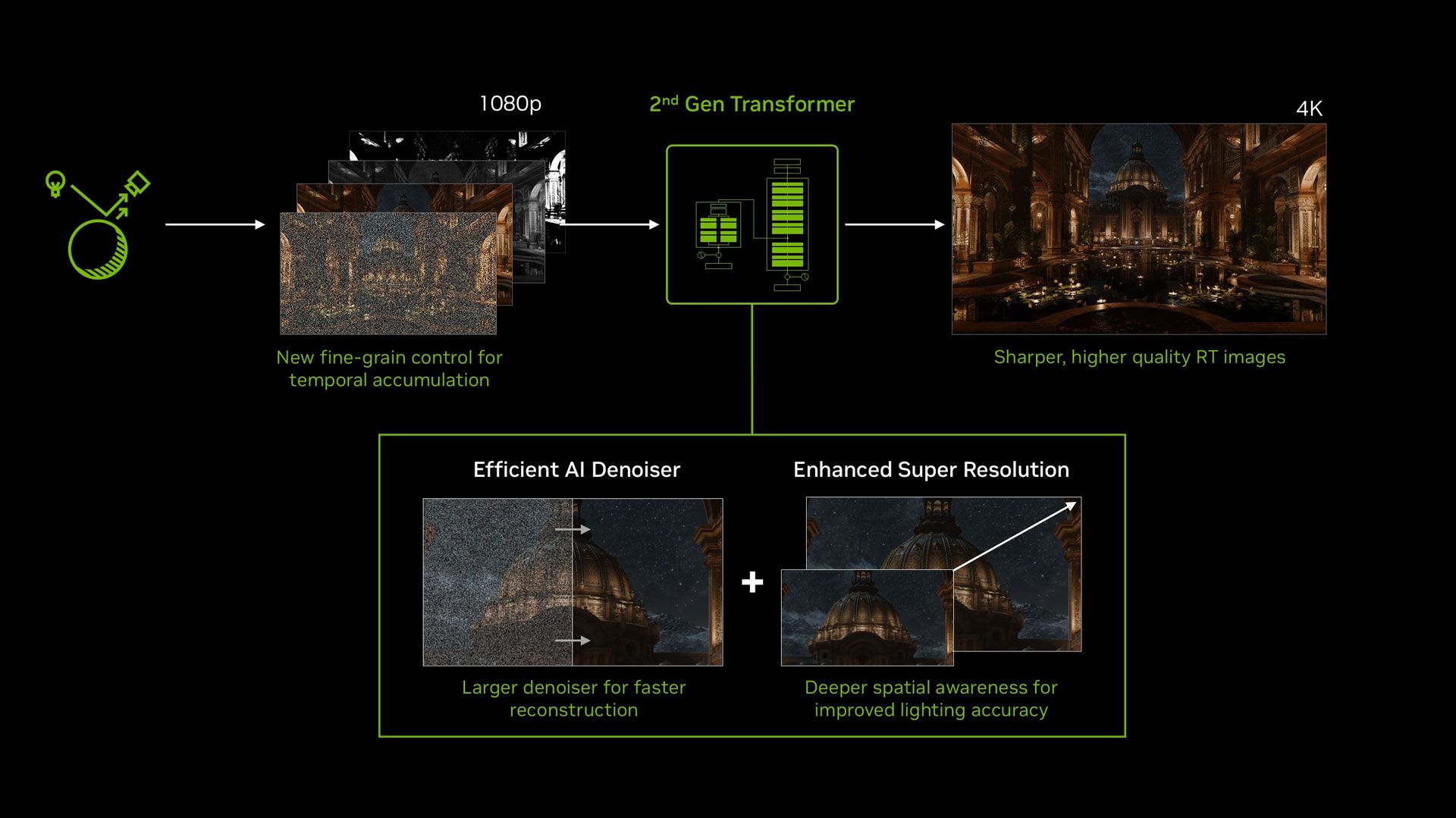
According to NVIDIA, DLSS 4.5 Ray Reconstruction arrives in August 2026 and will be distributed through the NVIDIA App to all GeForce RTX GPUs, including RTX 20, RTX 30, RTX 40 and RTX 50 series (reported by NVIDIA and Videocardz). Videocardz and NVIDIA documentation state the update uses a second-generation transformer model with reportedly 35% more compute capability and processing 20% more parameters while maintaining similar runtime performance. NVIDIA and Videocardz list initial support for 27 games at launch and say Blender Cycles will integrate the denoiser in Blender 5.3 for viewport previews. The update represents an incremental step in shifting ray-traced denoising toward neural reconstruction, which lowers per-frame sampling requirements and standardizes denoising across engines.
What happened
According to NVIDIA and coverage by Videocardz and Tom's Hardware, DLSS 4.5 Ray Reconstruction is scheduled to ship in August 2026 and will be delivered via the NVIDIA App to all GeForce RTX GPUs, explicitly including RTX 20, RTX 30, RTX 40, and RTX 50 series. NVIDIA's developer documentation and Videocardz report that the new Ray Reconstruction uses a second-generation transformer model; Videocardz quotes NVIDIA saying the model offers 35% more compute capability and processes 20% more parameters while keeping similar performance to the prior version. Videocardz also reports NVIDIA will support 27 games at launch, naming titles such as Alan Wake 2, Cyberpunk 2077, Half-Life 2 RTX, Hogwarts Legacy, DOOM: The Dark Ages, and others, and that Blender Cycles will add the denoiser in Blender 5.3.
Technical details
Per NVIDIA's developer pages, DLSS Ray Reconstruction replaces traditional hand-tuned denoisers with a supercomputer-trained neural network that reconstructs missing pixels in noisy ray-traced and path-traced renders and optionally upsamples to higher output resolutions. NVIDIA's DLSS documentation describes the DLSS 4.5 family as combining Dynamic Multi Frame Generation with an updated transformer backbone for improved stability, anti-aliasing, and clarity. Videocardz reports the update also gives developers finer control over temporal accumulation parameters used by the neural denoiser.
Industry context
Editorial analysis - technical context: Neural denoisers and learned reconstruction have been advancing quickly because they enable visually plausible results with far fewer ray samples per pixel, reducing GPU render cost for ray tracing. The move toward transformer-based models in real-time graphics follows a broader industry pattern where attention-style architectures improve temporal coherence and cross-frame information aggregation compared with earlier CNN or small MLP denoisers.
Practical implications for developers and artists
Editorial analysis: Integrating DLSS 4.5 Ray Reconstruction into engines and tools could simplify denoiser parity across titles, since a pre-trained network supplied via NVIDIA can replace bespoke solutions. For offline and interactive artists, the Blender Cycles integration (targeted for Blender 5.3) promises faster viewport previews with higher-fidelity ray-traced lighting, per Videocardz. For engine and middleware teams, the reported increase in model size and compute means end-to-end performance profiling will be necessary on target hardware, even if NVIDIA states runtime parity with prior models.
What to watch
Editorial analysis: Observers should track the announced list of 27 launch games for implementation patterns (how developers wire temporal inputs and feedback), benchmark comparisons of image quality versus prior DLSS Ray Reconstruction and established hand-tuned denoisers, and Blender Cycles' release notes for details on presets and controls. Also watch for third-party reports on actual performance on non-RTX-50 hardware, since NVIDIA states broad RTX-series support but model compute and parameter increases may affect older GPUs differently.
Limitations of reporting
The available sources are NVIDIA documentation and secondary reporting by Videocardz and Tom's Hardware; none of the scraped coverage includes independent image-quality benchmarks or developer postmortems at time of publication. NVIDIA's public materials provide the claims about model sizing and dataset improvements, while independent verification will be available once the update ships in August.
Key Points
- 1NVIDIA will ship DLSS 4.5 Ray Reconstruction in August 2026, available to RTX 20-50 series via the NVIDIA App, per NVIDIA and Videocardz.
- 2The update uses a second-generation transformer, which Videocardz reports has 35% more compute and 20% more parameters, improving temporal stability and lighting accuracy.
- 3Editorial analysis: Wider engine and Blender integration centralizes denoising, reducing per-title engineering effort but increasing the need for runtime profiling on older RTX hardware.
Scoring Rationale
This is a notable product update affecting real-time and viewport ray-tracing workflows, with broad GPU support and Blender integration. It matters to engine developers, technical artists, and performance engineers but is an incremental improvement rather than a frontier research breakthrough.
Sources
Public references used for this report.
View 1 more source
Practice interview problems based on real data
1,625 SQL & Python problems across 15 industry datasets — the exact type of data you work with.
Try 250 free problems