KubeCon, OpenInfra and PyTorch Unite to Scale AI
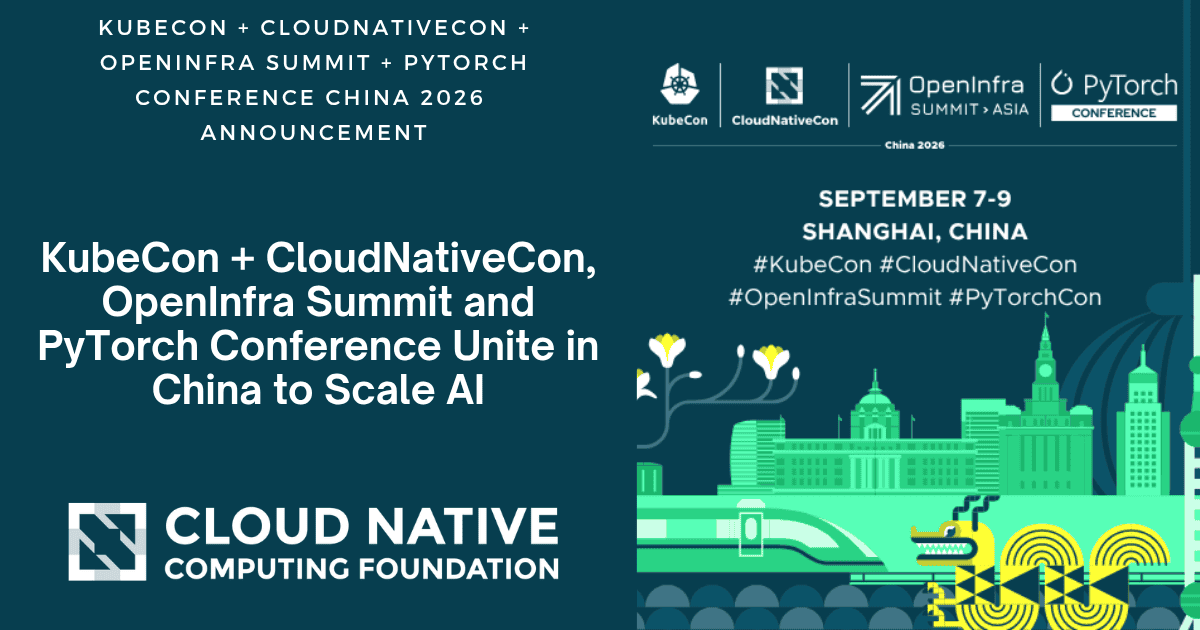
The Cloud Native Computing Foundation (CNCF), OpenInfra Foundation, and the PyTorch Foundation announced the inaugural co-location of KubeCon + CloudNativeCon, OpenInfra Summit, and PyTorch Conference China for September 7-9, 2026 at the Shanghai International Convention Center, according to CNCF and LF Open Source event pages. The CFP and registration are open, with CFP deadlines listed on the CNCF and PyTorch sites and LF Open Source noting CFP notifications on June 15 and a schedule announcement on June 17. The Linux Foundation sponsorship prospectus lists an anticipated 1,000 in-person attendees, attributing that estimate to prior registration trends. Session topics called out on the CFP pages include AI/ML, AI infrastructure, accelerators, platform engineering, observability, security, and hardware enablement.
What happened
The Cloud Native Computing Foundation (CNCF), OpenInfra Foundation, and the PyTorch Foundation announced the inaugural co-location of KubeCon + CloudNativeCon, OpenInfra Summit, and PyTorch Conference China for September 7-9, 2026 at the Shanghai International Convention Center, per the CNCF announcement and LF Open Source pages. The CNCF and PyTorch pages state the event will bring cloud native, open infrastructure, and machine learning communities onto a single stage, and list CFP and registration details. The LF Open Source CFP page records CFP logistics including a submission deadline of May 3 and CFP notifications on June 15, with a schedule announcement on June 17. The Linux Foundation events sponsorship prospectus lists an anticipated 1,000 in-person attendees, noting the estimate is based on registration trends from previous events.
Technical details
Context and significance
What to watch
Reported logistics and participation
The PyTorch blog and CNCF announcement state registration and CFP submission links are live and list ticket types including corporate, individual, and academic registrations. The LF Open Source CFP page instructs submitters not to be listed as speaker on more than three proposals and gives time zone and schedule details, noting sessions will be recorded. The Linux Foundation sponsorship prospectus describes benefits for sponsors and reiterates the 1,000 projected in-person attendance figure as an estimate tied to prior registration trends.
Practical implication for teams
Editorial analysis
The published CFPs and program guidance emphasize crosscutting technical themes rather than a single vendor or stack. CNCF and LF Open Source highlight topics including AI/ML, AI infrastructure and accelerators, performance engineering, platform engineering, observability and reliability, security and confidential computing, networking and edge, and hardware enablement, per the CNCF, PyTorch, and LF Open Source CFP pages. This framing implies the program will cover both model-level concerns (data pipelines, training and inference workflows) and infrastructure-level challenges (heterogeneous accelerators, runtime optimization, and multi-tenant platform design).
Public reporting frames this co-location as part of a broader industry trend where open source cloud native and AI communities converge to address productionization challenges. Observers have increasingly treated integration between orchestration platforms, runtime stacks, and ML frameworks as a critical operational problem; the joint program described in the CFPs foregrounds that shared operational surface. For practitioners, consolidated vendor-neutral sessions and cross-community keynotes can accelerate the transfer of operational patterns for distributed training, inference at scale, and platform engineering.
Practitioners and observers should track the published schedule and session recordings, which LF Open Source notes will be available on the CNCF YouTube channel within two weeks after sessions, per the LF Open Source schedule snippet. Watch for sessions that pair case studies from large-scale operators with hands-on tutorials about accelerator utilization, runtime tuning, and secure multi-tenant deployments, as those signal actionable guidance for integrating model workflows into cloud native platforms. Also monitor the solutions showcase and sponsor materials in the Linux Foundation prospectus for signals on which cloud, hardware, and observability vendors will promote production-focused toolchains.
For platform and ML engineering teams, a single co-located program of this scale offers a concentrated way to validate cross-stack patterns-such as orchestrating multi-node training, integrating model serving with service meshes, and applying confidential computing to sensitive data workflows-without relying on vendor-specific roadmaps. Attendance and recorded content may yield reusable runbooks, benchmarking data points, and community-tested operator patterns applicable to production AI systems.
Caveat
What is reported in the announcements is programmatic and logistical. None of the scraped sources provides detailed session content beyond topic tracks, and no third-party attendee numbers beyond the Linux Foundation prospectus estimate are published in the available sources.
Key Points
- 1Three open source ecosystems-cloud native, open infrastructure, and PyTorch-are co-locating in Shanghai, concentrating cross-stack AI and infra conversations.
- 2CFP topics emphasize both model workflows and infrastructure, signaling sessions on training, inference, accelerators, platform engineering, and security.
- 3Recorded sessions and a consolidated solutions showcase create a practical resource for platform and ML engineering teams seeking production patterns.
Scoring Rationale
The co-location brings major open source infrastructure and AI communities together, offering practical, production-focused content for ML and platform engineers. It is notable for practitioners but not a frontier research or paradigm-shifting release.
Sources
Public references used for this report.
Practice interview problems based on real data
1,625 SQL & Python problems across 15 industry datasets — the exact type of data you work with.
Try 250 free problems