ICFP 2026 Contest Allows AI Agents and Introduces Spatial Language
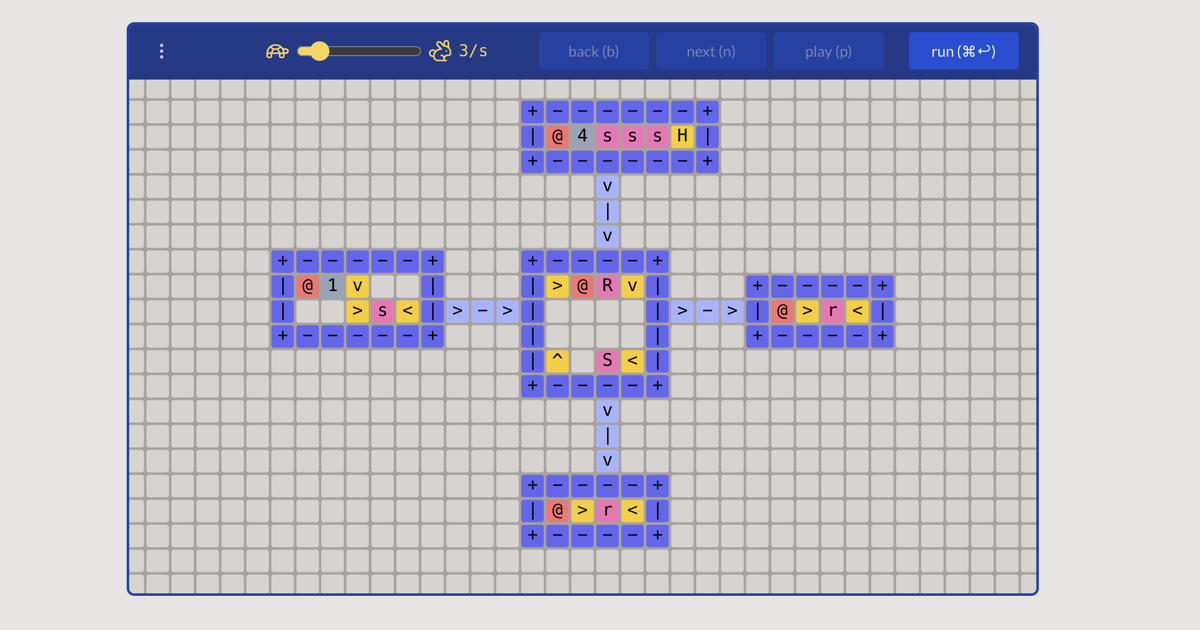
The 29th ICFP Programming Contest began online July 24 and runs through July 27, with AI agents explicitly allowed. Organizers designed the task around a new two-dimensional language called littleman, where programs require spatial layouts and moving actors, aiming to make unmonitored agent loops less decisive while keeping the contest open to any language and tool.
The 29th annual ICFP Programming Contest began online on July 24, 2026 and will run for 72 hours, ending July 27 at 12:00 UTC. The official rules allow teams to use any programming language, platform, or tool, including AI agents.
A contest designed for the agent era
Organizer Nolen Royalty wrote that the team wanted to avoid a competition where the strongest strategy was simply running an unmonitored coding agent for three days. Their response was to build the challenge around a new language called littleman.
Littleman programs are two-dimensional. Instead of executing a conventional linear instruction stream, small actors move across instructions placed in a spatial layout and exchange data through pipes drawn into the program. The organizers also published an open textbook explaining the language.
The design does not ban automated coding tools. It changes the problem around them: contestants may use AI agents, but they still need to reason about a novel execution model, spatial structure, and scoring behavior. The official contest rules keep the event open to teams of any size and require prize-eligible teams to submit their source code when the contest ends.
What the format tests
The contest includes a 24-hour lightning round followed by the full 72-hour event. Winners will be announced at ICFP 2026, the ACM SIGPLAN conference on functional programming scheduled for August 24-29 in Indianapolis.
For AI and software-engineering teams, the notable part is the evaluation design. Rather than treating agent use as misconduct, the organizers permit it and try to create a task where tool orchestration alone is not sufficient. That makes the contest a practical example of how assessments may adapt when participants have access to increasingly capable coding agents.
The event is not a controlled benchmark of human versus AI performance, and results were not available when this article was prepared. The useful evidence will come after the contest: submitted approaches, score distributions, and whether successful teams relied on autonomous agents, human-designed solvers, or a combination of both.
Key Points
- 1The online ICFP Programming Contest runs from July 24 to July 27, 2026, with a 24-hour lightning round.
- 2Contest rules explicitly permit AI agents and any programming language or platform.
- 3The new littleman language uses two-dimensional programs, moving actors, and data pipes to emphasize spatial reasoning.
Scoring Rationale
The contest offers a concrete, current example of assessment design adapting to AI coding agents and introduces a novel spatial programming language. Its impact is meaningful to programming-language and coding-agent practitioners but narrower than a major model or platform release.
Sources
Primary source and supporting public references used for this report.
Practice interview problems based on real data
1,625 SQL & Python problems across 15 industry datasets — the exact type of data you work with.
Try 250 free problems