Honor Robot Beats Bolt's 100m Human Record
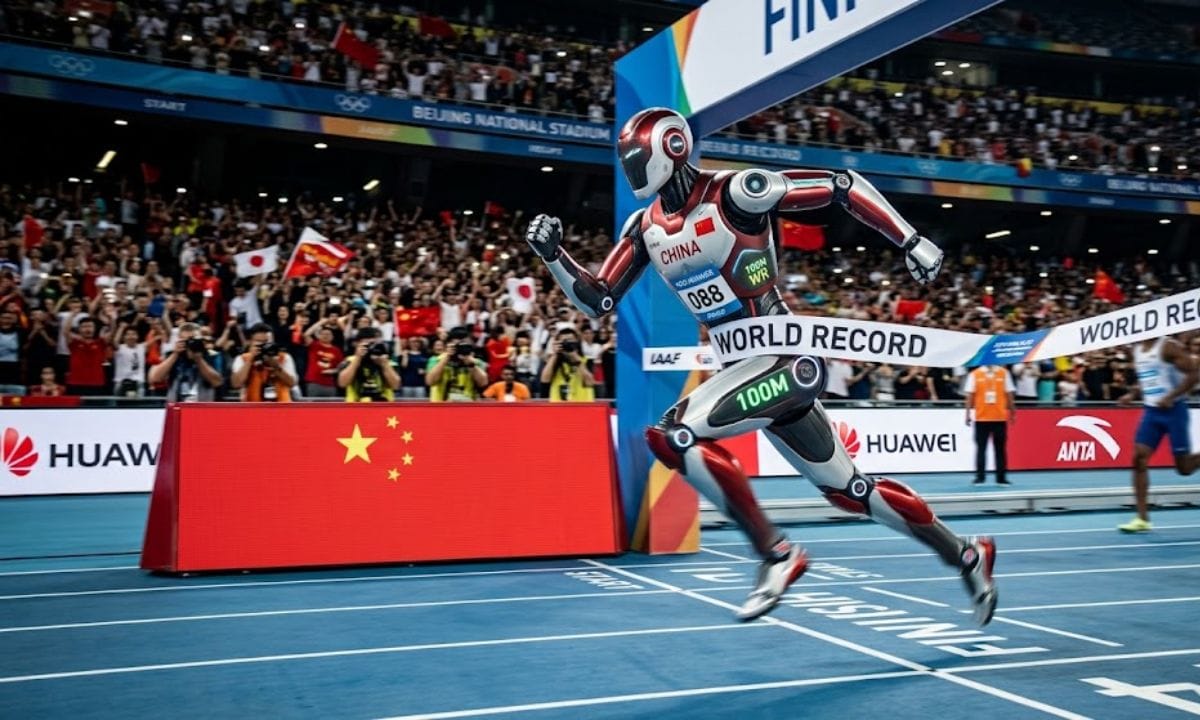
Honor's humanoid robot Lightning ran 100 meters in 9.32 seconds on August 22, beating Usain Bolt's 9.58-second men's world record in a preparatory test for Beijing's second World Humanoid Robot Games, according to Reuters citing China's state broadcaster. Lightning reached a reported peak speed of 14.5 meters per second, but the result was recorded in a robot-games test rather than a human athletics competition.
Honor's humanoid robot Lightning ran 100 meters in 9.32 seconds during a preparatory test for the second World Humanoid Robot Games in Beijing, Reuters reported on August 22, citing China's state broadcaster. That time is faster than the 9.58-second men's human world record set by Usain Bolt at the 2009 World Athletics Championships in Berlin.
Lightning reached a reported peak speed of 14.5 meters per second during the test.
A performance claim tied to Beijing's robot games
The World Humanoid Robot Games opened in Beijing on August 22 and run through August 26, ABC reported. NBC News, citing organizers, reported that more than 2,000 humanoid robots are participating in the five-day event, which includes 51 events and more than 1,000 competitions spanning running, table tennis and soccer.
There is a minor discrepancy in published coverage of the sprint result. Reuters, ABC, The Guardian, Deutsche Welle and Al Jazeera reported Lightning's time as 9.32 seconds, citing Chinese state media. NBC News reported that a humanoid robot recorded 9.39 seconds in the 100-meter event, without identifying that robot as Lightning in the cited passage. The available reports do not provide standardized timing methodology, track conditions, robot mass, autonomy level, energy use, or verification procedures.
Those missing details matter when comparing robotics demonstrations. In humanoid locomotion, sprint time alone does not establish repeatability, fall recovery, sensor robustness, runtime, or the degree of teleoperation. Robotics competitions can nevertheless provide useful visible tests of mechanical design, balance control, perception and motion planning when organizers publish comparable protocols.
Hardware changes and prior endurance result
Reuters reported that Lightning won the 21-kilometer Beijing half marathon in April with a time of 50 minutes and 26 seconds. At that event, the robot stood 169 centimeters tall and had 95-centimeter legs, Reuters reported.
China Central Television reported that researchers subsequently lengthened Lightning's legs by 10 centimeters to 1.05 meters ahead of the World Humanoid Robot Games. Altering leg geometry can affect stride length, joint loading, stability margins, actuator requirements and the controller's locomotion policy, which means the April endurance result and the August sprint should not be treated as results from an unchanged platform.
ABC reported that the 2026 games added precision hand tasks, including tightening screws, opening bottles and picking up beads with tweezers. Such tasks extend evaluation beyond locomotion toward manipulation, an area where visual perception, grasp planning, compliant control and reliable hardware integration are central constraints.
China has identified humanoid robotics as a strategic emerging industry, Reuters reported, with public policy and company activity focused on potential manufacturing, logistics and consumer uses. Across the sector, public demonstrations of speed or coordinated movement are becoming more common, while production deployments generally require evidence on safety, uptime, maintenance, task success rates and total operating cost.
Key Points
- 1Lightning's reported 9.32-second test run is faster than Bolt's human record, but it was recorded in a robot-games test rather than a human athletics competition.
- 2Published reports omit timing methodology, autonomy level and operating conditions, limiting direct technical comparison with athletic or robotics benchmarks.
- 3Robot competitions increasingly combine locomotion with manipulation tasks, reflecting the industry's challenge of showing that prototypes can work reliably in the real world.
Scoring Rationale
The reported sprint result is a notable public benchmark for high-speed humanoid locomotion and arrives at a major Chinese robotics event. Its practitioner significance is constrained by the lack of disclosed evaluation methodology, autonomy details and reproducibility data.
Sources
Public references used for this report.
Practice interview problems based on real data
1,625 SQL & Python problems across 15 industry datasets — the exact type of data you work with.
Try 250 free problems