
Hobbyists Run Private Offline AI on Raspberry Pi
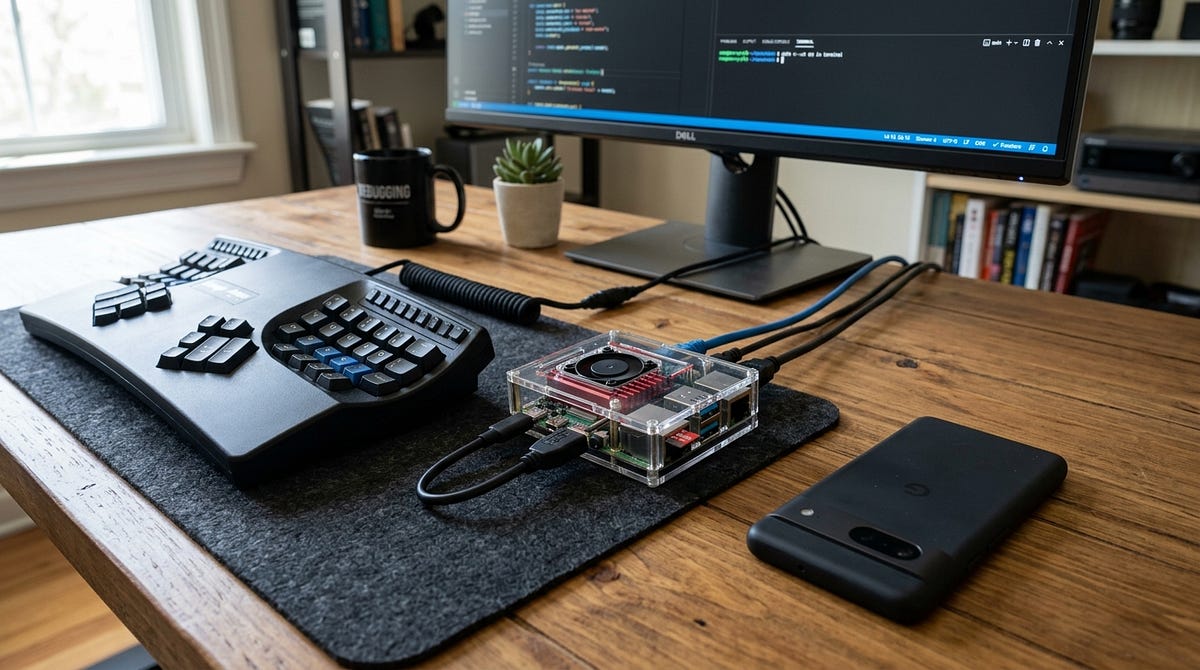
A Towards AI guide published July 4, 2026, shows a Raspberry Pi 5 running a private offline assistant by serving downloaded 1-4B parameter models locally rather than calling a cloud API. The article says the setup can handle short Q&A, summarization, drafting, light code help, keyword extraction and home automation, while making clear that the Pi is for inference, not model training. For practitioners, the practical lesson is that ARM-friendly runtimes and quantization now make local experiments cheap, but production edge AI still depends on latency measurement, memory headroom, update hygiene and realistic expectations about model capability.
Private edge assistants are becoming practical because the deployment target has changed: small quantized models can now be useful for narrow local tasks even when they are far from frontier quality. The practitioner value is not that a Raspberry Pi replaces a cloud GPU, but that it offers a cheap, inspectable test bed for privacy-first inference.
What happened
A Towards AI guide published on July 4, 2026 describes building a private offline assistant on a Raspberry Pi 5 using downloaded pre-trained models. The guide frames 1-4B parameter models as realistic for the device class and lists short Q&A, summarization, drafting, light code help, keyword extraction and home-automation control as suitable tasks. It also states that the Pi is used for inference, not training.
Technical context
The enabling pattern is familiar across edge AI: quantized checkpoints reduce memory pressure, ARM-friendly runtimes make CPU inference usable, and the application scope is kept narrow. A separate Raspberry Pi 5 local-voice-AI guide reports similar constraints around 8GB hardware, small speech models, local text-to-speech and 1-4B class LLMs, which supports the broader direction without turning a hobby build into a production benchmark.
For practitioners
Treat the build as an experimentation pattern. Useful engineering checks include tokens per second, end-to-end latency, thermal behavior, memory use under load, model update workflow and local secrets handling. Teams should also define what data stays on device and what logs, if any, leave the system.
What to watch
Watch for better ARM inference runtimes, easier packaging for quantized local models and small multimodal models that fit commodity edge hardware. Those improvements will matter more than raw model size for practical offline assistants.
Key Points
- 1Local assistants on Raspberry Pi are now practical for experiments, but they remain inference projects, not training platforms.
- 2Quantized 1-4B models and ARM-friendly runtimes are the core enablers for privacy-preserving edge AI prototypes.
- 3Teams should benchmark latency, memory headroom, update paths and local security before reusing hobbyist builds in production.
Scoring Rationale
This is a practical edge-AI how-to that helps practitioners understand local inference trade-offs, privacy and deployment constraints. It is useful but remains a hobbyist/practitioner guide rather than a new model, benchmark or platform release.
Sources
Public references used for this report.
Practice interview problems based on real data
1,625 SQL & Python problems across 15 industry datasets — the exact type of data you work with.
Try 250 free problems