Google Releases Colab CLI For Remote Colab Runtimes
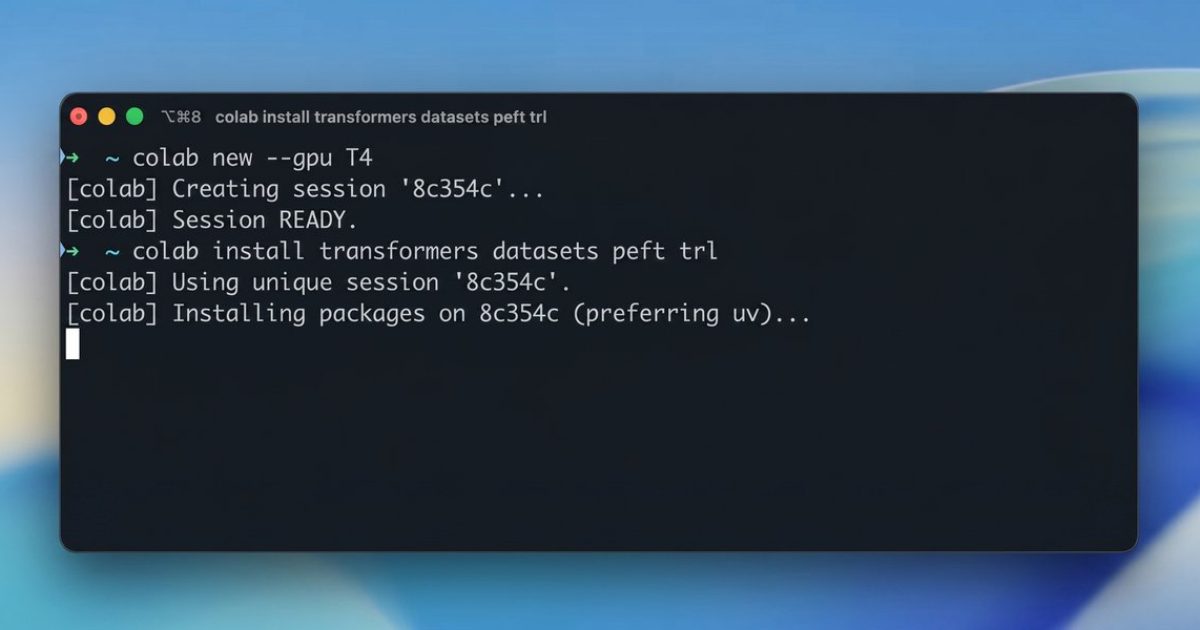
Google released the Google Colab CLI, a command-line tool that connects local terminals to remote Colab runtimes, according to Google's developer blog. The CLI lets users provision CPU, GPU, and TPU sessions and execute local Python scripts remotely using commands such as colab new, colab exec, colab download, colab log, colab repl, and colab stop, per reporting by MarkTechPost, InfoQ, and Help Net Security. MarkTechPost and Help Net Security report GPU options including T4, L4, A100, and H100, and TPU options v5e1 and v6e1. The package is open source under the Apache 2.0 license, MarkTechPost reports. Google ships a prepackaged skill file named COLAB_SKILL.md for AI agents, and published demos show an agent-driven QLoRA fine-tuning workflow for google/gemma-3-1b-it, according to InfoQ and Help Net Security.
What happened
Google released the Google Colab CLI, a command-line interface that connects local terminals to remote Colab runtimes, according to a post on Google's developer blog and corroborating coverage by InfoQ, MarkTechPost, and Help Net Security. The CLI exposes commands such as colab new, colab exec, colab download, colab log, colab repl, colab console, colab install, colab auth, and colab stop, per MarkTechPost and Help Net Security. MarkTechPost and Help Net Security report GPU options including T4, L4, A100, and H100, and TPU options v5e1 and v6e1. MarkTechPost reports the project is open source under the Apache 2.0 license. Google and the coverage examples include a demo where an agent provisions a T4 runtime, installs libraries, runs a QLoRA fine-tuning script for google/gemma-3-1b-it, logs the session to an .ipynb, and downloads artifacts, as described by InfoQ and Help Net Security.
Editorial analysis - technical context
The CLI surfaces a compact set of primitives-session lifecycle, remote execution, file transfer, logging, and interactive shells-that map directly to common iterative ML tasks. Industry-pattern observations: developer-focused CLIs that support stdin-driven execution and replayable logs reduce friction for experiment reproducibility. The tool's colab exec behavior (sending local file contents to remote runtimes) and colab log export to .ipynb or .jsonl enable a local-first workflow where remote runs are replayable artifacts, a pattern already present in remote-execution tools but newly focused on Colab's notebooks and artifact model.
Editorial analysis - agent integration
Coverage by MarkTechPost, InfoQ, and Help Net Security highlights that the CLI ships a COLAB_SKILL.md skill file intended to make the interface consumable by agents. Industry-pattern observations: when terminal-driven tools provide explicit agent skills or instruction artifacts, they lower integration costs for orchestration systems and agent frameworks that already execute shell commands. The public demos (reported by InfoQ and Help Net Security) showing agents like Antigravity driving a QLoRA pipeline for google/gemma-3-1b-it illustrate how the CLI can be used in end-to-end automated workflows without manual browser interaction.
Context and significance
Editorial analysis: For practitioners, the main utility is operational-quickly binding local edit/run cycles to cloud accelerators without switching to a browser UI. The CLI's emphasis on artifact retrieval and session logs aligns with reproducibility needs when iterating on model training or fine-tuning. Industry-pattern observations: similar CLI-first tooling from other platforms has been adopted for CI/CD integration, automated benchmark runs, and agent-driven orchestration; the Colab-focused variation primarily shifts those same primitives to a widely used notebook platform and its existing ecosystem.
What to watch
Editorial analysis: Observers should watch how authentication and quota management are surfaced, since both affect multi-user automation and agent-driven scaling. Also monitor the open-source repository for operational details such as session metadata storage (MarkTechPost notes ~/.config/colab-cli/sessions.json), package installation behavior, and any limits documented for GPU/TPU allocations. Finally, keep an eye on community examples and CI integrations that demonstrate reproducible, secure agent workflows using the provided COLAB_SKILL.md.
Key Points
- 1Developer-focused CLI maps Colab notebook workflows to terminal primitives, speeding local-to-remote experiment cycles.
- 2Providing a COLAB_SKILL.md reduces integration friction for agents and automation frameworks requiring shell access.
- 3Artifact export to replayable .ipynb and jsonl logs improves reproducibility for iterative fine-tuning and debugging.
Scoring Rationale
This is a notable tooling release that lowers friction for running Colab-backed experiments from terminals and agents. It is not a frontier-model change, but it materially affects developer workflows and automation possibilities.
Sources
Public references used for this report.
Practice with real Health & Insurance data
90 SQL & Python problems · 15 industry datasets
250 free problems · No credit card
See all Health & Insurance problems