Google Launches Dreambeans To Curate Personalized Daily Stories
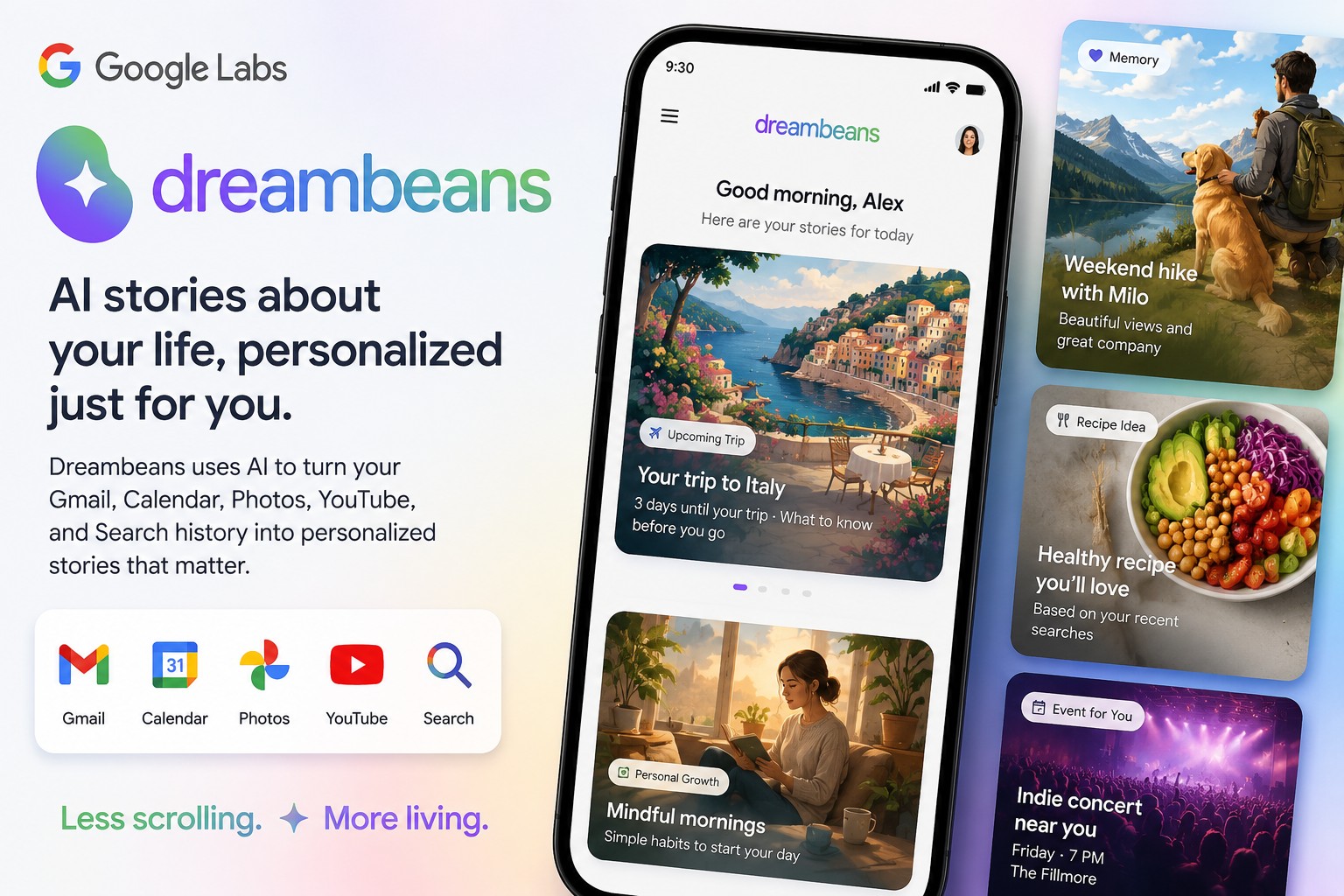
Google Labs has launched Dreambeans, an experimental app that assembles a finite set of AI-illustrated daily stories from a user's connected Google data, including Gmail, Calendar, Photos, YouTube, and Search history, according to a Google Labs blog post. Google says the app uses Personal Intelligence, the same system behind personalized features in the Gemini apps and AI Mode in Search, to build context, and its image model Nano Banana 2 to generate the artwork, drawing in part on the user's own photos. Product manager Gozde Oznur told TechCrunch the app typically surfaces 10 to 14 stories per day and is designed as a finite collection rather than an endless feed. Google and 9to5Google say Dreambeans is rolling out for eligible Google AI Ultra subscribers aged 18 and over in the US on Android and iOS, with a waitlist for others. Oznur told TechCrunch that only the user can access their stories and that users can delete connected data or choose which services to link.
What happened
Google Labs launched Dreambeans, an experimental app that assembles a curated, finite set of personalized daily stories from a user's Google data, according to a Google Labs blog post. Google says Dreambeans uses Personal Intelligence and its image model Nano Banana 2 to create illustrated stories from signals across Gmail, Google Calendar, Google Photos, YouTube, and Search history. TechCrunch reports product manager Gozde Oznur described the stories as ideas for "places to visit, topics to explore, things to try, upcoming trips, events that you should be aware of," and said the app typically surfaces 10 to 14 stories per day, positioned against endless scrolling. Google and 9to5Google say the app is available through Google Labs on Android and iOS for eligible Google AI Ultra subscribers aged 18 and over in the US, with a waitlist for other users.
How it works
Per Google, Dreambeans connects, with the user's permission, to selected Google services and distills the signals into a daily set of illustrated stories; users can choose which apps to connect and give feedback to tune future collections. Google describes Personal Intelligence as the same system that powers personalized features in the Gemini apps and AI Mode in Search, and says Nano Banana 2 generates the full-screen artwork, drawing in part on the user's own photos (Google Labs blog; 9to5Google; Tom's Guide).
Privacy and controls
TechCrunch reports Oznur said the only person with access to an individual's Dreambeans stories is the user, and that users can delete connected data or choose which Google services to link. Google's blog notes users can tune recommendations through feedback. Google has not published full architectural details, retention windows, or a complete threat model in the launch materials, and at least one outlet flagged that an app drawing on this much personal data warrants scrutiny (Google Labs blog; TechCrunch; Lifehacker).
Analysis
Proactive, cross-product assistants commonly fuse contextual signals from email, calendar, and photos to generate recommendations, which as a general matter depends on robust consent flows and scoped, well-governed access to personal data. The integration points Dreambeans uses, email, calendar events, photo metadata, and search history, are rich signals but also widen the surface area for scope-limited access, feedback-driven personalization, retention policy, and safety filtering of generated content. The finite-digest framing also trades continuous-engagement metrics for targeted relevance, shifting engineering effort toward precision in signal extraction and relevance feedback.
For practitioners, what to watch
Watch whether Google publishes technical or privacy documentation covering retention windows, whether personal signals are used in model training, and any on-device or scoped server-side inference options. Track how feedback signals are stored and looped into personalization without leaking sensitive information, and watch adoption among Google AI Ultra subscribers and the waitlist size as early signals of traction.
Key Points
- 1Google Labs launched Dreambeans, an experimental app that turns a user's connected Google data (Gmail, Calendar, Photos, YouTube, Search) into a finite set of AI-illustrated daily stories, using Personal Intelligence and the Nano Banana 2 image model.
- 2Product manager Gozde Oznur told TechCrunch the app surfaces about 10 to 14 stories per day and frames it as an antidote to endless scrolling; it is rolling out to Google AI Ultra subscribers (18+) in the US on Android and iOS, with a waitlist for others.
- 3The cross-product data fusion makes consent scoping, data-deletion controls, and retention design central; Google has not published full architectural or retention details in the launch materials.
Scoring Rationale
A notable, widely covered Google product launch that fuses cross-product personal data with the Nano Banana 2 image model and the Personal Intelligence system, with practical implications for personalization pipelines and consent and retention design that interest practitioners. It is an experimental consumer app limited to AI Ultra subscribers rather than a frontier-model or research release, so impact is notable but not major.
Sources
Public references used for this report.
View 11 more sources
- New Google Labs 'Dreambeans' app is like a hyper-personalized Google Now9to5google.com
- Google's New 'Dreambeans' App Creates Personalized AI Stories From Your Digital Lifeeweek.com
- I tried Google Labs' Dreambeans app, and it finally broke my infinite-scrolling habittomsguide.com
- Google launches Dreambeans, an AI app that curates daily stories from Google datasiliconangle.com
- Dreambeans by Google Labsplay.google.com
- dreambeansapps.apple.com
- Google's 'Dreambeans' App Generates 'News Stories' From Your Lifelifehacker.com
- Google just launched an app that turns your chaotic inbox into a daily storybookandroidpolice.com
- Google Launches Dreambeans, an AI App That Animates Your Lifetechnology.org
- Dreambeans finally gives you a reason to stop doomscrolling, and it's actually clevermakeuseof.com
- Google Labs' New Dreambeans App Now Availabledroid-life.com
Practice with real Ad Tech data
90 SQL & Python problems · 15 industry datasets
250 free problems · No credit card
See all Ad Tech problems