Google backs UCSD phone-cluster datacenter project
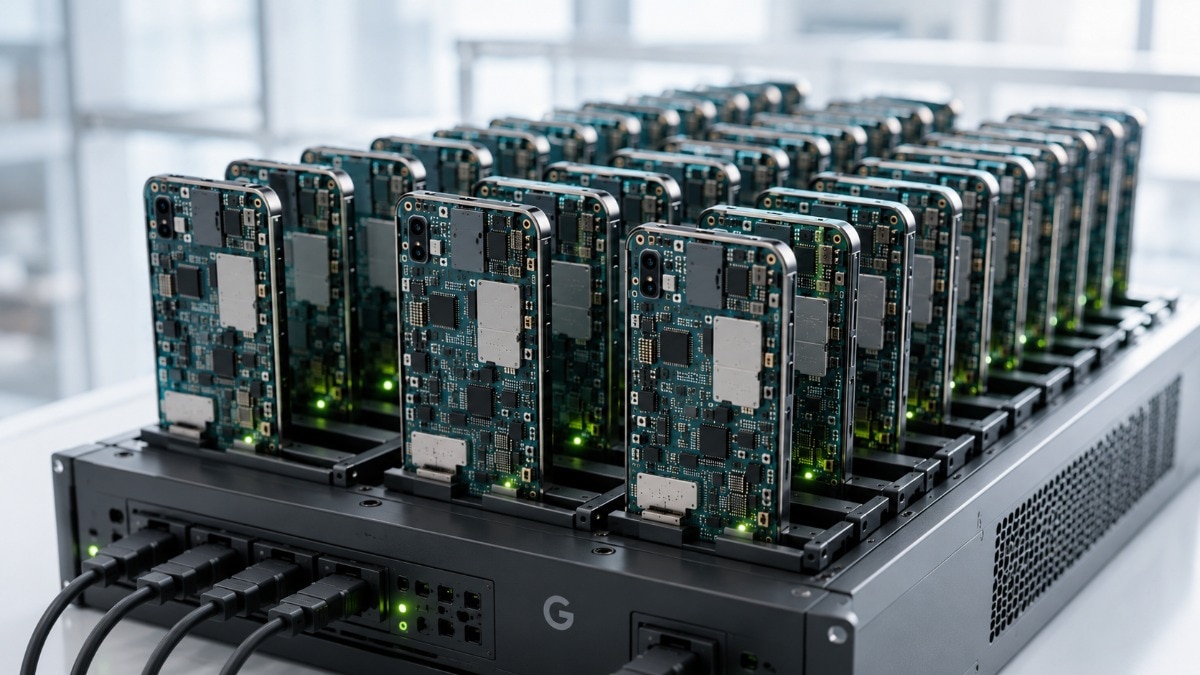
The headline number, 2,000 phones, matters less than what this project proves: embodied carbon, the emissions locked into manufacturing hardware, can be cut by redeploying retired smartphone motherboards as compute nodes instead of buying new servers. According to Google's own research blog (authors Jennifer Switzer and David Patterson) and an interview with UC San Diego's Ryan Kastner reported by The Register, the cluster uses stripped-down Pixel Fold motherboards running Kubernetes on a custom Linux build, after Google engineers flagged batteries as datacenter fire hazards. Google's cited SPEC benchmarks put 25-50 phones at roughly one server's worth of throughput, and the system targets EdTech, grading, and research workloads, not GPU-scale AI training. For AI/ML infrastructure teams, it is a concretely benchmarked case study in reusing heterogeneous consumer silicon for latency-tolerant jobs. Full deployment is planned for fall 2026.
Why it matters
The number to watch is not "2,000 phones" but what the project quantifies: embodied carbon, the emissions locked into hardware manufacturing, which Google's blog says accounts for roughly 50 percent of a smartphone's footprint in the motherboard alone. Instead of squeezing more efficiency out of datacenters that already exist, Google and UC San Diego are testing whether retired consumer silicon can substitute for new server purchases entirely. For AI/ML infrastructure and sustainability-minded practitioners, this is one of the more concretely benchmarked embodied-carbon reduction efforts in computing, backed by SPEC test results and a real deployment date rather than a roadmap slide.
What is actually being built
According to a Google Research blog post by Jennifer Switzer, a former UC San Diego PhD student now a postdoctoral researcher at Google, and David Patterson, UC San Diego plans to deploy a cluster built from 2,000 retired Pixel smartphones by fall 2026. Reporting by The Register, which interviewed UCSD associate professor Ryan Kastner, specifies the handsets are Pixel Folds, each built around a Tensor G2 chip with 12GB of memory. Phones are stripped to their motherboards because Google's engineers determined that batteries and other components are fire hazards in a datacenter setting; for the full rollout, Google is working with a third party to handle motherboard extraction at scale.
The engineering underneath the headline
The motherboards run a general-purpose Linux distribution instead of Android, which required disabling consumer safeguards such as the "low memory killer" daemon, and are wired together using custom PCBs that supply power and wired Ethernet rather than Wi-Fi or cellular, for practicality and security, Kastner told The Register. Google's own SPEC benchmarks show 25-50 phones deliver roughly the throughput of one modern multicore server, and the company's blog states the full 2,000-phone system is expected to provide about 50 server-equivalents of compute. Workloads run as containers orchestrated with Kubernetes across self-managing clusters of 25-50 devices, an approach that looks more like managing a heterogeneous edge or IoT fleet than a conventional rack of servers.
Not an AI training cluster
It is worth being precise about scope, since some headlines, India Today's included, framed this as Google repurposing phones to "power its AI data centres." Even that outlet's own reporting clarifies the target workloads are EdTech grading systems, Jupyter notebooks, and parallel-computing coursework: bursty, latency-tolerant jobs that today run on small cloud instances like an AWS t3.micro. Google's blog reports a 20-phone test cluster handled peak grading loads for a class of 75-plus students at lower latency than that AWS baseline. There is no GPU-scale training workload in scope, and The Register notes that full access to the phones' onboard tensor accelerators remains unresolved.
What to watch
The most useful signals for practitioners will be whether motherboard extraction can be industrialized beyond a research pilot, how reliability holds up under sustained load (a stated research goal in Google's blog), and whether UC San Diego's campus supercomputing center adopts the cluster for production research jobs, a possibility Kastner raised with The Register. The Register also places the project in a longer lineage: 1990s Beowulf clusters built from commodity PCs, and UC Santa Barbara's 1,050-node Raspberry Pi cluster built with Oracle, suggesting phone-cluster computing extends a recurring pattern of repurposing consumer hardware for specialized, budget-constrained compute rather than introducing a wholly new idea.
Key Points
- 1Google and UC San Diego plan a 2,000-phone Kubernetes cluster built from retired Pixel Fold motherboards to replace new campus servers.
- 2It targets embodied carbon, since Google says a smartphone's motherboard holds about 50 percent of its manufacturing emissions, unlike efficiency-only fixes.
- 3Practitioners should read this as a Kubernetes playbook for heterogeneous consumer silicon on latency-tolerant workloads, not a blueprint for GPU-scale AI training.
Scoring Rationale
Legitimate, well-documented systems and sustainability research from Google Research and UC San Diego, corroborated by independent reporting (The Register's interview with UCSD's Ryan Kastner) and datacenter trade press (DataCenterDynamics), with real SPEC benchmarks and a concrete fall 2026 deployment date rather than a speculative roadmap. It is a genuine infrastructure and green-computing innovation relevant to AI/DS/ML practitioners tracking embodied-carbon accounting and heterogeneous/edge compute, modestly raised from 6.1 given stronger-than-typical corroboration. It remains a university teaching and research pilot rather than a production AI system or an architecture shift with broad industry adoption, keeping it in the notable-but-not-major band.
Sources
Public references used for this report.
Practice with real Ad Tech data
90 SQL & Python problems · 15 industry datasets
250 free problems · No credit card
See all Ad Tech problems